The Sensor Must Capture Millisecond Airflow Events in a Moving Hand
That verification requires capturing biomechanical events that last less than half a second. A proper inhalation for a Metered Dose Inhaler generates inspiratory flow between 30-60 L/min sustained for 3-5 seconds, yet the actual drug release occurs in a 100-millisecond blast during that window. Smart inhaler hardware design must sample pressure or acoustic signatures at 100Hz or higher to characterize this flow curve, yet the device moves in the patient’s hand, creating accelerometer artifacts that mimic flow signatures. Sensor fusion becomes mandatory, using IMU data to subtract motion noise from pressure signals. Condensation presents another failure mode: breath is 37°C and fully saturated, falsifying readings if the pressure port faces the flow directly. You must design laminar flow paths that isolate the sensor from moisture while maintaining acoustic transparency if using microphones for detection. Propeller Health’s early attachments used acoustic signatures to distinguish inhaler types, which proved that accelerometer-only approaches miss the clinical signal entirely.
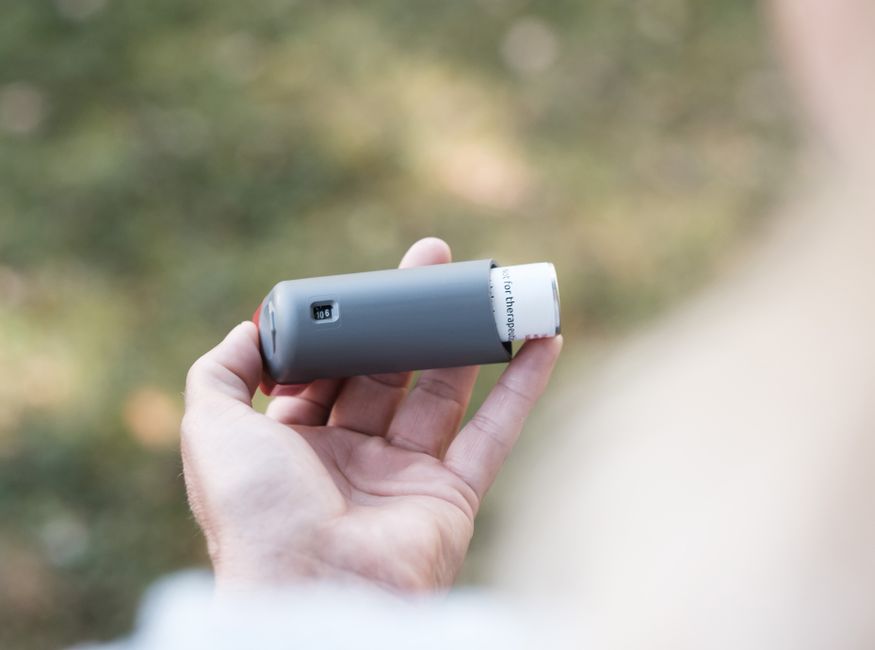
Photo by Cnordic Nordic on Pexels
Form Factor Determines Whether You Can Distinguish MDI Technique from DPI Technique
That sensor placement decision is complicated by the fact that MDI and Dry Powder Inhaler mechanics demand opposite flow profiles. Connected inhaler engineering must accommodate the reality that MDIs require slow, steady inspiration coordinated with canister actuation, while DPIs require forceful, rapid inspiration (60-90 L/min) to de-aggregate powder. A universal sensor attachment cannot reliably distinguish optimal flow rates across both modalities without mechanical switching or complex dynamic calibration. Hailie’s integrated approach embeds specific flow paths calibrated to the device’s resistance profile, capturing clinically relevant data but locking you to specific drug formulations. Universal attachments like those from Findair or ResMed‘s Propeller prioritize medication identification over technique validation, accepting that they can confirm “a dose was taken” but not necessarily “the drug reached the lungs.” If your architecture tries to serve both inhaler types, your sensor calibration must account for flow resistance differences up to 4kPa, a mechanical problem that compounds firmware complexity and delays time to clinical evidence.
FDA Validation Requires Proving Sensor Output Correlates with Lung Deposition
That distinction capability determines your regulatory strategy and development budget. FDA inhaler design requirements for connected devices hinge on clinical validation: you must demonstrate that your sensor’s “good technique” flag actually predicts improved drug deposition in the lungs. This typically requires imaging studies (gamma scintigraphy) or pharmacokinetic equivalence trials comparing sensor-validated doses against traditional delivery. The FDA treats these as either 510(k) medical devices or, if the sensor affects drug delivery, combination products requiring more stringent review. Inhaler adherence tracking without correlation to lung deposition is merely counting button presses; the 510(k) submission must include data showing your flow detection algorithm predicts clinical outcomes. This validation cost often exceeds the hardware development budget by 3-4x, meaning teams must design for the clinical study from day one, selecting sensor thresholds that map to published efficacy data rather than arbitrary classifications.

Photo by Cnordic Nordic on Pexels