
Boeing: Why Aircraft Manufacturing Rejects Newcomers

The Statistical Impossibility
Aircraft manufacturing is an industry designed to reject new entrants. Since the 1960s, when the modern aerospace industrial structure coalesced around Boeing, Douglas, and the European consortium that would become Airbus, approximately ninety-nine point nine percent of state-sponsored attempts to build competitive aircraft manufacturers have failed. Indonesia’s IPTN collapsed under the weight of developmental costs and political corruption. Every Latin American effort at state-led aviation industrialization ended in subsidy drain and technological stagnation. The gravitational pull of aerospace economics concentrates production into duopolies, oeing and Airbus in commercial wide-bodies, Lockheed Martin and Raytheon in defense platforms, nd crushes anything occupying the middle ground.
Yet Embraer persists.
The company represents the sole successful entrance into aircraft manufacturing since the consolidation of the jet age, a fact that should be statistically impossible. Its survival is not merely a story of Brazilian industrial policy or fortuitous timing, though both matter. Rather, Embraer exists because it learned to operate in the gaps where scale destroys value, maintaining engineering discipline in market segments that bankrupted Bombardier, exhausted Saab, and forced British Aerospace into consolidation. It survives through a peculiar alchemy: a three-segment business model that shouldn’t work, a geographic arbitrage that cannot be replicated, and an engineering culture that functions as an economic variable rather than a corporate slogan.
But gravity remains undefeated indefinitely. Embraer’s continued existence depends on a series of narrow constraints that are now tightening, etween the imperative to grow and the fragility of its culture, between the decline of its core market and the impossibility of entering larger ones, between the pricing power of Airbus and the capital requirements of survival. The question is not whether Embraer is well-managed; it is whether the physics of the industry finally reclaim their exception.
The Portfolio as Gravity Shield
Embraer organizes around three distinct revenue engines that operate on incompatible rhythms. The commercial segment produces regional and narrow-body jets, primarily the E175, E190, and E195 families, in high volumes at thin margins, selling to consolidated airline customers who negotiate discounts approaching fifty percent off list price. The defense segment, comprising roughly twenty to thirty percent of revenue, builds the KC-390 tactical transport and maritime patrol aircraft at lower volumes but with what observers have described as “ridiculous, absurd efficiency.” The business jet segment manufactures the Phenom, Legacy, and Praetor lines in Florida, not Brazil, targeting fractional charter operators and high-net-worth individuals through relationship-based sales at margins that the commercial side cannot approach.
This tripartite structure should not exist. Competitors have attempted similar diversification and failed. Bombardier, once the closest analogue, was forced to divest its commercial aircraft program to Airbus (the C-Series, now A220) and its rail division to Alstom, eventually shrinking to a pure business jet manufacturer. The engineering competencies, sales cycles, and capital requirements of tactical military transports and light business jets differ so radically that maintaining excellence across all three simultaneously violates the logic of corporate focus. Yet Embraer’s portfolio functions as a hedge against the cyclicality that destroys mono-line aerospace companies. When commercial airline consolidation depresses regional jet pricing, the Phenom 300, selling at approximately twelve million dollars per unit at production rates of five monthly, generates cash flows with superior margin profiles. When defense budgets contract, aftermarket revenue from the installed base of commercial aircraft, though largely captured by subsystem suppliers rather than Embraer itself, stabilizes revenue.
The segmentation also creates strategic optionality unavailable to pure-play competitors. While Bombardier had to surrender its commercial aviation ambitions to Airbus, effectively subsidizing the A220’s supply chain advantages, Embraer can absorb commercial margin compression because the business jet segment operates as a profit sanctuary. The Florida manufacturing location for executive aircraft, distinct from the Brazilian production of commercial and military planes, provides geopolitical insulation and labor market access that a mono-national producer cannot replicate. This geographic bifurcation is not merely operational convenience; it represents an arbitrage on regulatory environments and customer proximity that the defense and commercial segments could not sustain.
The Brazilian Hedge
The most underappreciated structural advantage in Embraer’s model is invisible on the balance sheet: an organic foreign-exchange hedge embedded in its geographic footprint. Approximately seventy to eighty percent of the value of an Embraer jet consists of imported components, avionics, engines, subsystems, while the finished aircraft are exported and denominated in dollars. This creates a natural currency offset that protects margins from Brazilian real volatility without requiring financial derivatives or pricing adjustments.
Competitors cannot replicate this advantage. Boeing and Airbus manufacture primarily in dollar or euro zones, exposing them to currency mismatches when sourcing globally. Moving production to Brazil to capture similar hedge benefits would require absorbing the country’s regulatory complexity, labor market rigidities, and political volatility, rade-offs that outweigh the currency benefits for established players. Embraer alone occupies the sweet spot of a Brazil-based cost structure with dollar-denominated revenues, effectively shorting the real through operational structure rather than financial engineering.
This geographic arbitrage extends to human capital. The company draws from the Instituto Tecnológico de Aeronáutica (ITA), an engineering academy that functions as a parallel talent pipeline producing aeronautical engineers at cost structures below American or European equivalents. The combination of imported high-value components and domestically engineered airframes creates a cost discipline that explains Embraer’s ability to profit in segments where competitors hemorrhaged capital. The KC-390 tactical transport, developed for the Brazilian Air Force, incorporates a wing box structurally comparable to a Boeing 767 wide-body yet achieved development costs and unit pricing efficiency that Lockheed’s C-130 and Airbus’s military transports struggle to match. This efficiency is not merely engineering virtuosity; it is the economic consequence of a Brazil-based cost architecture that converts currency volatility into competitive moat.
Culture as Operating System
In aerospace, culture is not a soft metric. It is an economic variable measurable in program delays, cost overruns, and safety incidents. Boeing’s transition from engineering-led development to financially optimized management, prioritizing shareholder returns and spreadsheet metrics over airframe integrity, provides the cautionary parallel. When financial engineering supersedes aeronautical engineering in aircraft manufacturing, the result is not merely cultural decay but economic destruction: delayed certifications, grounded fleets, and destroyed market capitalization.

Embraer’s durability derives from the inverse model. The company maintains an engineering-driven decision structure embedded through decades of hiring, promotion, and capital allocation. This culture originated during the privatization of the 1990s, when the simultaneous breakthrough of the ERJ-145 regional jet created a scaling opportunity that required engineering excellence rather than financial restructuring. The leadership of figures like Mauricio Botelho and Fred Curado institutionalized cost consciousness not as austerity but as technical discipline, very program manager understood that margin preservation required manufacturing precision rather than supplier squeezing or accounting adjustments.
This advantage is fragile. Cultural infrastructure in industrial companies rarely survives professionalization and public-market scaling. The transition to financial management practices required by institutional investors, earnings guidance optimization, share buyback prioritization, ROI hurdle rates for R&D, tends to displace engineering judgment with spreadsheet logic. Embraer has resisted this transition longer than comparable manufacturers, but the risk is existential. One chief executive hire emphasizing financial engineering over airframe development could flip the model, converting the company from a precision manufacturer into a capital-allocation vehicle that slowly loses its technical edge. The culture is non-transferable; it cannot be acquired through merger or licensed through partnership. Its preservation requires active resistance to the governance norms of public aerospace companies.
The Regional Interregnum
Despite these structural defenses, Embraer rests on a fragile assumption: that the regional jet market will persist at meaningful scale despite the structural transformation of the airline industry. The company’s commercial backbone, the E175, exists in a technological interregnum. It replaces thousands of aging fifty-seat regional jets, the CRJ-200s and ERJ-145s reaching the end of their service lives, with seventy-five-seat aircraft that are, as industry observers note, “not an ideal solution” for the routes they serve. They are simply the only game in town.
The problem is not merely aircraft sizing. The hub-and-spoke airline model that created demand for regional feeders is undergoing secular decline. U.S. airline consolidation has reduced the major carriers to three or four entities plus Southwest, eliminating the feeder networks that once supported hubs in Pittsburgh, Charlotte, and St. Louis. Point-to-point carriers, JetBlue, Allegiant, Breeze, and the Southwest model, are growing by bypassing hubs entirely, flying secondary city pairs with narrow-body mainline aircraft rather than connecting through spoke airports. This structural shift threatens to strand the E175 as a transitional asset without replacement demand.
The numbers appear favorable temporarily. Thousands of fifty-seat aircraft remain in service, and the E175 captures the replacement cycle. But if fuel prices remain low, reducing the economic pressure to retire aging aircraft, and if point-to-point networks continue expanding, the addressable market for seventy-five-seat regional jets could compress faster than production cycles adjust. Embraer is betting that hub-and-spoke retains sufficient viability to support a generation of regional aircraft. The consensus among network planners suggests otherwise: regional feeders are increasingly viewed as legacy infrastructure rather than growth platforms. If this structural decline accelerates, Embraer faces not merely a demand cycle but a market extinction event in its highest-volume segment.
The Price War They Cannot Win
Even if the regional market persists, Embraer confronts a competitor whose cost structure renders sustainable pricing increasingly difficult. Airbus’s acquisition of Bombardier’s C-Series, rebranded as the A220, provided the European giant with a sub-150-seat aircraft and, critically, Bombardier’s supply chain relationships integrated into Airbus’s global purchasing power. The A220 now operates with “enormous supply chain muscle,” allowing Airbus to drive down costs continuously while maintaining pricing flexibility that Embraer cannot match.
The mathematics are brutal. Commercial aircraft list prices function as “a great work of fiction,” with typical transactions occurring at discounts approaching fifty percent for standard purchases. Bombardier, facing insurmountable cost disadvantages, effectively gave the C-Series program to Airbus to prevent outright collapse. Embraer’s E190 and E195 families now compete directly against the A220-100 and A220-300 in the narrow-body space, but without the scale to match Airbus’s supplier leverage or the balance sheet to survive a price war.
This creates an unresolvable tension. Embraer can compete aggressively on price, accepting margins that approach unsustainability and eroding the cash flows that fund engineering excellence. Or it can maintain pricing discipline, ceding market share to Airbus and accepting volume declines in its largest revenue segment. Neither option is viable long-term. The former path converts Embraer into a low-margin assembler dependent on Brazilian export credit subsidies; the latter path concedes the commercial aircraft market to Airbus while the company attempts to pivot toward defense and business aviation: transition that would require doubling down on segments that currently provide minority revenue.
The Scale Event Horizon
These pressures drive toward a strategic impasse that has destroyed every other mid-tier aircraft manufacturer: the temptation to break out of the regional niche into wide-body competition. The logic is seductive. Boeing’s market disruption leaves gaps in the product line; Embraer’s engineering culture suggests technical capability; the defense relationships hint at military transport technology that could scale upward.
But the physics of aerospace manufacturing prohibit this escape velocity. Developing a wide-body aircraft requires capital expenditures that dwarf Embraer’s market capitalization, forcing partnerships with U.S. defense primes, Raytheon, General Electric, Lockheed Martin, as equal partners rather than suppliers. Such arrangements dilute control and expose proprietary technology to competitors with superior lobbying power in Washington. Embraer cannot raise the capital independently; the Brazilian government, despite its historical relationship with the company, lacks the fiscal capacity to subsidize a wide-body program the way European governments underwrote Airbus.
Staying small preserves the margins and cultural coherence that make Embraer unique, but it caps growth and leaves the company vulnerable to the regional market’s decline. Attempting to scale invites the gravitational collapse that destroyed Bombardier and nearly claimed Airbus during its development phase. The company is trapped in a narrow band between boutique manufacturing and industrial behemoth, a space that the industry’s economics suggest should not exist.
Defense and the Geopolitical Ceiling
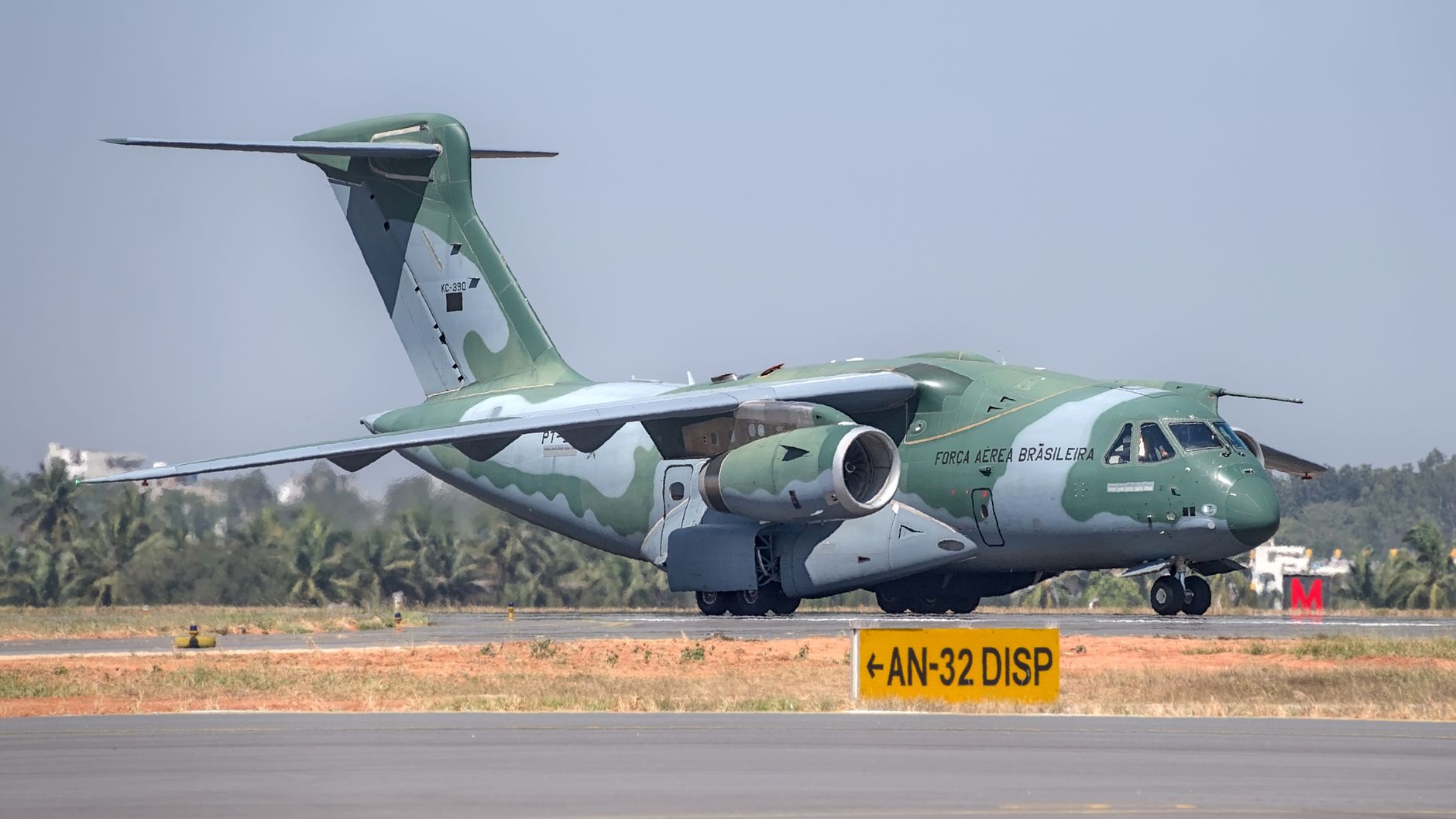
The defense segment offers apparent relief from these commercial constraints. The KC-390 tactical transport demonstrates the efficiency advantages of Embraer’s engineering culture, evelopment costs fractionally comparable to Western equivalents, unit pricing that undercuts the C-130 while offering comparable payload. Yet the program faces a ceiling that military efficiency cannot penetrate: the lack of U.S. military certification.
Without the Pentagon’s stamp of approval, the KC-390 remains confined to second-tier export markets, razilian allies, nations without U.S. defense relationships, countries seeking to diversify suppliers for political rather than technical reasons. The aircraft is, by technical metrics, a superior product for its mission set. With U.S. adoption, it would be a “killer product,” displacing the aging C-130 fleet in allied nations. Without it, the addressable market is insufficient to amortize development costs across a production run that justifies the program’s existence.
This creates a geopolitical fragility. Expanding defense sales to non-aligned nations, aggressively pursuing markets in Africa, Southeast Asia, or the Middle East outside U.S. security frameworks, risks triggering American sanctions or partnership restrictions that would cripple Embraer’s access to U.S. technology and components. Passivity, meanwhile, leaves revenue uncaptured and allows Lockheed Martin to maintain its transport monopoly. The defense segment’s growth depends on navigating a U.S.-Brazil relationship that has historically oscillated between cooperation and suspicion, with no guarantee that future Brazilian governments will align with American strategic interests sufficiently to unlock the Pentagon’s procurement process.
The Aftermarket Mirage
Compounding these strategic tensions is a structural leakage in Embraer’s revenue model. Over a twenty-five-year aircraft life, aftermarket services, maintenance, parts, modifications, generate approximately one hundred twenty-five percent of the original sale price. This stream represents the economic justification for low-margin original equipment sales; manufacturers accept thin profits on airframes to capture the annuity of service revenue.
But Embraer captures surprisingly little of this value. Brake pads, turbine blades, avionics updates, and structural components flow primarily to subsystem suppliers, Collins Aerospace, Honeywell, Safran, rather than to Embraer’s own service divisions. The company lacks the vertical integration of Boeing or Airbus in aftermarket support, leaving it dependent on airframe margins while suppliers extract the lifetime value of the aircraft.
This matters critically as commercial margins compress under Airbus pressure. If Embraer cannot offset declining new aircraft profitability with aftermarket capture, the commercial segment’s economics deteriorate faster than top-line revenue suggests. The three-segment portfolio provides temporary ballast, but the business jet and defense segments cannot indefinitely subsidize a commercial operation that loses money on every delivery while giving away the lifetime value to third parties.
The Physics of Remaining
Embraer defies gravity by occupying a position that industry structure suggests is uninhabitable: large enough to achieve manufacturing efficiency, small enough to maintain engineering culture; diversified enough to survive cyclical downturns, focused enough to avoid the capital traps of wide-body competition; Brazilian enough to exploit currency and labor arbitrage, international enough to sell into dollar-denominated global markets.
But defiance is temporary by definition. The regional jet market assumption, that hub-and-spoke feeders persist long enough to replace the fifty-seat fleet, grows more fragile with each point-to-point airline launch. The pricing pressure from Airbus’s supply chain advantages is not cyclical but structural, driven by permanent scale differences. The engineering culture that enables cost discipline faces constant threat from the governance requirements of public markets.
The company survives by remaining small, but smallness in aerospace is a precarious equilibrium. Gravity eventually wins. For Embraer, the question is whether it can harvest sufficient value from its current portfolio, defense efficiency, business jet margins, Brazilian cost structures, to fund a transition away from the regional commercial market before that market disappears, or whether it will follow Bombardier into the contraction that seems to be the inevitable fate of those who try to build aircraft in the spaces between Boeing and Airbus.
The comparison with Bombardier is instructive not merely as historical parallel but as counterfactual anatomy. When Bombardier faced the same structural pressure that now squeezes Embraer, the moment when a regional manufacturer must choose between accepting permanent niche status or betting the company on breakthrough scale, it chose incorrectly not once but twice. First, by developing the C-Series as a clean-sheet narrow-body to compete directly with Airbus A320 and Boeing 737 families, committing twelve billion dollars the company did not possess to a program that required twenty billion more to reach maturity. Second, by attempting to solve the first mistake through financial engineering rather than operational retrenchment, divesting the C-Series to Airbus for essentially nothing while retaining the business jet division that lacked the volume to support the corporate overhead.
Embraer’s avoidance of this trajectory has been less a matter of superior foresight than of constrained optionality. The Brazilian context, imited state fiscal capacity, stricter IMF discipline during the privatization era, a domestic capital market too shallow to fund speculative wide-body development, orced capital discipline. Bombardier had access to Canadian government backstops and Quebec provincial guarantees that allowed it to pursue scale delusions; Embraer’s government, facing hyperinflationary memory and currency crises, could not offer similar subsidies. The constraint became the strategy. Embraer learned to manufacture profitably at volumes and price points that required Bombardier to accept loss-leading market share or exit entirely.
Yet this historical advantage creates present vulnerability. The engineering culture that enabled profitable operation at constrained scale depends on specific institutional continuity. The ITA pipeline functions not merely as a recruiting channel but as a closed system of technical vocabulary and manufacturing ethics. Graduates enter Embraer having already absorbed the company’s methodological assumptions, omposite layup techniques derived from Brazilian agricultural aircraft heritage, assembly line efficiencies adapted from automotive partnerships, a particular Brazilian approach to “good enough” precision that avoids the over-engineering costs of European manufacturers while exceeding the quality floors of Russian or Chinese competitors. This is not generic engineering talent; it is a geographically concentrated, linguistically bounded, institutionally specific human capital stock.
When Mauricio Botelho led the privatization in 1994, he preserved this pipeline by embedding ITA graduates throughout the management structure, ensuring that financial decisions required engineering sign-off. Fred Curado, who succeeded Botelho and led the company through the 2008 financial crisis and the BRIC expansion, maintained this arrangement through informal authority rather than formal governance structures. The danger now lies in professionalization. As Embraer’s investor base has shifted from Brazilian pension funds to global institutional investors, the governance pressure to appoint chief executives with financial services backgrounds, private equity veterans, McKinsey alumni, capital allocators rather than aeronautical engineers, intensifies. Such appointments would not immediately destroy the culture. The first year might see improved working capital management and share buybacks. But by year three, the composition of the engineering review board would shift; by year five, the ITA pipeline would become one recruitment channel among many, diluted by MBA graduates from international business schools who speak the language of return on invested capital but not of wing box fatigue limits.
The mechanism of cultural decay is subtle but predictable. In engineering-led organizations, investment decisions emerge from technical feasibility studies, what can we build given material constraints? In financially-led organizations, decisions emerge from hurdle rate calculations, what return does this project generate against our weighted average cost of capital? The shift appears rational from a corporate governance perspective. But in aircraft manufacturing, it proves fatal. Boeing’s 737 MAX crisis traces directly to this transition: financial optimization of supplier contracts and training cost minimization overrode engineering judgment about flight control system redundancy. Embraer’s historical advantage is that its Brazilian cost base allows it to maintain engineering redundancy, testing cycles, safety margins, manual inspection protocols, that financialized competitors have eliminated. Lose the culture, and Embraer becomes merely a Brazilian Bombardier with better currency hedging.
The Florida manufacturing operation for business jets represents another underexamined structural element that requires deeper scrutiny. The Phenom and Praetor lines are assembled in Melbourne, Florida, not São José dos Campos, a geographic separation that costs more in logistics complexity than it saves in labor arbitrage. The rationale lies in regulatory capture and customer psychology. The Federal Aviation Administration’s certification processes move faster for domestic manufacturing facilities, reducing time-to-market for new executive aircraft variants by six to twelve months. More critically, fractional charter operators, NetJets, Flexjet, Flight Options, purchase aircraft through Delaware holding companies and Oklahoma tax shelters; they prefer dealing with U.S.-based sales teams who understand Delaware corporate law and can navigate the LUX and MON aircraft registries without cross-border contract friction. The Florida facility provides Embraer with a Delaware address without the Delaware incorporation, a legal fiction that converts Brazilian manufacturing into American product in the eyes of lessors and charter operators.
This arbitrage is fragile. Brazilian labor law changes or U.S. visa restrictions on Brazilian engineers could sever the pipeline that feeds the Florida facility. The Melbourne plant relies on a rotating cadre of São José dos Campos expatriates for quality control and composite fabrication expertise; if U.S. immigration policy tightens for Brazilian skilled workers, or if Brazilian tax policy penalizes expatriate employment, the knowledge transfer mechanism stalls. The facility also operates on a distinct labor model, on-union, right-to-work Florida manufacturing wages rather than Brazilian CLT labor contracts with extensive severance obligations. This creates margin advantage but political exposure. A shift in U.S. administration favoring unionization or “Buy American” procurement preferences for defense-adjacent manufacturing could force Embraer to choose between absorbing higher labor costs or relocating production to Brazil, thereby losing the FAA speed advantage and the customer intimacy that supports the business jet premium pricing.
The defense segment’s geopolitical constraints merit equally granular examination. The KC-390 has secured orders from Hungary, the Czech Republic, and Portugal, NATO members seeking tactical transport diversity, but notably not from the United States, despite the aircraft’s technical superiority to the aging C-130H fleet. The blockage operates through the Foreign Military Sales (FMS) system, where the Pentagon acts as purchasing agent for allied nations. Without FMS endorsement, the KC-390 cannot access the financing mechanisms, Foreign Military Financing grants, Defense Department credit guarantees, that lubricate international defense procurement. Embraer’s current strategy involves “NATO interoperability” demonstrations, proving the aircraft can refuel F-35s and carry standard U.S. military pallets, but the political barrier remains: no Brazilian manufacturer has ever penetrated the U.S. tactical airlift market, and congressional protectionism for Lockheed Martin’s Marietta, Georgia C-130J production line creates insurmountable lobbying resistance.
The alternative, aggressive pursuit of non-aligned nations, presents its own trap. Brazil’s diplomatic orientation under recent governments has flirted with BRICS alignment and South-South cooperation, potentially opening markets in Angola, Nigeria, or Southeast Asia for the KC-390. But these sales risk triggering U.S. sanctions under the Countering America’s Adversaries Through Sanctions Act (CAATSA) if purchasers overlap with Russian or Chinese defense relationships. Embraer relies on U.S.-origin content, Honeywell avionics, Pratt & Whitney Canada engines, that would be embargoed if the company were designated a sanctions risk through association with proscribed customers. The defense segment thus operates in a narrowing corridor: too dependent on U.S. technology to sell to American adversaries, too foreign to sell to the U.S. military, confined to the diminishing space of NATO members seeking marginal diversification and developing nations with sufficient foreign exchange reserves to purchase Western equipment but insufficient strategic importance to trigger Washington’s intervention.
The aftermarket revenue leakage requires similar dissection. When an E175 lands at Chicago O’Hare requiring a brake pad replacement, the airline does not purchase from Embraer. It purchases from Safran Landing Systems, the French conglomerate that manufactured the original equipment. When the auxiliary power unit requires overhaul at the twelve-year mark, the work goes to Honeywell or Pratt & Whitney, not to Embraer’s maintenance division. The one hundred twenty-five percent lifetime value figure that tantalizes aerospace investors flows primarily to these subsystem monopolists, who established their positions through intellectual property moats, proprietary software in the full-authority digital engine control (FADEC), patented ceramic matrix composites in the brake assemblies, that Embraer cannot easily replicate without infringing patents or triggering supplier retaliation.
Embraer has attempted vertical integration through its “E-Jets Services” division, but the economics prove hostile. The company lacks the balance sheet depth to inventory spare parts at the scale required for global airline support; it cannot match Safran’s ability to pre-position brake assemblies in Singapore, Dubai, and Miami. The result is a revenue mix that reverses the industry standard: whereas Airbus and Boeing might capture sixty percent of lifetime value through aftermarket services, Embraer captures perhaps twenty percent, forcing dependence on the initial sale margin. This explains the particular intensity of the A220 pricing threat. When Airbus discounts the A220 to win a SkyWest or Republic Airways order, it accepts thin airframe margins because it will capture the aftermarket through its Safran-GE joint ventures and its own services divisions. Embraer, facing the same pricing pressure, lacks the annuity offset, making each discounted sale a direct hit to enterprise value.
The FX hedge, while durable, carries hidden fragilities in its execution details. The seventy percent import content creates natural dollar liability matching against dollar-denominated aircraft sales, but the composition of those imports matters critically. Jet engines, typically the most expensive single component, are purchased under long-term contracts with escalation clauses tied to the euro (for Safran) or the yen (for certain Japanese material suppliers). When the real weakens against the dollar, the hedge protects the top line, but if the dollar simultaneously strengthens against the euro or yen, the cost base shifts unfavorably. The 2015-2016 period demonstrated this complexity: the real’s collapse against the dollar should have enhanced Embraer’s competitiveness, but concurrent yen appreciation on carbon fiber contracts and euro strength on avionics partially offset the advantage. The hedge works directionally but not perfectly, and the accounting volatility, marking dollar liabilities to market while holding real cash reserves, creates reported earnings swings that disturb institutional investors despite the operational protection.
Finally, the transition from fifty-seat to seventy-five-seat aircraft demands examination of the specific operational economics driving airline purchasing decisions. The aging CRJ-200 and ERJ-145 fleets suffer from three distinct cost disabilities: fuel inefficiency relative to modern turbofans, maintenance intensity on aging airframes, and crew constraints under U.S. scope clauses that limit regional airline pilot compensation but cap aircraft size at seventy-six seats. The E175 exists at the exact scope clause limit, making it the largest aircraft that regional carriers can operate under major airline contract restrictions. This regulatory arbitrage, selling the maximum allowed aircraft size to labor-constrained buyers, creates artificial demand that could disappear instantly.
If U.S. airline pilot unions succeed in renegotiating scope clauses to allow larger regional aircraft, or if the pilot shortage forces majors to bring regional flying in-house with mainline crews, the E175’s entire value proposition evaporates. It is too large for fifty-seat route economics when operated at mainline cost structures, too small to compete with A220s on trunk routes. The aircraft’s market position depends entirely on a specific American labor market regulation, the 76-seat scope cap, that is politically contested and historically unstable. Should the Air Line Pilots Association (ALPA) succeed in reducing or eliminating scope restrictions as part of the next industry bargaining round, Embraer’s installed base becomes instantly obsolete, stranded between aircraft categories with no migration path.
The confluence of these pressures, ultural fragility, geopolitical constraints in defense, aftermarket revenue leakage, imperfect currency hedging, and regulatory dependence in the core commercial segment, uggests that Embraer’s statistical impossibility rests on a narrower foundation than surface profitability indicates. The company survives through a portfolio strategy that diversifies cyclical risk while accepting structural risk in each individual segment. But diversification provides protection only if the segments do not simultaneously deteriorate. A scenario where Airbus pricing pressure intensifies concurrently with U.S. scope clause relaxation and Brazilian political instability would test the portfolio hypothesis, forcing Embraer to retreat into a smaller niche than even Bombardier’s current rump business.
What remains is the engineering culture, the one advantage that cannot be purchased, replicated, or financialized. It persists through the inertia of institutional memory: he tacit knowledge of how to bond composite materials in humid Brazilian climates, how to manage the ITA recruitment cycle, how to negotiate the peculiar intersection of Brazilian labor law and international aerospace standards. This culture is the final hedge, the reason Embraer has outlasted competitors with superior balance sheets and larger home markets. Its preservation is the only strategic imperative that transcends the quarterly earnings cycle, yet it is the one metric that does not appear on the dashboard of the financial executives increasingly populating the boardroom. The gravity that eventually claims Embraer will likely arrive not through competitive displacement or technological obsolescence, but through the slow substitution of engineering judgment by capital allocation discipline, the quiet replacement of airframe intuition by spreadsheet optimization, until one morning the company wakes to find it has become what it was built to resist: a Brazilian division of the global aerospace oligopoly, surviving on margin rather than mission.