Intel: From Monopoly to Irrelevance
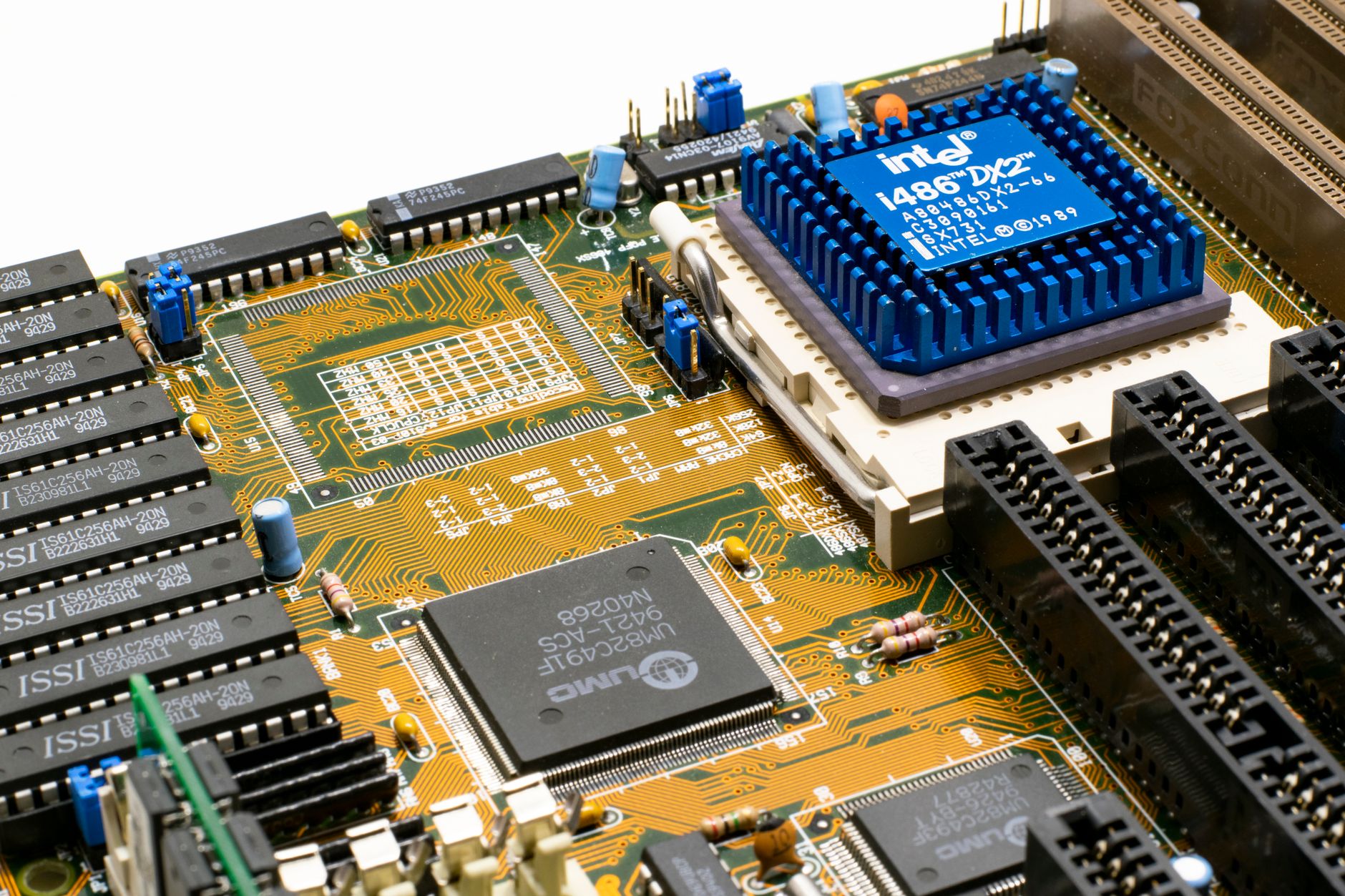
When Andy Grove ran Intel, the business model was almost insultingly simple: maintain a two-year process technology lead over the nearest competitor, pair it with the x86 architecture’s software lock-in, and collect 30 percent operating margins while controlling 90 percent of the server and PC markets. The company designed the most complex processors on earth and manufactured them in-house, capturing both the fabless design premium and the foundry economics. It was a vertically integrated monopoly that worked because Intel’s manufacturing was not just good; it was definitively better than anyone else’s. When that stopped being true, when TSMC’s 7nm node shipped before Intel could rescue its floundering 10nm transition, the engine didn’t merely sputter; it seized. AMD, long dismissed as a permanent also-ran, ported its Zen architecture to TSMC’s superior nodes and began offering more performance per watt than Intel could match. Suddenly, Intel’s design division was competing with an external foundry’s economics, while its manufacturing division was years behind the industry standard. The company that once defined process leadership became a cautionary tale about the fragility of vertical integration.
Today, Intel trades at roughly the same market capitalization it commanded at Grove’s peak, but the earnings power has collapsed. Operating margins fell from above 30 percent to 7.5 percent in 2024. Gross margins contracted 17 percentage points. The company still holds 80 percent of the PC market and 70 percent of servers, but these are no longer moats; they are depreciating assets, shrinking by single digits annually as AMD and ARM-based designs erode the x86 monopoly. To survive, Intel must execute a transformation unprecedented in semiconductor history: simultaneously splitting itself into separate design and foundry businesses, leapfrogging five process nodes in four years, and building $125 billion of new fabrication capacity, ll while funding the transition with cash flows from a CPU business that is itself under siege. The question is not whether this is difficult. The question is whether it is possible.
Serving Your Enemies
The defining structural constraint shaping Intel’s every decision is this: it must convince external customers to trust it with their most advanced chip designs at the exact moment it is competing against those same customers in the marketplace. This is not a problem that can be solved by legal separation or internal firewalls. Intel’s Foundry Services division must attract the likes of Apple, Qualcomm, and AMD, companies that spend billions on silicon, to manufacture their leading-edge products. Yet Intel’s Product division remains the direct competitor to all of them. Apple wants to beat Intel in PCs. Qualcomm wants to beat Intel in mobile and now PCs. AMD already is beating Intel in servers.
In a normal foundry relationship, TSMC offers neutrality. It does not design chips that compete with Nvidia, Apple, or AMD. It is a pure-play manufacturer, incentivized only by volume and yield. Intel, by contrast, faces an irreconcilable incentive structure. If Intel’s foundry manufactures a chip for Qualcomm that outperforms Intel’s own design division’s product, the foundry wins but the product division loses. If the foundry slows Qualcomm’s ramp to give Intel’s designers time to catch up, the foundry loses credibility. Customers understand this. They will not port their most valuable designs, those requiring the latest 3nm or 2nm processes, to a foundry owned by a competitor who might see their layouts, learn their power management techniques, or simply prioritize its own wafers during supply crunches.
The cultural inversion required is staggering. For forty years, Intel’s competitive advantage rested on proprietary integration: controlling the EDA tools, the process design kits, and the validation stacks to ensure that only Intel could fully exploit Intel’s manufacturing. Building a credible foundry requires the opposite, eding control to Synopsys and Cadence, open-sourcing interfaces, and letting customers customize flows. Intel must transform from a company that dictated terms to the ecosystem into one that begs for design ports. This is not a marketing challenge; it is an economic impossibility unless customers believe, with religious fervor, that the foundry is truly independent. So far, they do not.
Five Nodes Against Physics
If the structural constraint is customer trust, the fragile assumption underlying the entire recovery is execution speed. Pat Gelsinger has committed Intel to advancing five process nodes in four years: Intel 7 (completed), Intel 4 (ramping), Intel 3 (launching first half of 2024), Intel 20A (2024), and Intel 18A (2025). This cadence includes the adoption of EUV lithography, the transition to gate-all-around transistors (RibbonFET), and the implementation of PowerVia backside power delivery. No semiconductor manufacturer has ever moved this fast at the leading edge. TSMC, the industry’s gold standard, advances roughly one node every two to two-and-a-half years, and even that pace strains the limits of materials science.
The physics of sub-3nm manufacturing are exponential in their complexity. A single yield excursion, a contamination in a EUV scanner, a defect in a gate oxide layer, a thermal budget miscalculation, can delay a node by six to twelve months. Intel has built no buffer into its roadmap. If Intel 3 slips by a quarter, or if Intel 20A’s yields fail to reach economic thresholds by late 2024, the cascade is immediate. Customers planning 2025 products will lock in TSMC capacity instead, paying premiums for N3E or N2 rather than risk their product launches on Intel’s unproven 18A. Once those design wins move to Taiwan, they do not return. The validation cycles for server CPUs and smartphone SoCs span years; a customer who ports to TSMC in 2024 will not consider Intel again until 2027 at the earliest.

Gelsinger’s credibility, he is a Grove protégé and Intel’s first CTO, buys the company patience that a financial engineer or outsider could not command. Engineers believe he understands process technology because he literally built Intel’s early fabs. Customers believe he will prioritize manufacturing excellence over short-term financial engineering. But credibility cannot bend the laws of physics. The bet is that Intel’s institutional knowledge, dormant for a decade, can be reactivated to out-execute TSMC while simultaneously teaching a new organization how to be a foundry. If any node slips, the entire edifice of the turnaround collapses, because Intel will have spent $25 billion annually on fabs that are obsolete before they fill.
Geography as a Business Model
Most analyses of Intel’s recovery focus on nanometers and transistor density, comparing Intel 18A to TSMC’s N2. This misses the underappreciated structural advantage that makes the math work: Intel is no longer competing purely on technology. It is competing on geopolitics. The CHIPS Act has allocated $52 billion in subsidies for domestic semiconductor manufacturing, with Intel the primary beneficiary, $8.5 billion in direct grants and $11 billion in loans. More importantly, the concentration of advanced logic manufacturing in Taiwan, accounting for over 90 percent of the world’s most advanced chips, as become a strategic vulnerability that the U.S. government and major cloud providers can no longer ignore.
This creates a demand floor for Intel’s foundry services that did not exist in a purely commercial market. Even if Intel’s 18A process offers slightly worse power efficiency or yield than TSMC’s equivalent node, customers will pay a premium, or accept a penalty, for the assurance of supply chain diversification away from the Taiwan Strait. Microsoft, Amazon, and the Pentagon will buy Intel wafers not because they are the best, but because they are in Arizona and Oregon. This is not cyclical demand; it is structural fragmentation of the global semiconductor supply chain. As long as U.S.-China relations remain tense, Intel has a built-in customer base that TSMC cannot match, even if TSMC builds its own Arizona fabs.
The fragility here is obvious: if geopolitical tensions ease, or if TSMC accelerates its U.S. capacity to 3nm by 2026, Intel’s artificial demand premium evaporates. But for now, geography functions as a moat. It reduces the commercial risk of the foundry launch by guaranteeing utilization rates for the $125 billion capital program. Without this subsidy, both direct financial support and the implicit subsidy of geopolitical risk, Intel would be attempting this turnaround into a headwind of pure market competition it would likely lose.
Software Eats the Turnaround
While Intel attempts to resurrect its manufacturing, it is simultaneously trying to build a GPU and AI accelerator business to offset the decline in CPU dominance. The Gaudi3 accelerator is technically competitive with Nvidia’s H100 in raw throughput, and Intel has targeted $2–3 billion in revenue within three years. This is fantasy. The AI accelerator market is winner-take-most, and Nvidia’s CUDA software stack has created switching costs that make x86 look porous by comparison.
In the CPU market, customers diversified to AMD because the software stack (Windows, Linux, enterprise applications) was identical. Porting from Intel to AMD required hardware validation but not software rewrites. In AI, the opposite is true. CUDA has become the lingua franca of machine learning. Every major framework, every optimized library, every trained model expects Nvidia’s architecture. Even if Gaudi3 matches the H100 on benchmarks, customers face the prospect of rewriting entire software stacks, retraining engineers, and accepting integration risk for no meaningful economic benefit. Cloud providers like Meta, Google, and Microsoft use accelerators for cost efficiency; they will not pay a “diversification tax” to support Intel’s revenue targets.
Intel could spend $10 billion developing Gaudi and subsequent generations and still capture only 5–10 percent of a $400 billion market (by 2027 estimates). The GPU business will not provide the revenue offset Intel needs to compensate for CPU share loss. It will be a niche product for customers with specific architectural needs or anti-Nvidia sentiments, not a growth engine. The capital allocated here competes directly with the foundry buildout, creating an opportunity cost that Intel cannot afford.
Capital Intensity as a Prison
The financial mechanics of Intel’s position are brutal. The company is committing $125 billion in capital expenditures over five years to build new fabs. Depreciation on existing and new capacity already exceeds $10 billion annually and will rise. Foundry economics, even at scale, yield operating margins of roughly 20 percent, alf the 40 percent-plus margins Intel enjoyed as a vertically integrated CPU monopoly.
Here is the trap: even if Intel succeeds in winning foundry customers, the financial results will look like failure for years. If Foundry Services generates $3–5 billion in revenue by 2026 (an optimistic scenario), but carries $10 billion in depreciation and startup costs, the segment will be deeply unprofitable. Meanwhile, the Product division’s margins compress as CPU prices fall to compete with AMD and ARM. The consolidated company could show revenue growth while operating margins remain depressed in the single digits or low teens, generating negative free cash flow and forcing dividend cuts or debt increases. Investors expecting a V-shaped recovery will instead find a long, shallow U-shaped slog where the “recovery” means merely surviving until 2027 or 2028 when, if the nodes hit and the customers arrive, margins might approach 25 percent.
There is no scenario where Intel avoids this capital intensity. The equipment is ordered years in advance; the depreciation clock starts whether the wafers are qualified or not. Intel has effectively committed to a $10 billion annual drag on earnings for the remainder of the decade, betting that volume and yield improvements will eventually outrun the depreciation curve. In cyclical downturns or if node delays occur, this fixed cost base becomes an existential threat.

Leadership as a Balance Sheet Item
In most turnarounds, leadership is discussed as a soft factor, a matter of morale or vision. At Intel, it is a hard economic variable that affects the cost of capital, employee retention, and customer commitment. Pat Gelsinger is not merely a CEO; he is a specific type of insurance policy. His background, Intel’s first CTO, architect of the 80486, Grove disciple, signals to process engineers that the company has returned to technical leadership after years of financial engineering under prior management. This matters because process technology cannot be hired from the outside. It requires institutional knowledge of Intel’s specific equipment, its chemistry, its failure modes. If Gelsinger cannot retain the senior talent capable of executing the five-node roadmap, the turnaround is mathematically impossible.
His presence also functions as a customer relations tool. When Qualcomm or Apple evaluates whether to trust Intel with a design port, Gelsinger’s credibility allows them to believe that manufacturing, not financial returns, is the priority. A generic CEO would face immediate skepticism; Gelsinger buys time and tolerance for yield learning curves.
But leadership cannot manufacture alone. Gelsinger must simultaneously force a cultural inversion, emanding that Intel’s organization cede the proprietary control that defined its golden age. The company that once sued competitors for patent infringement must now welcome them as customers. The engineers who optimized processes solely for x86 must now optimize for ARM, RISC-V, and custom AI accelerators. This cultural shift is an economic prerequisite for the foundry model, yet it may be incompatible with the DNA of a company that built its identity on integration. If the design division sabotages the foundry, consciously or unconsciously, by withholding IP or prioritizing its own wafers, the separation fails. Gelsinger must manage this schism while running a manufacturing sprint that defies semiconductor history.
The Synthesis
Intel is not undergoing a cyclical correction; it is attempting to transform its business model, manufacturing technology, and corporate culture simultaneously while defending a core franchise that is actively eroding. No semiconductor company has successfully executed this combination of tasks under competitive pressure. The vertical integration that created Intel’s monopoly has become a straitjacket, preventing it from becoming the neutral foundry the market demands, while its manufacturing lag has destroyed the cost advantage that made integration profitable.
Yet the analysis changes when accounting for the non-market forces at play. The CHIPS Act and geopolitical fragmentation of semiconductor supply chains create a subsidy, both direct and implicit, that lowers the commercial bar for success. Intel does not need to beat TSMC on price or even density to win customers; it merely needs to be “good enough” and located in the United States. This is a profound shift from the pure technology competition of the 2000s.
The bet, then, is that geopolitical demand will fund the turnaround long enough for the five-node roadmap to restore technical parity, and that Gelsinger’s leadership can hold the organization together through the cultural and financial strain. If Intel 18A ships on time with competitive yields, and if the foundry secures commitments from even two major non-Intel customers, the company emerges as a structurally different but viable entity: lower margins than its historical peak, but diversified across manufacturing services, GPUs, and CPUs, with a geographic moat that TSMC cannot easily cross.
If the nodes slip, or if the customer paradox proves insurmountable, Intel becomes a cautionary tale of a different sort: a company that spent $125 billion to prove that vertical integration, once lost, cannot be reassembled, and that process leadership, once ceded, cannot be bought back at any price. The margins of 2026 and 2027 will tell which story wins.
The margins of 2026 and 2027 will tell which story wins.
To understand the stakes, consider what it actually takes to port a leading-edge design from TSMC to Intel. This is not a matter of signing a contract and shipping GDSII files. A modern 3nm smartphone SoC or AI accelerator contains tens of billions of transistors, requiring synchronization between the process design kit (PDK), the electronic design automation (EDA) tools, and the physical IP libraries. When Apple designs an A-series chip or Qualcomm creates a Snapdragon, they spend eighteen to twenty-four months co-developing the design with TSMC’s engineers, iterating on power grids, clock trees, and thermal characteristics specific to TSMC’s N3E or N2 node. The PDK is a living document, updated weekly as process corners shift and yield learning accumulates.
For Intel to win this business, it must convince these teams to abandon two years of sunk cost and start over. They must trust that Intel’s 18A PDK is stable, that Synopsys and Cadence have fully qualified their tools on Intel’s process, and that Intel’s physical IP, standard cells, memory compilers, SerDes, matches the performance and density of TSMC’s equivalents. If Intel’s design division maintains any proprietary advantage in its own PDK, if, for instance, Intel’s CPU team gets access to updated transistor models two quarters before external customers, the foundry is compromised. TSMC wins because it is a pure substrate; any asymmetry in Intel’s favor poisons the well.
This ecosystem dependency extends deeper than most analyses recognize. Intel historically treated EDA vendors as suppliers to be managed, not partners to be integrated. When the company controlled both process and design, it could dictate tool flows, forcing Cadence and Synopsys to adapt to Intel’s proprietary formats. As a foundry, the power dynamic inverts. Intel must adapt to industry-standard formats, supporting OpenROAD, interoperable PDKs, and third-party IP from vendors like Arm and Synopsys. This requires Intel’s process engineers to expose details, transistor leakage curves, interconnect parasitics, variation models, that the company historically classified as competitive intelligence. The cultural resistance within Intel’s manufacturing organization to this transparency should not be underestimated. For decades, these data sets were guarded as state secrets, the specific recipes that made x86 faster than the competition. Handing them to Qualcomm’s designers requires not just legal firewalls but psychological surrender.
The organizational tension manifests in capital allocation as well. When Intel was a monolith, the fab investment decision was simple: build capacity for the next x86 generation. The design team specified the die size, the yield team calculated the wafer starts, and the CFO approved the capex. In the foundry model, Intel must build capacity speculatively, before securing customer commitments, because lead times for EUV scanners from ASML extend to eighteen months and fab construction takes three years. Intel is currently committing $25 billion annually to fabs that may run empty if the 18A node fails to qualify with external customers on schedule. This is a radically different risk profile. TSMC can fill new capacity with Apple’s predictable iPhone cadence; Intel must aggregate dozens of smaller customers or rely on geopolitically motivated but economically reluctant purchasers like the Department of Defense.
The bear case, then, is not merely that Intel fails to catch TSMC technologically. It is that Intel succeeds partially, delivering a competitive 18A process in 2025, qualifying a few external customers, achieving technical parity, but still bleeds cash for a decade because the economics of foundry manufacturing contradict Intel’s cost structure. Assume Intel achieves $5 billion in foundry revenue by 2026, a reasonable success scenario. At 20 percent operating margins, this contributes $1 billion in operating income. But the depreciation burden on the new fabs exceeds $10 billion annually. The foundry business thus destroys $9 billion in value per year, masked only by the CPU division’s remaining profitability. As CPU margins compress further, say, to 15 percent on $40 billion in revenue, contributing $6 billion, the consolidated company generates negative operating cash flow. Intel must then choose between cutting the dividend (already suspended in this scenario), issuing dilutive equity, or curtailing the foundry buildout, which in turn cedes the strategic advantage to TSMC.
This dynamic creates a doom loop. If Intel slows capex to preserve cash, it signals to potential foundry customers that the company is not committed to leading-edge capacity long-term. Apple and Qualcomm, observing Intel’s balance sheet strain, delay their design ports, waiting to see if the company will survive as a manufacturer. Without those design ports, the fabs run underutilized, increasing the cost per wafer and making Intel’s offering even less competitive against TSMC’s scale. The company becomes trapped in a zombie state: too capital-intensive to abandon the foundry strategy, too financially constrained to execute it fully.
Historical precedent offers little comfort. In semiconductor manufacturing, process leadership, once lost, has never been regained. Texas Instruments dominated logic manufacturing in the 1980s before ceding leadership to Intel; it never returned to the leading edge, retreating to analog and embedded markets. GlobalFoundries abandoned pursuit of 7nm in 2018, recognizing it could not match TSMC’s economics; it now specializes in mature nodes and RF silicon. IBM maintained advanced research fabs for years, bleeding billions to manufacture Power processors for a shrinking server market, before finally paying GlobalFoundries $1.5 billion to take the fabs off its hands in 2014. The history of the industry is littered with companies that tried to maintain process leadership through sheer capital expenditure and failed. Intel’s bet is that its scale and geopolitical support exempt it from this pattern, but the physics of manufacturing economics suggest otherwise.
The specific technical risks embedded in the five-node roadmap compound this historical weight. Intel 4, the company’s first EUV node, is already in production, but volume remains limited to Meteor Lake tiles: relatively low-complexity design. Intel 3, ramping now, introduces higher EUV utilization and tighter pitches. But the real inflection points are Intel 20A and 18A, which introduce gate-all-around transistors (RibbonFET) and PowerVia backside power delivery simultaneously. These are not incremental changes. Gate-all-around replaces the finFET structure that has defined the last decade of Moore’s Law, requiring entirely new transistor architectures, new leakage control mechanisms, and new parasitic extraction models. Backside power delivery, routing power through the wafer’s backside to reduce frontside congestion, requires new wafer bonding techniques, thinning processes, and thermal management solutions. Introducing one of these technologies in a node transition is risky; introducing both simultaneously, while compressing the timeline to match TSMC’s N2, approaches hubris.
If RibbonFET’s channel control fails to meet leakage specifications, or if PowerVia’s wafer bonding introduces defect densities that crater yield, Intel faces not a six-month delay but a fundamental architectural restart. The company cannot simply “fix” a gate-all-around transistor in a quarter; it must redesign the device physics, requalify the manufacturing equipment, and retrain the process engineers. In such a scenario, Intel 18A slips to 2026 or 2027, by which point TSMC’s N2 is in high-volume production with proven yields. The customers waiting to diversify, Microsoft, Amazon, the automotive OEMs, will have committed to TSMC’s roadmap. Intel’s fabs, built on the assumption of 18A leadership, become white elephants, optimized for a process node that is obsolete before it achieves commercial viability.
The geopolitical subsidy, while substantial, cannot overcome technical failure. The CHIPS Act funding covers roughly 10 percent of Intel’s five-year capex program. If Intel 18A fails to qualify, the U.S. government will not purchase $10 billion in uncompetitive wafers annually out of patriotic duty; it will source from TSMC’s Arizona facilities or Samsung’s Texas expansion. The geopolitical advantage creates a demand floor only if Intel achieves technical viability; it cannot sustain a fundamentally uncompetitive manufacturing process indefinitely.
Nor can the CPU franchise fund the transition indefinitely. The x86 market is not merely cyclically depressed; it is structurally shrinking in terms of unit economics. ARM-based designs, Apple’s M-series, Qualcomm’s Snapdragon X, Amazon’s Graviton, are capturing not just market share but value share, particularly in high-margin enterprise and cloud workloads. Each percentage point of server share lost to AMD or ARM reduces Intel’s gross margin dollars by approximately $300 million annually, given the current revenue base and margin structure. As the installed base of x86 servers depreciates over five-year cycles, replacement decisions increasingly favor non-Intel architectures. The company is not defending a static fortress; it is retreating from a burning bridge while trying to build a new one.
The GPU and AI accelerator strategy compounds rather than alleviates this pressure. Gaudi3 requires software ecosystem investment from customers, framework optimizations, driver development, integration with PyTorch and TensorFlow, that divert resources from CUDA optimization. But CUDA optimization offers immediate, measurable performance returns on deployed Nvidia hardware. Intel is asking customers to invest in an uncertain software stack for hardware that may achieve price-performance parity only in specific, narrow workloads. The enterprise sales cycle for AI infrastructure is currently twelve to eighteen months; if Gaudi3 is not demonstrably superior to Nvidia’s B100 (launching in 2024) by early 2025, Intel misses the 2025 enterprise procurement cycle entirely. The GPU business then contributes negligible revenue in 2025 and 2026, precisely when the foundry cash drain is deepest.
Financially, the company is walking a tightrope with no safety net. Intel’s net debt position has deteriorated as it funds the capex program. If the company generates negative free cash flow of $5–10 billion annually through 2026, a realistic scenario if foundry utilization remains low and CPU margins compress, the credit rating agencies will downgrade Intel to junk status. This increases the cost of the $50 billion in debt Intel has issued to fund the turnaround, creating a self-reinforcing spiral of higher interest expense and reduced financial flexibility. A junk-rated Intel cannot support the capital intensity required for five nodes in four years; the bond market will demand yields that make the fabs unaffordable.
The only path through this constriction is flawless execution on 18A, immediate customer adoption, and a stabilization of CPU share loss, ll simultaneously. If Intel 18A qualifies on time with yields above 70 percent, and if Intel secures commitments from two major smartphone or AI chip designers by mid-2025, the narrative shifts. The foundry fills, absorbing the depreciation burden. The stock re-rates as investors discount eventual margin recovery. The CPU business stabilizes as Intel reclaims the manufacturing cost advantage, allowing price competition with AMD without sacrificing margins. The GPU business, even if marginal, provides optionality.
But this scenario requires the confluence of technical success, customer trust, and market stability that semiconductor history suggests is improbable. The more likely intermediate outcome is a muddled recovery: 18A ships but with yields 10–15 percent below TSMC’s N2, making Intel competitive only on price for less sensitive designs (automotive, IoT, government). The foundry generates $3–4 billion in revenue by 2027 but remains unprofitable. The CPU share stabilizes at 65–70 percent in servers but never recovers to 80 percent. The company survives but thrives only as a shadow of its former monopoly, a domestic alternative to TSMC rather than a peer competitor.
Even this outcome, survival through mediocrity, requires that Intel avoid catastrophic failure on any of the five nodes, that Gelsinger retains the confidence of the board and the engineering corps through three more years of cash burn, and that geopolitical tensions do not resolve in a way that eliminates the subsidy for non-Taiwanese manufacturing. Each of these is an independent variable; the probability that all resolve favorably is the product of their individual probabilities, not the sum.
In this light, the current market capitalization, roughly $200 billion, represents a binary option on manufacturing execution. If the fabs fill and the nodes hit, Intel is worth multiples of the current price; the earnings power of a restored vertical integration, even at lower margins than the Grove era, justifies a re-rating to $400–500 billion. If the nodes slip or the foundry fails to attract customers, the equity value approaches the liquidation value of the manufacturing assets minus the debt burden: scenario implying significant downside from current levels.
The semiconductor industry has no mercy for incumbents who falter. It is a business where capital advantages decay, where ecosystem lock-in erodes, and where process leadership, once surrendered, becomes an asymptote that recedes as fast as one approaches it. Intel is attempting to defy this gravity with the largest capital commitment in industrial history, supported by geopolitical tailwinds that may prove transient. Whether it becomes the exception that proves the rule, or merely the most expensive confirmation of it, depends on engineering decisions made in cleanrooms in Oregon and Arizona over the next eighteen months, ecisions that will determine not just the company’s fate, but the structure of the global semiconductor industry for the next decade.