Bringing Diagrams to Life Through Touch and Sound
Our Solution
The Result
Why It Matters
Independent learning for visually impaired students, one tactile diagram at a time.
Â
For most students, a quick glance at a diagram is enough to grasp an idea. For visually impaired learners, that same diagram can feel like an unscalable wall. Tactile diagrams exist, but they usually require a teacher’s constant guidance to interpret labels and relationships. With too few specialized educators available, many children fall behind in subjects like science and geography that rely heavily on diagrams.
Vembi Technologies set out to bridge this gap. The goal was not another assistive tool that depended on supervision, but one that gave students the ability to learn on their own, at their own pace.
THE CHALLENGE
The Difficulty was more than just “Reading Diagrams.”
The team had to build an entire system of accessibility:
- How do you make tactile diagrams interactive without overwhelming the student?
- How do you keep the device rugged enough for daily school use, but light enough to carry easily?
- How do you deliver audio descriptions in multiple Indian languages without adding complex infrastructure or training?
The device had to be simple to use, multilingual, easy to produce, and affordable for schools and NGOs.
OUR APPROACH
Bang Design worked with Vembi to design a solution that is intuitive and reliable. We observed how children interacted with tactile diagrams, where they hesitated, and where they felt confident. The insights shaped a product that fits naturally into the classroom:
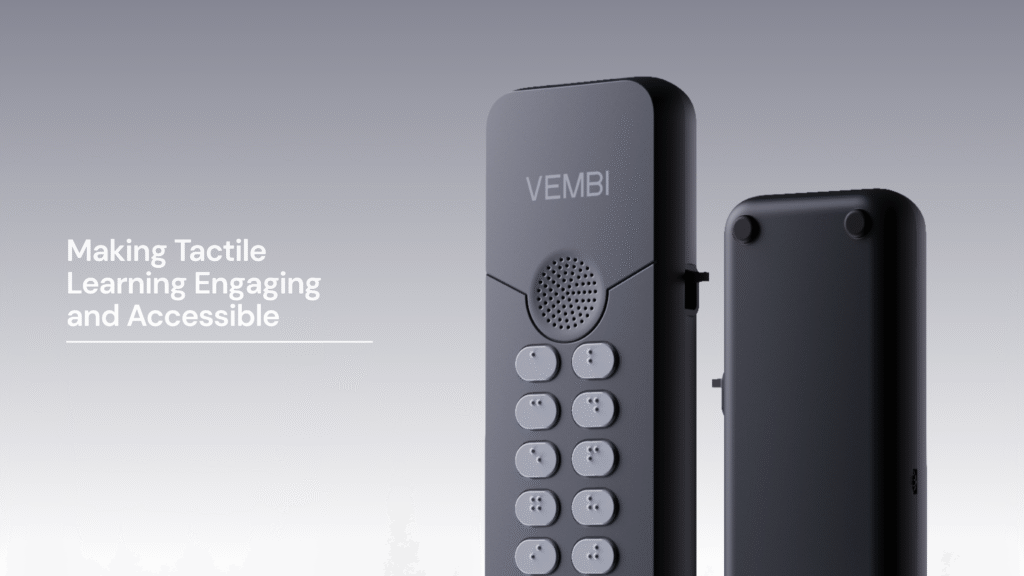
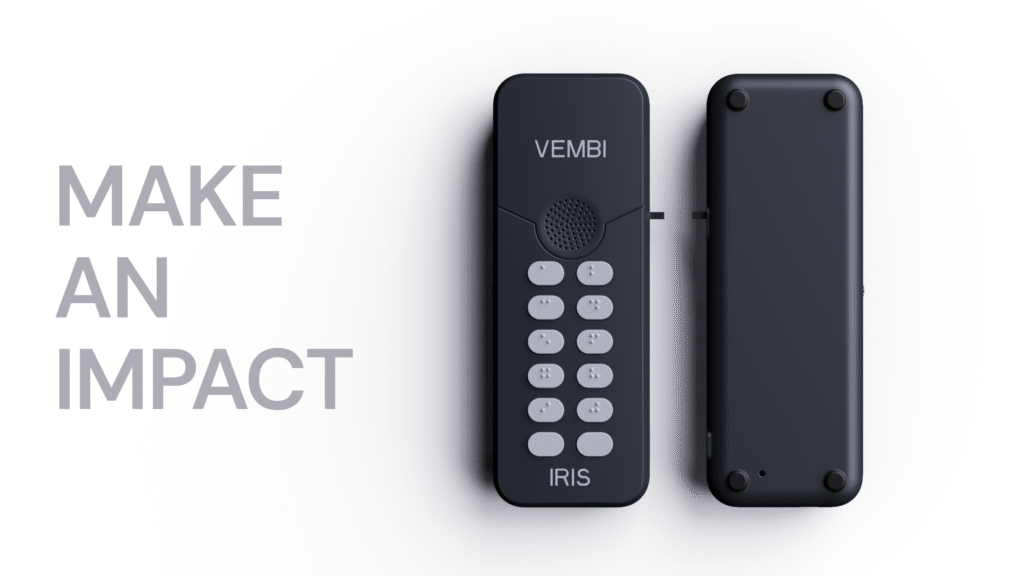
- Keypad Navigation: Tactile IDs (0–9) let students input diagram labels, with OK and CLR keys for quick editing.
- Dual-Level Audio Feedback: A short press reveals the label name, while a long press provides a detailed description.
- Universal Connectivity: USB-C charging, headphone jack, speaker, and Wi-Fi downloads keep the device updated and easy to use.
- Language Inclusivity: Support for more than 10 Indian languages makes it accessible across regions.
- Compact and Lightweight: At just 160 g, Iris is light, portable, and built to survive daily use in schools.
Design Highlights
Flexible Navigation
Students can explore diagrams in any order, encouraging curiosity and self-paced discovery.
Child-Friendly Durability
The form factor is designed to withstand the knocks and falls of daily school use without increasing cost.
Seamless Content Creation
With Vembi’s Antara cloud platform, teachers can create and update descriptions quickly in multiple languages.
Three-Part Engineering for Affordability
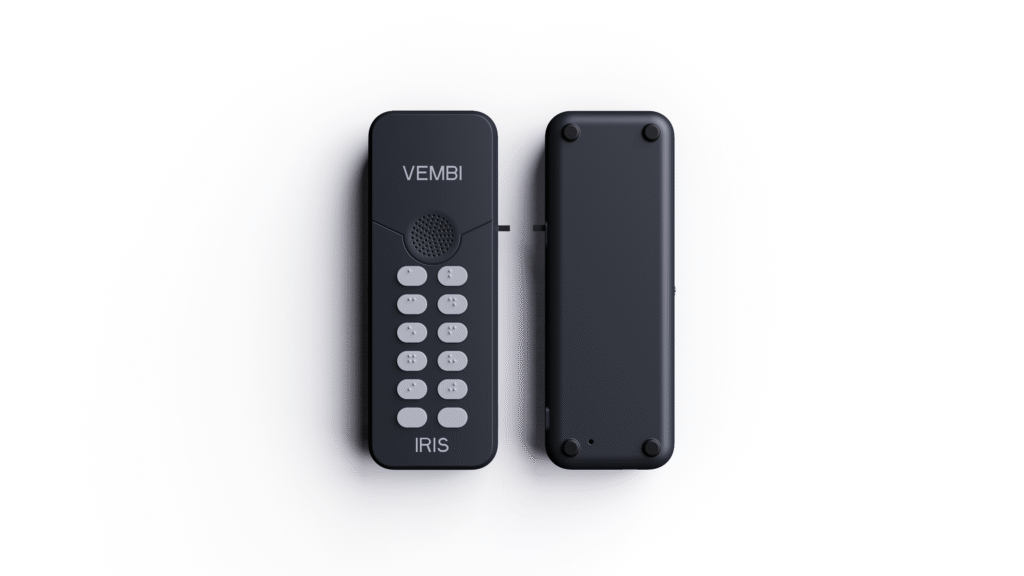
Iris was designed with only three injection-moulded parts:
- Top Cover – holds the integrated keytree.
- Bottom Cover – provides strength and closes the unit.
- Keytree – a single drop-in unit for all keys.
This design keeps tooling costs low, reduces assembly time, and avoids most post-moulding operations. The result is a device that is cost-effective to manufacture and easy to scale for schools.
OUTCOMES
Iris has already won recognition from Microsoft (AI4A Grant), the Government of Karnataka (Elevate 100), and the Young Social Entrepreneurs Award in Singapore. More importantly, it is making an impact in classrooms by:
- Enabling independent learning for thousands of visually impaired students.
- Allowing teachers to reach more learners with less effort.
- Closing the accessibility gap so children can study on equal terms with their sighted peers.