Designing the Perfect Puff
Our Solution
We designed an integrated nicotine device combining instant activation, consistent delivery, and sealed e-liquid containment.
The Result
A fully validated prototype delivered clean taste and premium differentiation, though launch was halted by regulation.
The Story
In 2017–2018, the global tobacco industry was in flux. Traditional cigarette sales were plateauing, and consumers were shifting toward new alternatives: e-cigarettes and nicotine pods. At the forefront was Juul Labs, which quickly captured over 70% of the U.S. market by 2018 with its sleek device and nicotine salts formula. Competitors like British American Tobacco (Vuse/Vype), Altria (Logic, and later Juul stake), Imperial Brands (Blu, Logic), and upstarts like NJOY and RELX rapidly followed suit.
Yet, Juul’s meteoric rise came with heavy controversy: lawsuits, government scrutiny, and global backlash over youth vaping and overdose. By 2018, regulatory pressure was reshaping the industry.
It was in this turbulent moment that one of Asia’s largest tobacco companies set out to design a disruptive alternative. The brief was clear:
- Compete directly with Juul, Vuse, Blu, and NJOY.
- Deliver lower nicotine concentrations, making it safer and more appealing in India’s conservative market.
- Ensure cleaner delivery with no liquid taste, solving one of the common consumer complaints.
Wrap it all in a stylish, premium device that could stand out in a crowded category.
THE CHALLENGE
Engineering Consistency, Safety, and Trust
The design challenge was threefold:
- Consistent nicotine/aerosol delivery — E-cigarettes are deceptively simple on the outside, but inside they require highly engineered airflow, heating, and fluid systems. The device needed instant response on inhalation, and uniform vaporization, and accurate nicotine release amid variable heating element supply.
- E-liquid containment — Preventing exposure/leakage of the liquids from the cartridge, especially no liquid carry-over into the mouth.
- Design differentiation — The market was flooded with plastic-bodied devices. The brand wanted something more premium, more personal, and instantly recognizable as a stylish accessory — not just a nicotine dispenser.
Meanwhile, India’s regulatory stance on vaping was uncertain. The looming risk of a ban added urgency: if this device launched, it needed to be category-defining.
THE APPROACH
Deep Engineering Meets Industrial Design
We designed the flawless puff from the ground up — blending style, with airflow and electronics.
Sensing without delay
We designed a precision airflow pathway with a strategically placed differential-pressure diaphragm sensor. The result: instant heating response the moment the user inhaled, with no lag. Intelligent airflow also meant consistent vapor volume and smoother throat feel.
THE PROCESS
Cartridge Design + Engineering
A transparent pod design showcased the nicotine liquid, with carefully engineered clarity and sealing. It wasn’t just for aesthetics; it allowed the user to see the liquid level at a glance, preventing the “dry hit” and burnt taste that occurs when the wick runs out of liquid.
Inside, we optimized the wick and heating coil construction to ensure that the e-liquid, absorbed by the wick via capillary action, is heated more evenly and rapidly. or liquid leakage.
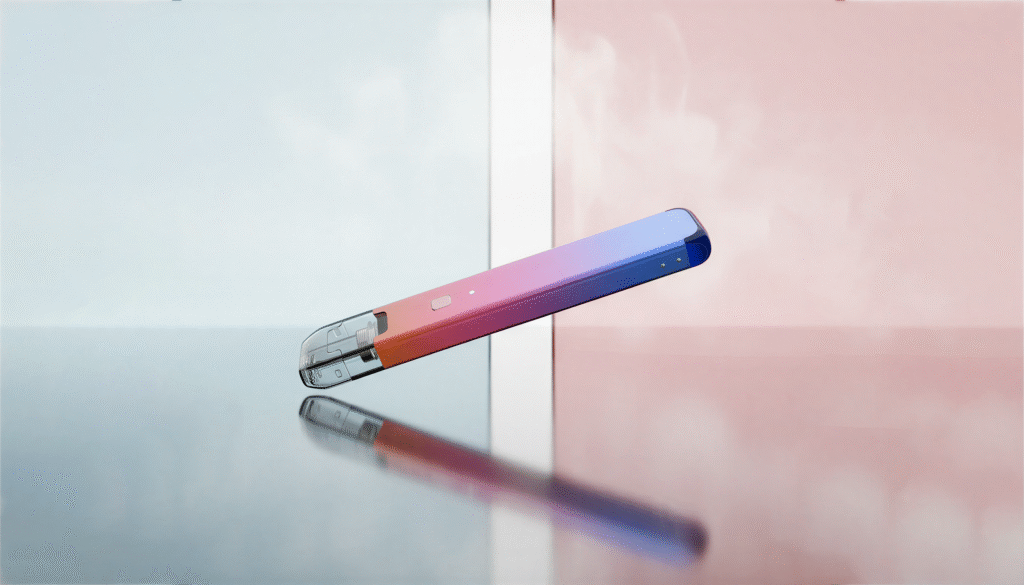
The pod clicked seamlessly into the body, maintaining hygiene and leak prevention.
To prevent the unpleasant taste of “raw” liquid, we optimized the interaction between the heating coil and the wick. The transparent cartridge was a masterclass in this. We used a custom-designed mesh-style heating element which offers a larger surface area than traditional spiral coils. This ensures that the e-liquid, absorbed by the wick via capillary action, is heated more evenly and rapidly. The wick material itself was a high-grade, porous cotton fiber chosen for its superior wicking properties and heat resistance. The transparency of the cartridge was a deliberate choice.
Materiality & Finish
We approached the product’s aesthetic not as a rigid container, but as a sensual object, an extension of the user’s hand. The decision to use an anodized aluminum shell was a pivotal one. It gave the device a jewelry-like feel, cooler to the touch, scratch-resistant, and premium enough to rival Juul’s minimalist design. We developed a palette of curated colors for the electrochemical process that were far from the mundane black or chrome of most e-cigarettes. These colors—think rich onyx, sophisticated champagne, and a bold cobalt blue—were designed to evoke a sense of modern luxury and personal style. Each color was a deliberate statement, transforming the device from a simple gadget into a chic accessory.
Every detail was tuned not just for performance, but to elevate the perception of e-cigarettes from a habit into a lifestyle accessory and EveryDay Carry (EDC).
Outcome and Reflection
The e-cigarettes were fully prototyped and tested — meeting the original goals of cleaner taste, instant delivery, and stylish appeal. Internal tests confirmed:
- No liquid taste in the mouth, a major advantage over early competitors.
- Lower nicotine concentration achieved satisfaction without harshness.
- Premium industrial design stood apart in a plastic-dominated market.
Unfortunately, before the product could be launched, the Government of India banned all forms of e-cigarettes in 2018, halting production and sales across the country.
The project never reached consumers — but it stands as an important milestone in our portfolio of high-stakes category innovations. It showcased how our unified approach to aesthetics and deep engineering could create a meaningful alternative in a regulated, fast-evolving market.