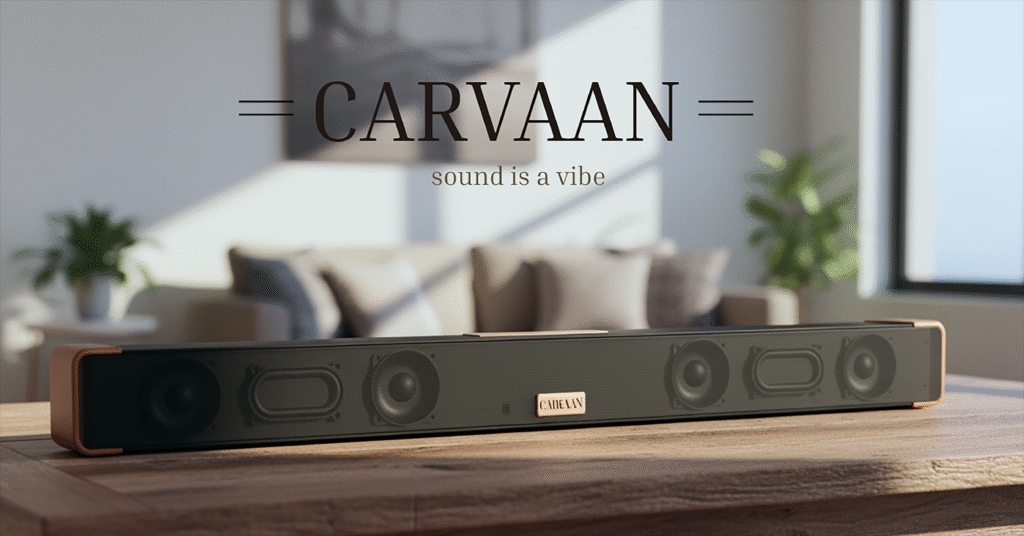
Sound is a Vibe
Our Solution
How we helped bridge an upstart manufacturer with a cultural behemoth to launch in the fastest selling home audio category
The Result
Oakter cemented not only its relationship with India’s oldest music label, but also its positioning as an ODM built on innovation.
The Story
In a world drowning in digital noise, where screens dominate our living spaces, Saregama is India’s oldest music label. A cultural behemoth that has reinvented itself as a lifestyle brand for the 21st century. Once HMV, today Saregama owns the world’s largest catalogue of Indian music across 14 languages, and had successfully built Carvaan into a beloved line of audio devices.
In 2021, the Sound Bar emerged as the fastest-selling home audio category in India, surpassing bulky music systems and reshaping living room entertainment. The market was crowded with sterile, black slabs from global giants like Sony and Bose, and a sea of generic, price-driven, distribution-led brands. SaReGaMa’s legendary music catalog, a treasure trove of Indian heritage, deserved a device that’s not just a gadget, but a soulful cultural accessory.Â
They turned to Oakter, an agile Indian ODM known for delivering millions of PayTM point-of-sale devices. Oakter, in turn, brought us in at Bang Design to imagine, engineer, and industrialize the Carvaan Sound Bar.
THE CHALLENGE
Music as Living Room Culture: Form, Function, and Feeling
The soundbar occupies a place of pride, resting directly beneath the TV in the living room. It’s a central object, it must be more than just functional; it must contribute to the aesthetic of the space. It should feel like a piece of furniture, a part of the home, not an alien object.Â
Â
The design brief was clear:Â
- it needed to be mass-manufacturable,Â
- reflect music and premium quality, andÂ
- remain affordable, targeting a price point of around INR 7,000.
OUR PROCESS
Process-Driven Aesthetics: Engineering for the Human Touch
Our analytical approach began with a deep dive into the constraints and opportunities of the chosen manufacturing processes. The housing was designed in extruded PVC, chosen for its affordability and clean linearity—perfect for a product that visually mirrors the geometry of modern flat-screen TVs. The key was to design the form around the process, not fight against it.
Tolerance Management:
Secondary Machining Integration:
Design for Affordability:
The target retail price was INR 7,000—a razor-thin margin in a market dominated by MNCs. We eliminated unnecessary processes and minimized part count, sandwiching electrical hardware between structural plastics in a way that reduced assembly time and consumables per unit. Every decision—materials, fastening, finishing—was tested against both performance and affordability.
Installation Reimagined, The Effortless Mount:
The Sound Bar was designed for effortless wall mounting. A simple guide rail allows any workman to fix it to the wall; the device then slides onto the rail and locks with a single fastener. No complex brackets, no fussy alignment—just intuitive design for Indian homes.
THE APPROACH
Program Execution
Oakter needed speed. We moved quickly from industrial design to engineering validation (DVT) and pilot validation (PVT) within compressed timelines, iterating hand-in-hand with Oakter as requirements evolved, to launch in time for the festival sales. Our approach mirrored an in-house extension of their team, rolling with changes while maintaining manufacturability.
THE RESULT