Iridium: Satellites and the ground layer economics
The Ground Layer is Where the Money Lives
In 1993, two analysts proposed a constellation of 840 broadband satellites operating in Ka-band spectrum. The idea was considered, in the parlance of the time, half-crazy. The aerospace establishment operated on certainties that appeared immutable: rockets were expendable, contracts were cost-plus, and space access remained a bespoke service for governments and broadcasters. The economics of putting nearly a thousand satellites in low Earth orbit to serve consumer internet belonged to the realm of science fiction.
Three decades later, the half-crazy idea has become the structural foundation of a $260 billion economy. But the money is not where the rockets are. The space economy operates as a two-layer value stack. The space layer, launch services and satellite manufacturing, generates roughly $20 billion in annual revenue. The ground layer, services and equipment, generates $260 billion. This asymmetry is the first principle that explains everything else. Satellites are not the product; they are the infrastructure. The product is connectivity, and connectivity is consumed by ground-based devices: chips running software, connected via networks, operating anywhere on the planet.
SpaceX understood this hierarchy earlier and more completely than its competitors. While legacy aerospace treated launch as the business, selling rides to orbit at $25,000 to $30,000 per kilogram, SpaceX recognized launch as the input cost for a connectivity service. By driving launch costs down to $2,500 per kilogram with Falcon 9, and targeting $200 per kilogram with Starship, SpaceX is not merely winning a market; it is attempting to transform the physics of infrastructure economics. The bet is that by reducing the cost of orbital access by two orders of magnitude, the company can unlock demand elasticity greater than one, expanding the addressable market from a $260 billion niche to the projected $1 trillion space economy by 2040.
This is not a linear scaling problem. It is a vertical integration play that inverts the traditional aerospace model. The margins accrue not to the launch provider selling commoditized rides, nor to the satellite manufacturer assembling hardware, but to the entity controlling the connectivity service layer. Starlink, SpaceX’s broadband constellation, is the economic engine. The rockets are merely the capital expenditure required to build it.
Launch is a Loss Leader for Connectivity
The central tension in SpaceX’s business model is whether to treat launch as a revenue center or as captive demand. Every Falcon 9 that lifts off with a Starlink satellite aboard represents a choice: that rocket could have carried a commercial payload at market rates, generating immediate cash flow and high margins. Instead, SpaceX fills its own capacity at marginal cost, effectively subsidizing Starlink’s deployment with foregone launch revenue.
This creates a strategic bind that grows more acute as the company scales. If SpaceX maximizes launch revenue by selling to external customers at premium prices, it strandscapacity, ockets sit idle while competitors capture the connectivity market. If it maximizes enterprise value by feeding Starlink, it cannibalizes its own launch business and requires sustained capital investment in a service layer with uncertain payoff timing. The company has chosen the latter path, but the economics are precarious. Starlink must achieve monopoly or near-monopoly status in low Earth orbit (LEO) broadband before competitors achieve parity, or the launch subsidy becomes a permanent drain rather than a temporary investment.
The vertical integration solves one problem while creating another. Traditional launch providers face a capacity utilization dilemma: they must maintain expensive manufacturing and operational infrastructure to serve sporadic demand. Arianespace or United Launch Alliance builds rockets for specific missions, and if the manifest thins, fixed costs destroy margins. SpaceX avoids this by being its own demand source. When commercial customers delay payloads or regulatory approvals stall, Starlink satellites fill the gaps. This ensures high launch cadence, approximately twice per month, which maintains operational rhythm and drives down per-launch fixed costs.
However, this integration requires flawless execution on two separate complex systems simultaneously. If Starlink encounters capacity constraints or regulatory roadblocks, SpaceX cannot pivot to pure-play launch services without admitting that the connectivity bet has failed. Conversely, if launch reusability encounters technical limits, Starlink’s deployment costs balloon, destroying the service’s path to profitability. The two businesses are fused at the spinal cord. This is not diversification; it is a high-leverage monoculture.
The Machine That Learns From Explosions
The most underappreciated structural advantage in SpaceX’s portfolio is not the reusable rocket technology itself, but the feedback loop it enables. Every Falcon 9 landing generates telemetry on thermal stress, structural fatigue, fuel consumption efficiency, and guidance precision. Because SpaceX launches with high frequency, unmatched by any competitor, it accumulates operational data at a rate that compounds into an insurmountable lead.
This is a machine learning problem disguised as a hardware problem. Traditional aerospace contractors operated under cost-plus contracts where lower costs meant lower profits. They had no incentive to optimize. Their rockets were expendable, so flight data served only safety review, not iterative improvement. SpaceX treats each launch as an experiment in a continuous optimization cycle. The data feeds back into design and manufacturing, reducing refurbishment time, improving landing precision, and extending vehicle life. A rocket that can fly ten times is good; a rocket that can fly a hundred times requires a different organizational metabolism entirely.
This advantage is cultural and technical, but it functions as an economic variable. The cost curve in aerospace has historically been static because the learning curve was shallow. Manufacturing scale drove costs down slowly; operational learning was minimal. SpaceX has converted launch operations into a data-generation engine where marginal launches produce marginal improvements in unit economics. Competitors launching quarterly or annually cannot match this learning velocity. Blue Origin, despite comparable capital and talent, remains years behind because it has not achieved the launch cadence required to close the feedback loop.

The durability of this advantage depends on maintaining the cultural permission to fail publicly. Aerospace traditionally punished failure with program cancellations and congressional hearings. SpaceX treats failure as information. A landing explosion is not a disaster but a data point. This organizational psychology is expensive to replicate in legacy institutions where careers depend on risk avoidance. The feedback loop is therefore protected by a cultural moat as much as a technical one.
The Elasticity Assumption
Beneath the engineering triumphs lies a fragile economic assumption: that demand for space access is elastic. Elon Musk’s fundamental bet is that reducing launch costs from $20,000 to $2,500 to $200 per kilogram will unlock applications that do not exist at current price points. If this elasticity holds, the total addressable market expands faster than prices fall, allowing SpaceX to capture a growing share of a growing pie. If demand is inelastic, the space economy remains a fixed-size market, and SpaceX’s cost advantage becomes a temporary margin booster that expires when competitors match its technology.
The bear case is sobering. Railroads and fiber optics followed similar cost-reduction curves without creating new demand categories; they simply redistributed existing economic activity. If lowering launch costs tenfold merely shifts weather satellite contracts from geostationary orbit to LEO, or moves military communications from ground stations to space, the $1 trillion projection collapses. The market consolidates around the lowest-cost provider, but the provider captures no premium returns because the pie stopped growing.
SpaceX’s vertical integration is specifically designed to hedge against this risk. By owning Starlink, the company does not need new space-based industries to emerge; it only needs terrestrial connectivity demand to grow. The satellite broadband market is the elastic demand source, illions of devices requiring ubiquitous coverage. But this hedge creates its own dependency. If terrestrial 5G and 6G networks satisfy most connectivity needs, or if consumer willingness to pay for satellite broadband plateaus, Starlink becomes a stranded asset regardless of how cheaply its satellites reached orbit.
The Starship program is the ultimate test of the elasticity thesis. At $200 per kilogram, the cost structure approaches that of international freight shipping. If that price point fails to generate qualitatively new use cases, orbital manufacturing, space-based solar power, lunar mining, then the space economy is fundamentally inelastic. SpaceX would remain the dominant launch provider, but it would be a utility, not a platform. The margin compression would be severe, and the Starlink investment would face an extended period of negative cash flow without the explosive growth required to justify it.
When Satellites Become Traffic Lights
Even if demand proves elastic, SpaceX faces a structural constraint that terrestrial infrastructure avoids: the physics of orbital mechanics create fixed capacity cells. Starlink operates as a blanket coverage system; once a satellite is in orbit, it covers everything beneath its path, including oceans and unpopulated deserts. This creates a utilization problem. In Washington State, Starlink must serve demand across approximately 200 orbital cells, each with fixed throughput. If demand concentrates in Seattle while eastern Washington remains sparse, the system faces congestion in some cells and stranded capacity in others.
This is not a software problem. It is a constraint imposed by the geometry of LEO constellations and the limitations of Ka-band spectrum. High-frequency bands provide the bandwidth necessary for broadband but cannot penetrate buildings or vehicles without line-of-sight. Lower frequencies penetrate obstacles but carry minimal bandwidth. Starlink has optimized for bandwidth over penetration, which limits its highest-value use cases.
The tension manifests in pricing strategy. If Starlink maintains premium pricing to manage congestion in high-density cells, it limits market penetration and invites competitors. If it prices for mass adoption, it risks oversubscription and service degradation. The company must choose between becoming a high-margin niche provider for rural exclaves or a low-margin utility battling capacity constraints. This determines whether Starlink realizes a $100 billion valuation or approaches the trillion-dollar scale of major telecommunications infrastructure.
The mobility market, connected vehicles and aircraft, exacerbates this tension. These use cases require electronic steering antennas and integrated panels rather than the consumer dishes currently deployed. They represent higher revenue per user but also higher technical requirements and spectrum competition. If automotive manufacturers adopt Starlink as primary connectivity, the capacity constraints become binding immediately. If they do not, Starlink remains a fixed-broadband alternative to fiber in areas where fiber will eventually arrive.
Inverting the Axioms
The economic architecture of SpaceX rests on a series of inversions of established aerospace axioms. Musk examined the fundamental assumptions of the industry, that rockets must be expendable, that cost-plus contracts align incentives, that failure must be avoided at all costs, and inverted each one. This was not merely innovation; it was a different accounting of risk and capital.
Traditional aerospace treated reliability as the absence of failure, achieved through exhaustive ground testing and conservative design cycles. SpaceX treats reliability as the product of high-cadence iteration, where rapid testing in operational environments produces robustness faster than simulation. This is a capital efficiency strategy. A company that destroys four prototypes to achieve a working fifth spends less than a company that spends a decade perfecting the first prototype before flight. The culture of public failure and rapid iteration is not bravado; it is a method for compounding learning per dollar spent.
The shift from cost-plus to fixed-price contracting similarly altered the incentive landscape. Under cost-plus, contractors maximize profit by maximizing cost. Innovation that reduces expenses reduces revenue. SpaceX’s fixed-price model aligns cost reduction with margin expansion. Every dollar saved on refurbishment is a dollar captured as profit. This created the organizational focus on reusability that competitors lack not because they cannot engineer reusable rockets, but because their economic models punish efficiency.
This cultural variable directly affects returns. The machine learning feedback loop, the tolerance for rapid iteration, and the vertical integration of manufacturing and operations all derive from this inversion of risk accounting. Legacy aerospace companies could technically replicate Falcon 9; they cannot replicate the organizational metabolism that produced it without dismantling their existing cost structures and contract relationships. The advantage is structural, not technological.
The Starship Moment
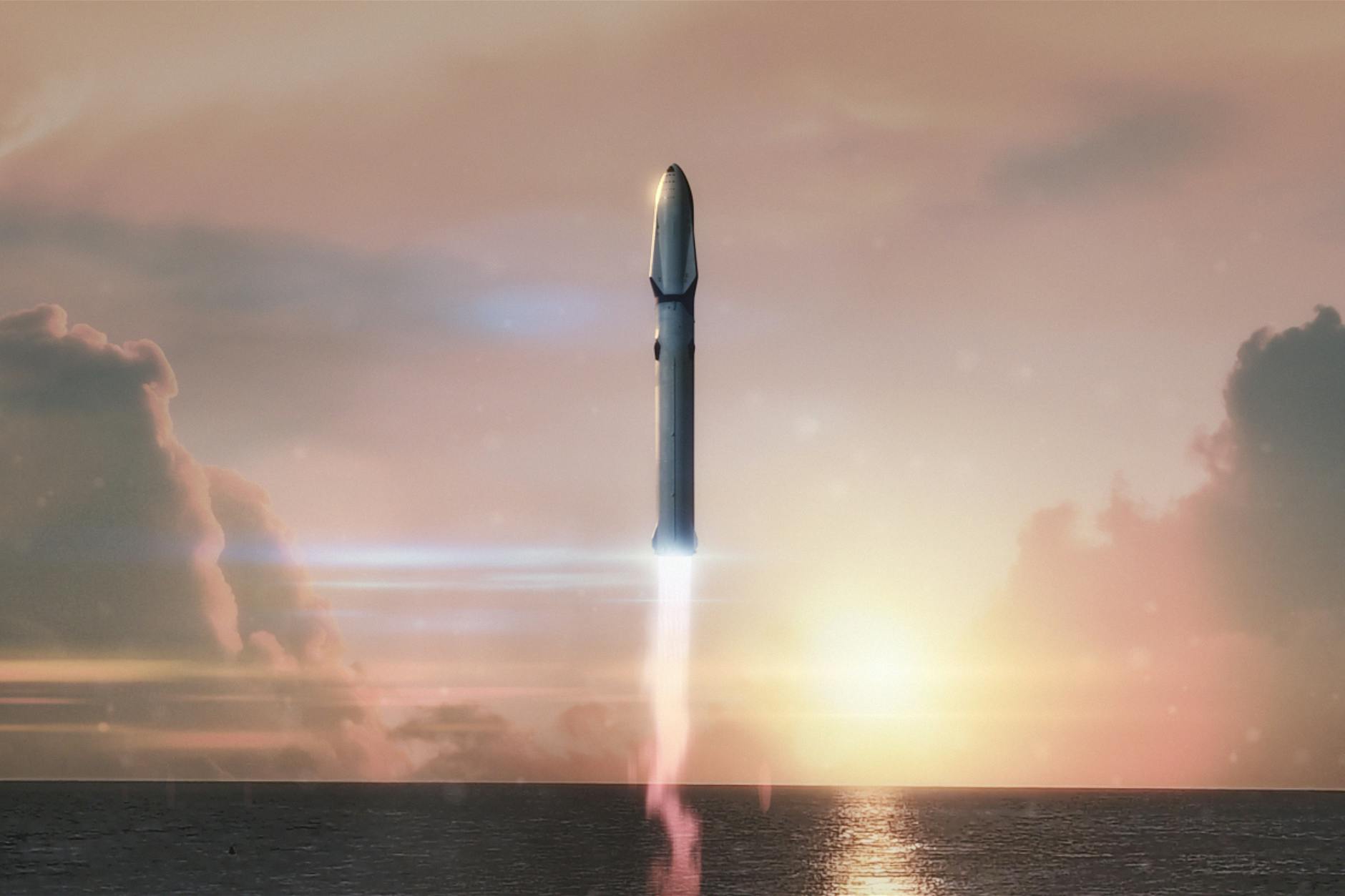
We are now at the inflection point where these tensions resolve or compound. Starship represents the attempt to drive launch costs below $200 per kilogram, an order of magnitude below Falcon 9. If successful, it validates the elasticity assumption and enables the deployment of Starlink’s second-generation satellites at a scale that saturates global coverage before competitors achieve critical mass. It completes the vertical integration cycle by making launch so cheap that the connectivity service becomes effectively a software margin business.
If Starship fails, f refurbishment costs exceed projections, if landing precision requires unsustainable operational overhead, if structural degradation limits reuse cycles: he model plateaus. SpaceX remains a successful launch provider with a costly side business in broadband. The cost advantage over competitors narrows. The feedback loop slows as launch cadence drops. Starlink faces capacity constraints without the satellite deployment velocity required to solve them.
The space economy is therefore in a peculiar moment. The ground layer already dominates the value stack, suggesting that infrastructure services, not launch hardware, will capture the long-term rents. SpaceX has positioned itself to own both layers, using one to subsidize the other in a flywheel that either creates a monopoly or collapses under its own weight. The outcome depends on whether the demand curve bends as the cost curve falls, hether lowering the price of access to the heavens actually opens them, or merely empties them faster.
The Physics of the Blanket
The geometry of Starlink’s coverage creates a paradox that terrestrial networks avoid. Because LEO satellites orbit at roughly 550 kilometers rather than 35,786 kilometers in geostationary orbit, they move relative to the ground. Each satellite sweeps across a cell, handing off connections to the next vehicle in the constellation like a relay race. This movement enables low latency but creates the blanket coverage problem: a satellite cannot choose where it provides service. When a Starlink satellite passes over the Pacific Ocean, it broadcasts capacity that no one uses. When it passes over Seattle, it faces demand that exceeds its throughput.
In Washington State, the system divides the territory into approximately 200 orbital cells. Each cell has fixed capacity determined by the number of satellites in view, the bandwidth of the Ka-band spectrum, and the physics of spectrum reuse. If Starlink sells subscriptions uniformly across the state, it must price for the congested cells or throttle service. If it prices for rural subscribers in eastern Washington, it invites oversubscription in Seattle. If it raises prices to manage Seattle congestion, it excludes the rural market that represents its theoretical competitive advantage over fiber.
This is not a temporary bottleneck solvable by launching more satellites. Each orbital plane has a fixed capacity ceiling determined by interference management. Satellites in adjacent cells cannot use the same spectrum without creating noise, so the system relies on spatial separation and time-division multiplexing. The result is a hard cap on density. In Manhattan or central Tokyo, Starlink could theoretically face demand that outstrips supply by orders of magnitude, forcing the company to choose between becoming a premium service for the wealthy or a degraded service for the masses.
The frequency choice compounds this constraint. Starlink uses Ka-band (26.5–40 GHz) because it offers the bandwidth necessary for broadband speeds. But Ka-band signals cannot penetrate buildings, foliage, or vehicle roofs. They require line-of-sight to the sky. This limits the service to fixed installations with clear sightlines, ural homes with user terminals mounted on rooftops, or vehicles with specialized flat-panel antennas. The highest-value use case, ubiquitous mobility, requires either lower frequencies that sacrifice bandwidth or expensive electronic steering arrays that track satellites as the vehicle moves.
Here lies the tension that could pivot the entire business model. If the primary demand comes from connected vehicles and aircraft, the moving devices that cannot be served by fiber, the company must abandon the consumer broadband market or accept that it cannot serve both masters. Electronic steering antennas cost thousands of dollars today, not the hundreds that consumer terminals require. The market bifurcates: a high-margin enterprise service for airlines and automakers, or a low-margin consumer utility for rural exclaves. The $1 trillion valuation requires serving both simultaneously, but the physics of spectrum and orbital mechanics may forbid it.
The Competitor’s Impossible Math
While SpaceX fills its rockets with Starlink satellites, its competitors face a capital allocation problem that has no solution. Consider the position of Amazon’s Project Kuiper or OneWeb. To compete with Starlink, they must build a constellation of comparable size: oughly 3,000 to 12,000 satellites. To launch these satellites, they need rockets. If they purchase launches from SpaceX, they fund their competitor’s capacity expansion while paying prices that include SpaceX’s margin. If they build their own launch capability, as Blue Origin attempts with New Glenn, they must spend billions on development while operating at a fraction of SpaceX’s launch cadence, meaning their learning curve remains flat while SpaceX compounds.
This is the stranded capacity trap. A launch provider without captive demand must price launches to cover fixed costs across sporadic missions. If the manifest dries up, the cost per launch balloons. SpaceX avoids this by ensuring that even if every commercial customer defects, Starlink provides sufficient volume to maintain operational rhythm. Competitors cannot replicate this without simultaneously building a constellation and a launch service, a capital requirement that exceeds $20 billion and requires a decade of negative cash flow.
The chicken-and-egg problem is insurmountable for legacy aerospace. Boeing or Lockheed Martin could theoretically build a reusable rocket, but their organizational structures are optimized for cost-plus contracting where failure is punished and innovation is rewarded with higher future costs. Their supply chains consist of thousands of subcontractors optimized for bespoke, low-volume production. To match SpaceX’s cost structure, they would need to dismantle their profit mechanisms, alienate their existing customer base (the U.S. government, which prefers expensive reliability), and bet the company on a market that may not exist.

Even well-capitalized private competitors face the cadence barrier. Blue Origin has spent two decades and billions developing New Shepard and New Glenn, yet launches remain annual events rather than monthly. Without the feedback loop of high-frequency operations, they cannot optimize refurbishment, identify failure modes, or drive down marginal costs. They are trapped in a static optimization problem, designing the perfect rocket before flight, while SpaceX solves the dynamic optimization problem of learning from flight. The gap widens exponentially, not linearly, because each SpaceX launch generates data that improves the next, while each competitor launch merely validates the previous design.
The Railroad Parallels and the Elasticity Mirage
History offers cautionary precedents for the assumption that cost reduction creates demand. The transcontinental railroads of the 1860s and 1870s reduced freight costs by 90 percent, yet the railroad companies largely failed as investments. The demand for transcontinental shipping existed, but the capacity expansion exceeded it. Railroads faced the same blanket coverage problem as Starlink: they had to maintain track across sparsely populated plains to connect the coasts, generating stranded capacity in the interior. They subsidized unprofitable routes with profits from dense corridors, but eventually competition on the dense routes drove rates down industry-wide. The result was bankruptcy cycles that consolidated the industry into a regulated utility.
Fiber optics followed a similar trajectory. The laying of transoceanic cables in the late 1990s reduced bandwidth costs by orders of magnitude, creating the assumption that demand would expand to fill the capacity. Instead, the market experienced a glut. Prices collapsed faster than volume grew, and carriers faced bankruptcy because they could not differentiate their product. The bandwidth became a commodity, and the value accrued to the applications layer, Google, Amazon, Netflix, rather than the infrastructure owners.
SpaceX argues that space is different because of the vertical integration into Starlink. But Starlink itself risks becoming the fiber optic glut of the 2020s. If competitors launch constellations simultaneously, or if terrestrial 5G advances sufficiently to serve rural markets, the price of satellite connectivity collapses. Unlike fiber, where the marginal cost of transmitting an additional bit approaches zero, satellites have hard capacity constraints. Once a cell is full, the operator cannot add capacity without launching more satellites, which requires launch windows and orbital slots. The pricing power disappears just as the capital requirements peak.
The bear case on demand elasticity suggests that the space economy remains a zero-sum game. Lower launch costs simply shift the same revenue between providers. Governments will always need weather satellites; broadcasters will always need geostationary relays; the military will always need secure communications. Reducing the cost to orbit does not create new governments or new militaries. It merely allows SpaceX to capture market share from Arianespace and Roscosmos. The $1 trillion projection assumes that entirely new industries emerge, orbital manufacturing, space-based solar power, lunar mining, but these remain speculative at $2,500 per kilogram, let alone the $200 target. If they do not materialize, SpaceX becomes the most efficient provider of a stagnant market, earning utility returns on aerospace capital.
The Sword Above the Orbit
Beyond the economics of demand lies a regulatory fragility that no amount of engineering can solve. Starlink operates in Ka-band spectrum allocated by the Federal Communications Commission and the International Telecommunication Union. This allocation is not permanent. It is a license subject to political pressure from terrestrial broadband providers who view Starlink as a threat to their rural subsidies and spectrum holdings. Verizon and AT&T maintain lobbying operations precisely to limit satellite encroachment on frequencies that could be repurposed for 5G or 6G terrestrial networks.
If regulators impose power limits or allocate competing spectrum to other operators, Starlink’s capacity constraints tighten further. The system relies on aggressive frequency reuse and tight beam-forming to serve dense areas. Regulatory restrictions on beam power or frequency allocation would reduce the effective capacity per cell, accelerating the congestion problem.
More acute is the risk of space debris and collision. Starlink currently operates over 5,000 satellites. At full deployment, it plans 42,000. Each satellite carries propulsion to de-orbit at end-of-life, but failures occur. A single collision in LEO generates thousands of debris fragments that cascade into further collisions: he Kessler Syndrome. If a Starlink satellite collides with a defunct Russian satellite or a piece of Chinese anti-satellite test debris, the regulatory response could freeze launch approvals. The FCC or international bodies could mandate de-orbiting requirements, collision insurance, or strict liability for debris generation that increases operational costs by an order of magnitude.
The geopolitical dimension compounds this. Starlink provides service to Ukraine during wartime, making the constellation a military asset. If China or Russia perceives Starlink as a threat to their information sovereignty, they may jam signals, deploy anti-satellite weapons, or pressure international regulators to deny spectrum rights. The constellation’s very success makes it a target. Unlike undersea cables, which are difficult to attack without attribution, satellites are visible and vulnerable. A single successful attack on a Starlink satellite could trigger insurance crises and regulatory shutdowns that strand billions in capital in orbit.
Manufacturing Scale Versus Operational Excellence
The Starship program represents a bet that reusability, not manufacturing scale, drives unit economics. Traditional aerospace achieved cost reduction through production lines, uilding more expendable rockets to amortize fixed tooling costs. SpaceX bets that building one rocket that flies a hundred times beats building a hundred rockets that fly once. But this requires solving problems that have never been solved at scale.
Refurbishment economics remain unproven at the target cadence. Falcon 9 requires weeks of inspection and component replacement between flights. Starship targets relaunch within hours or days. This requires flawless landing precision to avoid structural stress, rapid propellant loading without ice buildup, and thermal protection systems that survive reentry without degradation. If refurbishment requires disassembly, inspection, and replacement of heat tiles or engine components, the cost savings evaporate. The labor and facility costs of processing a rocket ten times may exceed the manufacturing cost of ten new rockets.

The tension between manufacturing and operations manifests in capital allocation. SpaceX could build Starships faster, accepting higher depreciation in exchange for operational redundancy. Or it could perfect rapid reuse, accepting lower inventory in exchange for higher asset utilization. The latter requires operational discipline that no aerospace company has maintained. Airlines achieve high utilization through massive maintenance infrastructures and standardized procedures refined over decades. SpaceX must invent this discipline for vehicles that experience forces and thermal loads that destroy conventional aircraft.
If the reusability thesis fails, if Starships require months of refurbishment, or if structural fatigue limits vehicles to ten flights rather than a hundred, SpaceX faces a margin crisis. At that point, it must revert to manufacturing-heavy operations, competing with Blue Origin and others on production efficiency rather than operational learning. The cost curve flattens, the feedback loop slows, and the vertical integration advantage narrows. The company becomes a traditional aerospace manufacturer with a sideline in internet service, rather than a platform that redefines both industries.
The Cannibalization Clock
The final tension resolves around timing. SpaceX currently sells launches to commercial customers at prices that imply scarcity. It maintains a backlog of missions for communications satellites, military payloads, and science missions. But every commercial launch represents a lost opportunity to deploy Starlink infrastructure. As Starlink grows, the incentive to cannibalize external revenue intensifies. At some point, SpaceX must choose: be the world’s launch provider, or be the world’s connectivity provider.
If it chooses connectivity, it risks alienating the commercial customers who funded its development. Satellite operators who today book Falcon 9 flights may tomorrow face a competitor that controls their access to orbit. SpaceX could refuse to launch competing constellations, inviting antitrust scrutiny, or charge monopoly prices, inviting regulatory intervention. If it chooses launch, it slows Starlink deployment, allowing Amazon Kuiper or Chinese competitors to capture the connectivity market.
This is not a distant concern. The Starship capacity will be so large, potentially 100 tons to orbit per flight, that a single launch could deploy hundreds of Starlink satellites. The marginal cost of filling that capacity with internal payloads approaches zero, while the opportunity cost of selling it externally includes not just the launch revenue but the delay in network expansion. The rational economic choice is to refuse external customers, but this transforms SpaceX from a commercial launch service into a closed ecosystem, vulnerable to the same regulatory and competitive pressures that destroyed the integrated monopolies of the Gilded Age.
The clock is running. Every month that competitors survive without achieving reusability is a month SpaceX extends its lead. But every month that Starlink consumes launch capacity without achieving profitability is a month the company burns cash that external launches would have provided. The vertical integration that created the advantage becomes the liability that consumes it. The space economy will be determined by which curve flattens first: the cost curve, or the demand curve. If the former, SpaceX owns the infrastructure layer of the twenty-first century. If the latter, it has built the most efficient mechanism for delivering capital into orbit, where it will remain, circling the Earth in decaying orbits, waiting for a demand that never arrived.
The depreciation schedule of a Starlink satellite, approximately five to seven years before atmospheric drag forces de-orbit, creates a capital replacement cycle that differs fundamentally from terrestrial infrastructure. Fiber optic cables last decades; cellular towers endure for thirty years. But each Starlink satellite is a depreciating asset with a terminal velocity. If the demand curve flattens while the constellation requires replenishment, SpaceX faces a cash flow trap: it must continue launching at $2,500 per kilogram to maintain network integrity, but without the revenue growth that justifies the maintenance capex. The constellation becomes a treadmill where each replacement launch merely preserves existing capacity rather than expanding it.
Consider the mathematics at maturity. A 12,000-satellite constellation with a five-year lifespan requires 2,400 launches annually just to maintain constellation size. Even at SpaceX’s marginal cost, assuming Starship achieves $200 per kilogram, that represents billions in annual maintenance capital. If Starlink’s subscriber base plateaus at twenty million users paying $100 monthly, the revenue supports the replacement cycle but leaves no margin for the Starship development costs or the Mars colonization fund that justifies SpaceX’s private valuation. The business becomes a utility with utility returns, barely covering its depreciation.
This is the hidden fragility of the blanket coverage model. Unlike terrestrial networks that can defer maintenance in low-demand areas, orbital mechanics do not permit selective neglect. Satellites decay regardless of utilization. A cell over the Pacific Ocean requires the same replacement cadence as a cell over New York, even if the former generates zero revenue. The fixed cost of maintaining ubiquitous coverage becomes an anchor if the elasticity assumption fails, dragging the enterprise into a cycle of capital consumption that ends only when the final satellite burns up in the atmosphere.