
Mineral Resources: The Hidden Infrastructure Play

The Misclassification Premium
At a market capitalisation of roughly $12 billion, Mineral Resources Limited sits in a peculiar valuation gap. By the numbers, it is a mid-tier mining concern with exposure to lithium, iron ore, and natural gas, ommodities that trade on cycles of fear and greed, attracting multiples of four to six times earnings. Yet buried inside this classification is InfraCo, an infrastructure division generating nearly $1 billion in annual EBITDA on fixed-fee, volume-based contracts that reset with 95 percent retention rates and stretch across decades. In any other context, these are annuity-like earnings, the kind that command enterprise values of ten to fifteen times EBITDA. If InfraCo stood alone, it might reasonably be valued at $10 billion to $12 billion. Which implies that the market is currently pricing MinRes’s mining assets, three of the world’s lowest-cost lithium hard rock operations, a major iron ore development, and natural gas interests, at something close to zero, or perhaps less.
This is not a market error in the conventional sense. The conflation is structural. MinRes reports as a single entity, files as a miner, and is covered by mining analysts who model commodity price decks. The infrastructure earnings are interwoven with mining economics, and the company’s founder, Chris Ellison, has shown no interest in the clarity of a split. For the sophisticated observer, however, the misclassification creates an arbitrage. The business is not a mining company with an infrastructure kicker. It is a capital allocation engine that manufactures high-multiple infrastructure assets from low-multiple mining cash flows, then selectively monetises them to fund further acquisitions. The engine works only because the market refuses to see it clearly. The moment the market fully recognises the infrastructure value, the pressure to separate the two divisions would sever the mechanism that creates that value in the first place. MinRes is a paradox: it is undervalued because it is misunderstood, and it must remain misunderstood to continue creating value.
The Anti-Asset
To understand how MinRes builds infrastructure at one-third the capital intensity and half the timeline of its competitors, one must look at what the company does not report. Roughly one-third of MinRes’s employees work in construction and design. They generate no direct revenue. They do not appear as a profit centre on any segmental disclosure. They are, in accounting terms, a cost pool attached to capital projects. Yet this internal design-build capability is the single most durable advantage the company possesses.
The standard model in Australian mining is to outsource engineering, procurement, and construction to EPC contractors. BHP and Rio Tinto, MinRes’s largest potential competitors and customers, operate this way by default. The process is sequential, committee-driven, and risk-averse. It treats each project as a bespoke undertaking, requiring extensive tendering, interface management, and external coordination. MinRes inverts this. Its construction teams work in continuous workflows, accumulating tacit knowledge about Western Australian geology, logistics, and labour management that no contractor can replicate. The result is not merely faster building; it is a different category of asset economics. When MinRes builds a crushing and processing facility, it does so with an intimacy of operational intent that ensures the infrastructure runs 30 percent more efficiently on 12-hour shifts than comparable assets run by the majors.
This efficiency is not an abstract metric. It translates directly into the renewal rates of InfraCo’s contracts. MinRes does not merely construct infrastructure for its own Mining Co division; it operates crushing, screening, and handling infrastructure for BHP, Rio Tinto, and other third parties. These customers do not renew at 95 percent rates because they are loyal. They renew because MinRes’s operational intensity, its ability to move more tonnes per hour with fewer interruptions, makes it cheaper to retain the incumbent than to bring the capability in-house or switch to a competitor. The construction division, despite generating no revenue, is the reason InfraCo commands premium pricing and sticky contracts. It is an anti-asset: valuable precisely because it is invisible on the balance sheet and irreplaceable in the field.
Manufacturing Multiples
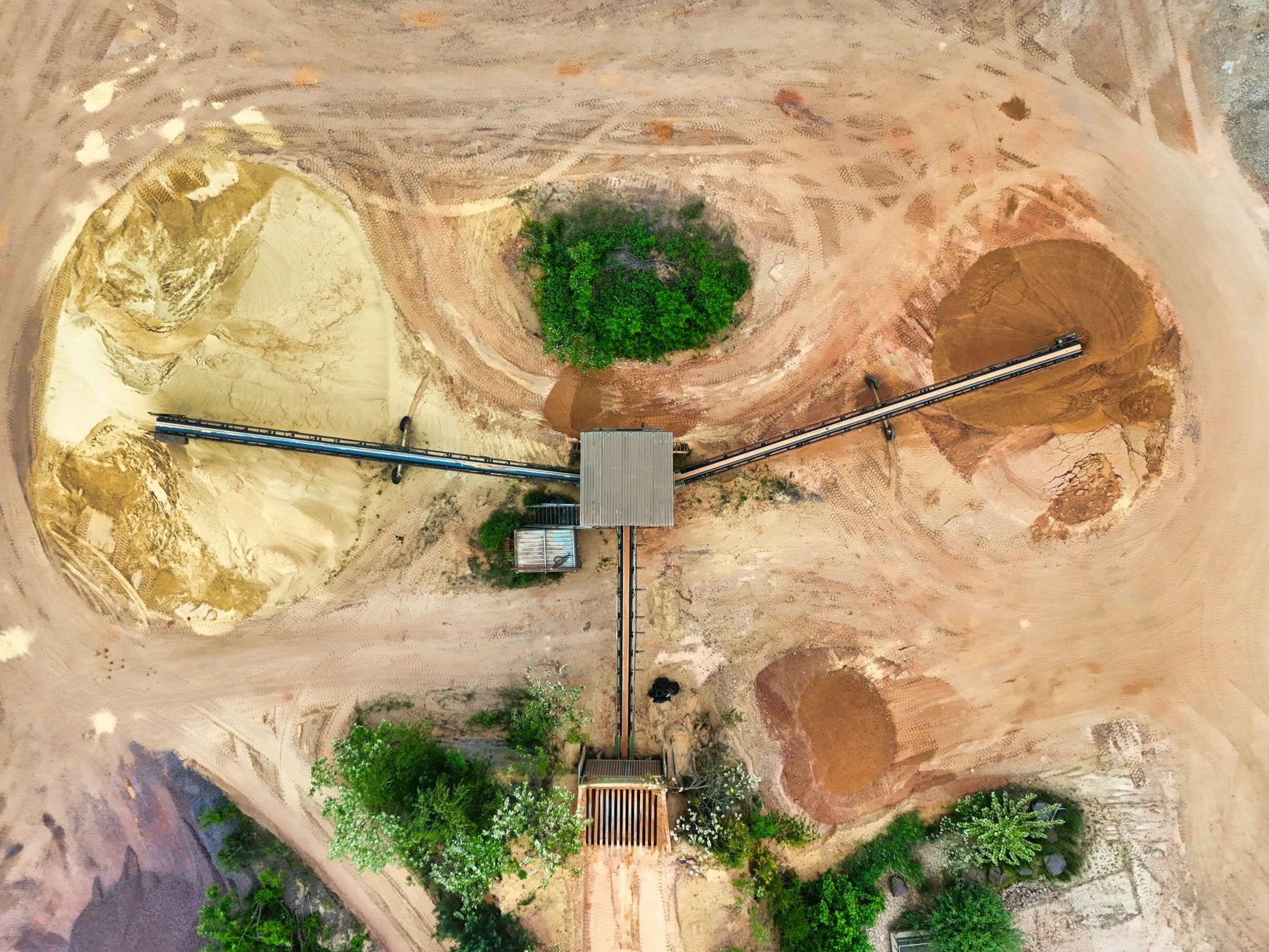
The economic engine depends on a specific sequence of transactions that Chris Ellison has refined over three decades. First, Mining Co acquires distressed or undervalued commodity assets, often from administration or forced sellers. These are not exploration plays; they are advanced projects that have stalled due to capital constraints or managerial failure. Second, the internal construction capability builds the necessary infrastructure rapidly and cheaply, transforming the project from a stranded resource into a cash-generating operation. Third, InfraCo takes ownership of the infrastructure on fixed-fee contracts with Mining Co, creating the stable, high-multiple earnings stream. Fourth, and crucially, MinRes periodically sells minority stakes in these InfraCo projects to external capital at infrastructure multiples of ten to fifteen times EBITDA.
The Onslow iron ore project illustrates the mathematics. Mining Co committed $800 million in capital to develop the mine, which is expected to generate $1 billion in annual EBITDA. InfraCo committed $1.7 billion to build the associated crushing and export infrastructure, expected to generate $560 million in annual EBITDA. MinRes then sold a minority stake in the InfraCo project, realising $1.2 billion in post-tax proceeds for roughly $140 million of annual EBITDA. The transaction converted a 30 percent return on invested capital project into an 80 percent-plus ROIC outcome. The proceeds funded further Mining Co acquisitions, repeating the cycle.
This is not financial engineering in the pejorative sense. It is a form of industrial arbitrage. The market values mining cash flows at four to six times because they are exposed to lithium price crashes, iron ore gluts, and natural gas volatility. It values infrastructure cash flows at ten to fifteen times because they are insulated from commodity prices through fixed-fee-per-tonne contracts. MinRes occupies the narrow space between these two valuations, converting the volatile into the stable through vertical integration and operational velocity. The flywheel compounds because each rotation generates surplus capital at multiples that far exceed the cost of acquiring the next mining asset.
The Liquidity Paradox
The model contains a self-defeating temptation. If InfraCo is truly worth $10 billion to $12 billion standalone, and if Mining Co is volatile and cheap, the obvious corporate finance solution is to separate the two. Activist investors have circled MinRes precisely for this reason. A split would unlock the infrastructure multiple, allowing InfraCo to trade as a pure-play contract operator while Mining Co retains the commodity exposure. Shareholders would realise an immediate re-rating.
Ellison has resisted this pressure because separation would destroy the mechanism. The integration is not incidental to the strategy; it is the strategy. Mining Co provides InfraCo with a captive customer base that de-risks initial construction and guarantees utilisation during ramp-up. Without Mining Co, InfraCo would compete for third-party contracts on the open market against the internal capabilities of BHP and Rio, losing the volume certainty that justifies the initial capital deployment. Conversely, without InfraCo’s construction capability, Mining Co would pay EPC premiums and lose the 30 percent efficiency advantage that keeps its assets on the low end of global cost curves. The vertical integration is what allows MinRes to build infrastructure at prices no competitor can match, then operate it at efficiencies no contractor can sustain.
There is a second, subtler tension. Selling minority stakes in InfraCo projects, necessary to realise the high multiples and fund further acquisitions, erodes the compounding earnings base. Each stake sale improves reported ROIC and returns capital to shareholders, but it reduces the recurring EBITDA that justifies the infrastructure valuation in the first place. Hold the assets, and the company lacks the liquidity to pursue distressed mining acquisitions. Sell too aggressively, and InfraCo becomes a hollowed-out shell, unable to demonstrate the growth trajectory that attracts infrastructure investors. MinRes must navigate a narrow channel: selling enough to prove the valuation arbitrage exists, but retaining enough to maintain the integrated flywheel. It is a balancing act that requires precise calibration of capital hunger against long-term earnings quality.
Ellison as Operating System
The dependency on Chris Ellison is not a governance footnote. It is a central economic variable. Ellison founded MinRes in 1992 with $10,000 and an undrawn credit card. He retains 12 percent ownership and remains chief executive. Over thirty-two years, he has constructed a personal network for sourcing distressed assets, a reputation for construction discipline, and a corporate culture that operates as a productivity instrument. This is not charisma as management style; it is specific operational architecture.
MinRes operates its own airline to fly workers to remote sites. It owns a resort in the Pilbara to house them. It employs Michelin-trained chefs in its camp kitchens. These are not perks. In the labour-scarce environment of Western Australian mining, they are mechanisms for reducing turnover, increasing shift intensity, and maintaining the 30 percent efficiency advantage over BHP and Rio. The cost of the airline is less than the cost of labour attrition. The cost of the resort is less than the cost of construction delays. Ellison’s innovations in workforce management are capital expenditures disguised as hospitality.
More critically, Ellison is the capital allocation algorithm. The decision to acquire a lithium mine from administration at one times annual EBITDA, or to commit $800 million to Onslow during a market downturn, or to sell a 25 percent stake in an InfraCo project rather than a 49 percent stake, hese are not committee decisions. They are judgments made by a founder who has spent three decades understanding the replacement cost of Australian mining infrastructure and the cyclical psychology of commodity markets. The 28 percent compounded annual return since IPO is not the result of sectoral luck. It is the result of a specific decision-making framework that pairs contrarian asset acquisition with operational execution speed.
This presents the fragility. The business model assumes Ellison’s continued involvement in sourcing deals and determining the timing of InfraCo stake sales. There is no evident succession plan that replicates his network or his discipline. Institutionalising the process risks bureaucratising it; committees do not acquire assets from distressed sellers at midnight auctions. Yet personal dependence creates key-man risk of the most severe kind. If Ellison departs, the deal flow likely dries up, the construction discipline may relax, and the capital allocation flywheel stalls. The market discounts MinRes for this dependence, but the discount is paradoxical: the dependence is why the premium exists.
The Commodity Foundation
For all the elegance of the infrastructure arbitrage, Mining Co remains the foundation. It generates roughly $2 billion in annual EBITDA, and it is fully exposed to the cycles of iron ore, lithium, and natural gas. MinRes positions these assets on the low end of global cost curves, but low-cost does not mean immune. A sustained lithium price collapse driven by oversupply from Chinese conversion capacity, or an iron ore price sustained below $50 per tonne, would not merely reduce Mining Co earnings. It would impair the cash flows that fund InfraCo’s growth projects.
The strategic tension is acute. During commodity booms, the temptation is to over-invest in Mining Co, acquiring assets at inflated prices and stranding capital when the cycle turns. During busts, the risk is under-investment, starving InfraCo of the project flow it needs to demonstrate growth to infrastructure investors. MinRes must maintain Mining Co as a cash generator through downturns, even as it resists the urge to double down during peaks. This requires a discipline that runs counter to the instincts of most mining executives, who tend to confuse high commodity prices with managerial genius.
The model also assumes that Mining Co assets will remain on the low end of cost curves. This is not guaranteed. New entrants with superior geology, or technological breakthroughs in processing, could erode MinRes’s position. The lithium assets, in particular, depend on hard-rock mining economics that compete with South American brine operations and emerging clay deposits. If the cost curve shifts, Mining Co becomes a drag rather than a feeder, and the capital allocation flywheel loses its fuel source.

Institutionalising the Arbitrage
The long-term question for MinRes is whether the arbitrage can survive its creator. The company has demonstrated that vertical integration creates value in Australian mining, but it has not demonstrated that this integration can be maintained by an institutionalised management team. The construction capability, the workforce culture, and the capital allocation discipline are all, currently, extensions of Ellison’s personal operating system.
There are precedents for founder-dependent models transitioning successfully, but they typically involve codifying decision rules rather than replicating personal genius. MinRes would need to systematise the process of evaluating distressed assets, the metrics for determining when to sell InfraCo stakes, and the operational standards that maintain the 30 percent efficiency advantage. This is possible, but it is dangerous. The moment the company creates a capital allocation committee, the speed advantage disappears. The moment it outsources construction oversight to external consultants, the cost advantage erodes.
The market’s confusion, valuing MinRes as a miner when it is, in essence, an infrastructure manufacturer, provides the company with strategic optionality. It can acquire mining assets cheaply because it is not competing with infrastructure funds for valuations. It can sell infrastructure stakes dearly because it is not burdened by mining’s cyclical stigma. This optionality depends on the persistence of the misunderstanding. If the market fully recognises the infrastructure value and forces a separation, the arbitrage collapses. Mining Co would lose its construction advantage; InfraCo would lose its captive customer. The whole would become less than the sum of its parts.
MinRes is therefore a bet on sustained complexity. It requires the market to remain partially blind, the founder to remain actively engaged, and the commodity cycles to remain sufficiently benign to fund the next rotation of the flywheel. It is a machine for converting volatility into stability, but the machine itself is volatile, ependent on the irreplaceable judgment of its architect and the continued tolerance of investors who cannot quite decide whether they own a miner or a utility. In that ambiguity lies the return.
The third-party InfraCo revenue exposes MinRes to a subtle but lethal competitive dynamic. Roughly one-third of the infrastructure division’s earnings, approximately $330 million of the projected $1 billion EBITDA, comes from servicing BHP, Rio Tinto, and other external miners. These are not arm’s-length transactions between equals. They are relationships between a specialised operator and vertically integrated giants who possess the balance sheets to replicate MinRes’s capabilities should they choose to. The current equilibrium depends on a calculation by the majors that outsourcing remains cheaper than internalisation, given MinRes’s 30 percent efficiency advantage and the capital intensity of building competing crushing and handling networks.
But equilibrium is not destiny. BHP and Rio have observed MinRes’s design-build model for two decades. They have watched the construction timelines compress and the capital intensity drop. At some point, the economic logic shifts. If MinRes’s efficiency advantage narrows, through wage inflation, construction cost escalation, or operational drift, the majors face a different calculation. They could internalise the capability, accepting higher capital intensity upfront to capture the long-term margin that currently flows to MinRes. Or they could demand rate reductions, using the threat of internalisation as leverage in contract renewals.
The fragility lies in the learning curve. MinRes has accumulated three decades of tacit knowledge about Pilbara geology, dust management, and labour logistics. This knowledge is embedded in teams, not patents. BHP and Rio could, over a five-year period, poach key MinRes construction managers, replicate the airline-and-resort workforce model, and build internal crushing divisions. They have not done so because the opportunity cost of capital has favoured outsourcing. But if MinRes’s margins become too wide, or if the majors face their own pressure to verticalise supply chains, the outsourcing decision reverses.
The contract structure provides only partial protection. While 75 percent of InfraCo contracts will extend beyond five years within the next two years, and retention rates exceed 95 percent, these statistics describe historical behaviour, not contractual obligation. The contracts are fixed-fee-per-volume, not take-or-pay. They contain performance clauses and termination provisions for convenience with notice periods. A major customer could exit, not through breach, but through non-renewal, forcing MinRes to find replacement volumes in a market where the other potential customers are already served or are the very competitors seeking to internalise.
The renewal cliff is particularly acute for the third-party book. Unlike Mining Co contracts, where MinRes controls the mine plan and can guarantee volumes to the infrastructure, third-party contracts depend on the customer’s production decisions. If BHP suspends an iron ore pit due to geology or economics, the associated crushing contract volumes drop regardless of MinRes’s operational excellence. The fixed-fee structure insulates against commodity price moves, but not against geological surprises or strategic shifts by the major miners.
This creates a capital allocation paradox. InfraCo must invest heavily in third-party capability to demonstrate growth to infrastructure investors, yet every dollar invested in third-party assets faces obsolescence risk if the majors internalise. Conversely, investing only in Mining Co captive infrastructure preserves the integrated model but limits the addressable market and invites scrutiny about whether InfraCo is truly a growth business or merely a captive service division. Ellison has threaded this needle by using third-party contracts as learning laboratories, testing new crushing technologies on BHP volumes before deploying them to Mining Co assets, but this strategy assumes the majors remain willing to serve as uncompensated R&D partners.
The operational culture that sustains the 30 percent efficiency advantage warrants closer examination as an economic variable, not a human resources footnote. MinRes operates an aviation division, a luxury resort in the Pilbara, and camp kitchens staffed by chefs trained in Michelin-starred restaurants. These appear as eccentricities, founder indulgences typical of Australian mining booms. They are better understood as fixed capital investments with specific return profiles.
The aviation division eliminates dependency on commercial charter operators who serve multiple miners and prioritise schedule reliability over MinRes’s operational tempo. By controlling the air bridge, MinRes ensures that shift changes occur precisely when the processing plant requires staffing, not when a charter company has aircraft available. The resort, complete with spa facilities, fine dining, and single-room accommodation, reduces workforce turnover in a region where labour competition is fierce. In Western Australia’s Pilbara, replacing a trained processing plant operator costs approximately $50,000 in recruitment, training, and lost productivity. If the resort reduces annual turnover by ten percentage points across a workforce of several thousand, it generates $50 million in retained human capital annually. The capital cost of the resort, amortised over its useful life, is less than the annual savings from reduced attrition.
The Michelin-trained chefs serve a similar function. Mining camp food is typically mass-produced, high-calorie fuel designed for physical labour. MinRes treats it as productivity infrastructure. Well-fed workers make fewer errors on 12-hour shifts. They sustain concentration through the final hours when fatigue typically causes processing inefficiencies. The food cost differential between a MinRes camp and a standard FIFO operation is perhaps $20 per employee per day. Spread across thousands of workers, this is $20 million annually. If the quality differential reduces plant downtime by two percent, avoiding crushing circuit interruptions caused by operator error, the return exceeds the cost by an order of magnitude.
These are not benefits. They are operational technologies disguised as hospitality. They are also non-replicable by competitors without cultural commitment. BHP and Rio could theoretically build resorts and hire chefs, but they would do so through procurement committees, sustainability reports, and union negotiations. MinRes does so as an extension of Ellison’s personal philosophy that labour is a precision instrument requiring specific maintenance. The culture is the moat, but it is a moat that drains if the founder’s attention wavers or if the company attempts to professionalise it through standardised HR policies.
The lithium exposure introduces another underappreciated tension. MinRes operates three of the world’s largest hard-rock lithium mines, all joint ventures with Albemarle and Ganfeng. The output flows exclusively to China’s battery supply chain. This is not diversification; it is concentration dressed as portfolio breadth. While the company claims low-cost positioning, hard-rock lithium mining remains inherently more energy-intensive and capital-intensive than South American brine operations. The cost advantage depends on high spodumene grades and efficient processing, dvantages that erode if Chinese chemical converters develop appetite for lower-grade feedstock or if direct shipping ore economics collapse.
The joint venture structures create additional complexity. MinRes does not control offtake decisions. Albemarle and Ganfeng determine where the spodumene travels and at what effective price, through transfer pricing mechanisms that obscure true market realisation. If Chinese lithium prices collapse, as they did in 2023, falling 80 percent from peaks, MinRes’s mining economics deteriorate rapidly despite the low-cost positioning. The company cannot pivot to European or North American markets because the infrastructure is built for Chinese specifications. It cannot stockpile inventory indefinitely because the joint venture agreements require continuous production to maintain offtake rights.
Moreover, the lithium assets sit within Mining Co, the volatile four-to-six-multiple division, yet they require InfraCo infrastructure to move ore to port. If lithium prices fall below cash costs, currently around $450 per tonne for MinRes’s operations, though this varies with energy and diesel inputs, the mines curtail production. Unlike iron ore, where MinRes owns the full chain and can adjust mine plans to preserve infrastructure utilisation, lithium curtailment idles InfraCo assets with no alternative customers. The crushing circuits at Wodgina or Mt Marion cannot pivot to process iron ore if lithium demand evaporates. They are single-purpose assets with stranded cost risk.
The natural gas interests compound this concentration. While marketed as a diversification into energy transition fuels, the assets expose MinRes to domestic Australian gas price volatility and regulatory risk around domestic reservation policies. Unlike iron ore, which exports globally, Australian gas is increasingly trapped in a local market with price caps and political scrutiny. The returns appear stable until they do not, and they provide no synergy with the core lithium and iron ore infrastructure networks.
The institutionalisation challenge becomes acute when examining specific decisions Ellison has made that no committee would replicate. Consider the acquisition of the Bald Hill lithium mine from administration in 2019. The asset was bankrupt, burdened with offtake agreements to Chinese converters at uneconomic prices, and surrounded by sceptical creditors. Ellison acquired it for approximately one times annualised EBITDA: ffectively paying for the plant and equipment while receiving the resource for free. A standard due diligence process would have flagged the offtake agreements as fatal flaws. Ellison saw them as renegotiable because he understood the Chinese converters’ dependency on consistent spodumene supply more deeply than the administrators did. He was correct; the agreements were restructured within eighteen months, and the asset now generates substantial cash flow.
Or consider the timing of the Onslow InfraCo stake sale. MinRes sold $140 million of EBITDA for $1.2 billion post-tax in 2022, at the peak of infrastructure valuation enthusiasm, just as interest rates began rising and before the iron ore price softened. The transaction captured a 15-times multiple on assets that, if retained, would now face refinancing pressure in a higher-rate environment. Ellison sold high to buy low, deploying the proceeds into lithium assets trading at distressed valuations during the 2023 price crash. This is not portfolio theory; it is cycle timing based on thirty years of observing where capital flows concentrate and where it flees.
To institutionalise this requires encoding not just rules but instincts. A successor would need to recognise when Chinese lithium converter distress creates buying opportunities in Western Australia. They would need to sense when infrastructure investors are paying irrational multiples for yield and when miners are panic-selling assets. These are not competencies that transfer through standard operating procedures. They require presence in the market, relationships with distressed lenders, and the credibility to close deals in compressed timelines without full committee approval.
The bear case, then, is not merely a commodity price downturn. It is a simultaneous failure of the flywheel’s multiple components. Imagine a scenario: lithium prices remain below $400 per tonne for three years, forcing curtailment at Mining Co’s lithium assets and idling the associated InfraCo crushing circuits. BHP, observing MinRes’s operational drift without Ellison’s daily involvement, decides to internalise its crushing capabilities, non-renewing contracts worth $300 million in annual InfraCo EBITDA. The remaining InfraCo assets, deprived of third-party learning and Mining Co volume growth, see their efficiency advantage narrow to 10 percent above peers rather than 30 percent. Contract renewals, still at 95 percent on paper, occur with 15 percent rate reductions to retain the business.
In this scenario, MinRes cannot execute the stake-sale arbitrage because infrastructure investors, observing volume declines and customer concentration, refuse to pay ten-times multiples. The company is left holding mining assets valued at four-times depressed EBITDA and infrastructure assets losing pricing power. The $12 billion market capitalisation, predicated on the integrated premium, collapses toward the sum of the parts: oughly $6 billion to $8 billion. The debt accumulated to fund Mining Co acquisitions during the boom becomes burdensome. The airline and resort, no longer justified by workforce scarcity, become stranded cost centres rather than productivity tools.
This is not a prediction. It is a stress test of the model’s dependencies. The business requires four conditions to hold simultaneously: commodity prices must remain above cash costs for Mining Co assets; BHP and Rio must continue outsourcing rather than internalising; Ellison or his equivalent must remain active in capital allocation; and the market must continue mispricing the integrated entity. The failure of any one condition damages returns. The failure of two or more breaks the model.
The longevity of the misclassification premium, MinRes trading at mining multiples despite infrastructure earnings, depends on analytical inertia as much as structural integration. Mining analysts cover the company because it files as a miner, mines commodities, and speaks the language of grade, strip ratios, and resource ounces. Infrastructure analysts ignore it because it reports mixed segments and carries commodity risk. This analytical gap is structural. It persists because the company’s investor relations strategy, deliberately or not, avoids the clarity that would force a re-rating. Ellison does not host infrastructure-style investor days emphasising contract durations and renewal rates. He discusses mining projects, commodity markets, and volume growth. The communication strategy reinforces the misclassification.
Yet this is rational. If MinRes were successfully reframed as an infrastructure company with mining exposure, the valuation would rise, but the strategic optionality would narrow. The company would face pressure to divest Mining Co, spin out InfraCo, and become a pure-play contract operator. It would lose the ability to acquire distressed mining assets using infrastructure-derived capital. The premium would be realised and simultaneously destroyed. Better to remain obscure, valued imperfectly but strategically unconstrained.
The final tension lies in the temporal mismatch between contract durations and capital cycles. InfraCo’s 95 percent renewal rates and five-year contract terms suggest stability, but the contracts roll in waves. Within two years, 75 percent of the book will require renewal. While historical retention is high, each renewal event is a pricing negotiation in current market conditions. If BHP and Rio have built internal capability by then, or if new entrants like Fortescue’s infrastructure division have achieved scale, the renewal terms will reflect competitive pressure rather than historical relationships.
Moreover, the fixed-fee structure, while insulating against commodity prices, exposes MinRes to volume risk. The contracts pay per tonne processed, not per dollar of commodity value. If Mining Co’s lithium mines curtail due to low prices, or if BHP’s pits suffer geological setbacks, InfraCo revenues fall immediately. The infrastructure is not toll-road demand-insensitive; it is volume-sensitive to mining production decisions made elsewhere. The stability is conditional on continued mining activity, which is conditional on commodity prices, which means the infrastructure earnings are ultimately correlated to the cycle, merely with a lag and a dampener.
MinRes has navigated this by ensuring its Mining Co assets sit at the first quartile of global cost curves, making them the last to curtail in a downturn. But cost curves shift. New lithium supply from Africa, iron ore from Guinea, or natural gas from Qatar could push MinRes toward the margin faster than the company can reduce costs. The 30 percent efficiency advantage is against current competitors; it is not a guarantee against future geological or technological disruption.
In this light, the business is a high-wire act of capital timing. It requires continuous access to distressed mining assets to feed the infrastructure machine, continuous operational innovation to maintain the efficiency gap, and continuous ambiguity in market perception to prevent the strategic straitjacket of a pure-play valuation. The returns have been extraordinary, 28 percent compounded over eighteen years, but they depend on conditions that are historically specific to Western Australia’s mining boom, Ellison’s particular genius, and the slow adaptation of the major miners to vertical integration alternatives.
Whether those conditions persist for another eighteen years is the bet embedded in the $12 billion valuation. The market, by pricing MinRes as a miner, implies scepticism that the infrastructure premium is sustainable or separable. The company, by continuing to integrate and compound, implies confidence that the flywheel can rotate indefinitely. The truth lies in the tension between those positions, n the recognition that MinRes is neither fully a miner nor an infrastructure play, but a temporary organisational form that exploits the gap between those categories while it can. When the gap closes, through market education or strategic separation, the arbitrage ends. Until then, the ambiguity generates the return, and the return justifies the ambiguity.