Trader Joe’s: Why Cheap Wine Outsells Whole Foods
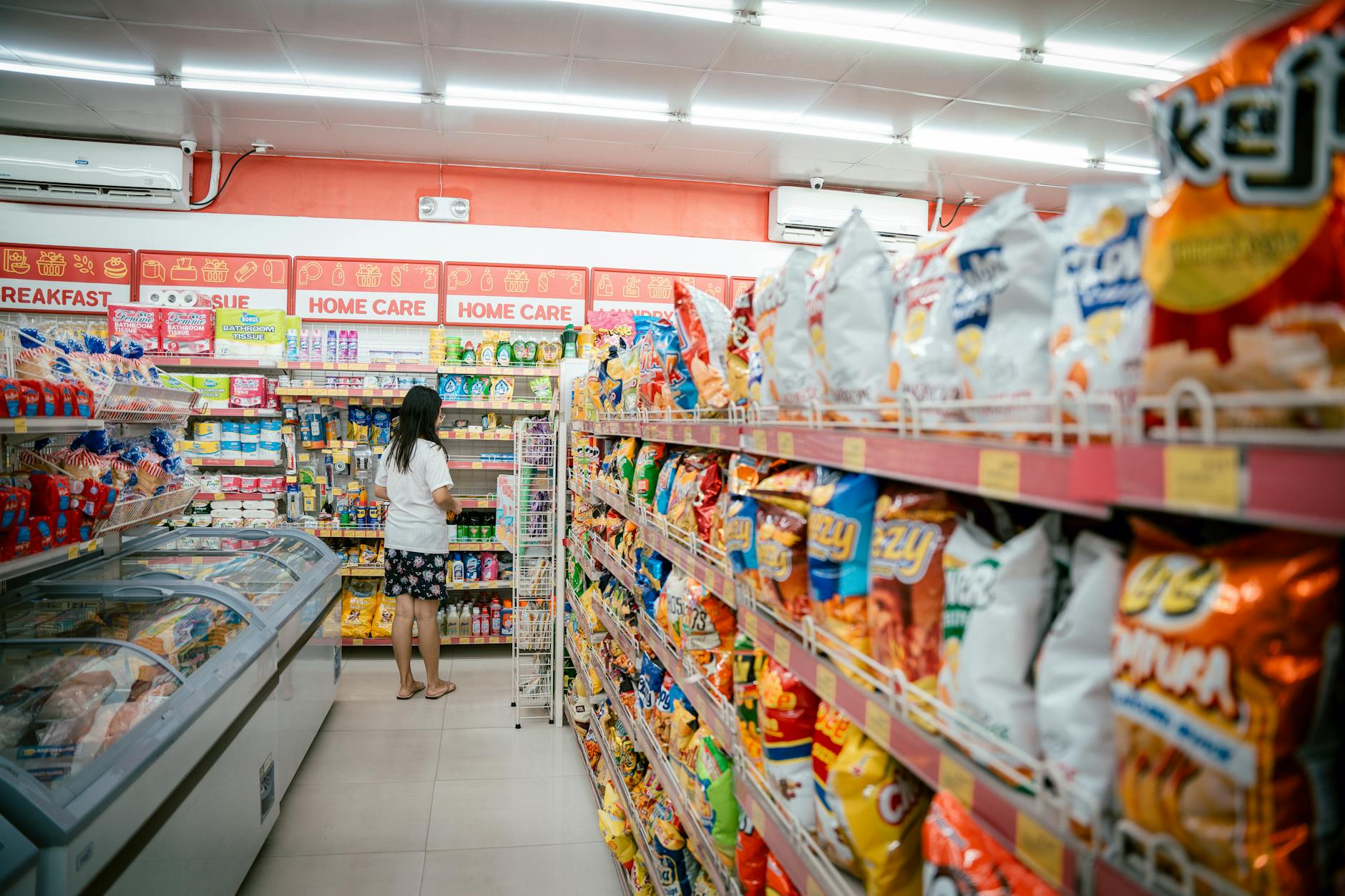
At a Trader Joe’s in Brooklyn, the line snakes through the entire store, ast the frozen palak paneer and the Two-Buck Chuck, past the hand-lettered chalkboards announcing “pocket coffees” and “everything but the bagel seasoning.” The building is perhaps ten thousand square feet, a postage stamp by modern retail standards, yet it generates roughly $1,800 in revenue per square foot annually. A conventional supermarket moves $400 to $600 through the same space. Whole Foods, the presumed competitor for the organic-conscious set, manages roughly half Trader Joe’s productivity.
The disparity is not explained by price. Trader Joe’s is cheap, but not cheapest; premium, but not luxurious. Nor is it explained by selection. The typical Kroger carries between 30,000 and 50,000 SKUs. Trader Joe’s stocks roughly 4,000. The store is an exercise in withheld inventory, a bet that customers will accept radical constraint in exchange for curation. This constraint is not merely operational preference; it is the central economic engine. By refusing to stock the vast majority of what consumers might want, Trader Joe’s eliminates the complexity that devours margins at conventional grocers. It sources directly from manufacturers, bypassing the consumer packaged goods (CPG) brands that extract tribute from competitors through trade spend. It pays wages high enough to reduce turnover to a trickle, converting labor from a variable cost into a fixed asset. The result is an estimated EBIT margin of 6 to 7 percent on roughly $15 billion in revenue, double the profitability of Kroger, achieved while opening only one or two new stores per year.
The model depends on a specific customer: educated, well-traveled, and underpaid. Joe Coulombe founded the chain in 1967 after operating Pronto Markets in Southern California, recognizing that the postwar expansion of higher education and the democratization of air travel had created a cohort of young professionals with sophisticated palates and thin wallets. They could appreciate the difference between a Sancerre and a Sauvignon Blanc, but they could not yet afford the former. Coulombe’s insight was that this demographic did not want choice; they wanted someone else to have made the choice for them, preferably with a sense of adventure and a price tag that suggested thrift rather than deprivation.
Trader Joe’s is therefore a machine designed to extract value from constraint. The question is whether the constraints that generate its returns will eventually calcify into liabilities.
The Efficiency of Refusal
Conventional grocery operates on a theory of abundance. The megastore model assumes that capturing the marginal customer requires carrying the marginal SKU: he specific brand of gluten-free pasta, the obscure hot sauce, the regional soda. Each additional product is justified by the revenue it might capture, while the costs of carrying it, shelf space, inventory management, supplier negotiations, spoilage, are treated as overhead to be optimized rather than eliminated. The result is a operational thicket. A typical supermarket manages tens of thousands of supplier relationships, promotional calendars, and planogram resets. The labor hours consumed by stocking, rotating, and tracking this inventory are substantial and largely invisible on the income statement.
Trader Joe’s solves this by refusing to participate. The 4,000-SKU cap is enforced with monastic discipline. Where a competitor might offer twelve varieties of peanut butter, Trader Joe’s offers two: its own, and perhaps one alternative. This is not a failure of assortment strategy but a radical simplification of the supply chain. With fewer products to manage, the company achieves velocity. Inventory turns faster, reducing working capital requirements and spoilage. Shelf space, freed from the tyranny of variety, can be allocated to high-price-per-cubic-meter categories: wine, specialty cheeses, prepared foods. The store becomes a curated exhibition rather than a warehouse, and the customer, relieved of the burden of comparison shopping, buys more per visit.
The constraint is self-reinforcing. Because the store stocks only what its buyers deem worthy, it cannot accept slotting fees: he payments CPG giants like Procter & Gamble or Kraft Heinz make to secure shelf space. At conventional grocers, these trade spend budgets often exceed the retailer’s operating profit. The supermarket effectively rents its shelves to the highest bidder, becoming a landlord rather than a merchant. Trader Joe’s, by declining this revenue stream, is forced to make money on the merchandise itself. This aligns incentives: the product must sell on its own merits, not because a supplier subsidized its placement. The buyer becomes a curator with skin in the game, responsible for the turn rate of every item.
Competitors cannot easily replicate this. To slash SKUs to 4,000 would require terminating thousands of supplier contracts, weathering customer complaints about missing favorites, and rebuilding organizational culture around curation rather than logistics. It would mean forfeiting the trade spend that props up thin margins. For a publicly traded chain like Kroger or Albertsons, such a transformation would constitute a collapse in reported earnings before the benefits of simplification materialized. The SKU reduction is not merely a operational choice; it is a strategic moat built on the ashes of conventional grocery economics.
The Anti-Slotting Economy
The elimination of trade spend deserves closer examination, for it represents an inversion of the standard power dynamic between retailers and manufacturers. In the traditional model, the retailer provides real estate; the manufacturer provides product and marketing support. The manufacturer pays for end-cap displays, promotional pricing, and prime positioning. For many grocers, these payments are the difference between profitability and loss. The financial statements obscure this by burying trade spend in revenue rather than treating it as a reduction of cost of goods sold, but the economic reality is that the retailer is extracting rent from suppliers rather than serving customers.
Trader Joe’s does not accept these payments. It sources directly from manufacturers, often buying odd lots, surplus capacity, or private-label formulations that would not fit the national branding strategies of CPG conglomerates. A supplier might produce a high-quality cookie or frozen entrée that lacks the marketing budget to secure distribution at Walmart or Safeway. Trader Joe’s offers access to a dense, loyal customer base without the cost of slotting fees or trade promotion. The manufacturer wins on volume and margin; Trader Joe’s wins on exclusivity and cost.

This direct-to-source model collapses the middleman margin. Where a conventional grocer buys from a distributor who buys from a manufacturer, Trader Joe’s often buys from the factory floor. The savings are passed to the customer in the form of lower prices, but they also accrue to the bottom line. The estimated 6 to 7 percent EBIT margin, exceptional for a industry that averages 3 to 3.5 percent, derives largely from this structural advantage. The company does not need to mark up products as heavily because it is not subsidizing a vast apparatus of brand marketing and trade negotiation.
The durability of this advantage lies in the difficulty of replicating the buyer relationships. Trader Joe’s buyers operate with a degree of autonomy and expertise that is rare in retail. They travel extensively, sourcing charcuterie from Italy and frozen dumplings from Taiwan, negotiating directly with producers who may never have sold to an American retailer. This requires a organizational culture that tolerates eccentricity and accepts failure; a buyer who commits to a container of pineapple salsa that fails to sell must be able to absorb the loss without bureaucratic recrimination. Conventional grocers, with their centralized procurement and reliance on national brands, lack the infrastructure to manage such a decentralized, relationship-driven sourcing model. The advantage is not merely contractual but cultural.
Demographic Arbitrage
The economic engine only functions if the right customers show up. Coulombe’s original insight, hat the expansion of higher education and international travel had created a class of culturally sophisticated but financially constrained professionals, emains the bedrock of the model. The target customer is overeducated and underpaid: graduate students, junior associates, young architects, nonprofit workers. They possess the cultural capital to appreciate the difference between a mass-market wine and a small-batch vintage, but they lack the income to shop at Whole Foods without anxiety.
This demographic is valuable because of their price elasticity. They are not poor; they are simply not yet rich. They respond to value but reject the signaling of poverty. Trader Joe’s branding, witty copy in the Fearless Flyer, Hawaiian-shirted “crew members,” the aesthetic of maritime adventure, allows them to feel sophisticated while paying $3.99 for a bottle of wine. The store sells the experience of discovery without the cost of risk. If the frozen cauliflower gnocchi is disappointing, the financial loss is minimal; if it is delightful, the customer feels clever for having found it.
The targeting creates geographic constraints. These customers cluster in dense urban areas near universities and professional centers: Cambridge, Berkeley, Brooklyn, Silver Lake. They do not live in exurban sprawl. Trader Joe’s therefore requires high-density real estate with expensive parking or no parking at all. The stores are small because the real estate is expensive, and the real estate is expensive because the customers are there. This is not a model that scales into suburban strip malls or rural markets. The attempt to expand beyond the core demographic, into areas where the median education level is lower or the median age higher, destroys the unit economics. The store becomes merely a small, oddly curated grocery with limited selection and no brands.
The fragility here is demographic drift. As the core customer ages into higher income brackets, they may graduate to Whole Foods or specialty butchers. Alternatively, if urban centers gentrify to the point where the “underpaid” professional can no longer afford to live nearby, the customer base disperses. The model assumes a perpetual replenishment of twenty-eight-year-olds with master’s degrees and roommates. If education stops expanding, or if remote work disperses the young professional class into suburban homes with attached garages and Costco memberships, the density advantage evaporates.
Labor as Fixed Cost
The in-store experience is the marketing department. Trader Joe’s spends almost nothing on traditional advertising, o television, no digital campaigns, no influencer partnerships. Brand awareness spreads through word-of-mouth and the physical environment. This requires employees who are engaged, knowledgeable, and present. The company achieves this by paying wages significantly above market rates for retail. While competitors staff at minimum wage or slightly above, Trader Joe’s maintains a compensation structure that reduces turnover to a fraction of the industry standard.
High wages are not a charitable impulse; they are an inventory strategy. In retail, turnover is expensive. The cost of hiring, training, and managing new employees often exceeds the cost of retaining existing ones by a factor of two or three. By paying more upfront, Trader Joe’s converts labor from a variable cost that fluctuates with turnover into a fixed cost that generates returns through productivity. Tenured employees know the products, can recommend wines, and move through the store with efficiency. The “Captains”, store managers, operate with unusual autonomy, ordering product and managing staff without the centralized micromanagement that characterizes larger chains.
The Hawaiian shirts and the chalkboard signs are not merely aesthetic choices; they are economic signals. They indicate that the staff is empowered to engage, that the store is not operating on a razor-thin staffing model where employees are timed on bathroom breaks. This environment attracts a specific type of worker, often overqualified, often pursuing other ambitions, who brings intellectual curiosity to the job. A employee with an anthropology degree can discuss the provenance of a cheese with genuine enthusiasm; this cannot be scripted or trained in a weekend seminar.
The risk is wage inflation. If labor markets tighten, or if competitors adopt similar wage strategies to attract workers, Trader Joe’s loses its recruitment advantage. The model assumes that the wage premium is sufficient to ensure low turnover and high engagement. If the premium erodes, either because Trader Joe’s cannot raise wages due to price constraints, or because competitors raise theirs, the operational advantage dissolves. The store becomes merely another pleasant place to work, rather than a destination employer that guarantees service quality.
Geographic Fidelity
The company opens roughly one to two stores per year. For a retail chain with the brand recognition and capital resources of Trader Joe’s, this pace is glacial. It suggests not a lack of ambition but a structural inability to grow quickly without destroying the model. Each store must be situated within the demographic density described earlier, and each must be profitable almost immediately. Trader Joe’s closes stores that underperform, ruthlessly exiting locations where the customer mix shifts or the real estate costs outpace sales.
This slow expansion is a form of capital discipline. By refusing to grow for growth’s sake, the company maintains site selection standards that protect unit economics. It also preserves the culture. Rapid expansion would require the standardization of buying practices, the dilution of the captain system, and the acceptance of suburban locations with lower sales per square foot. The private ownership structure, Trader Joe’s is owned by Aldi Nord, the German discount chain, allows this patience. There is no quarterly earnings call to justify expansion into marginal markets, no activist investor demanding store count growth.
The constraint creates a scarcity premium. In cities where Trader Joe’s has few locations, the stores are crowded, the lines are long, and the parking is impossible. This inconvenience is oddly beneficial; it signals popularity and exclusivity without requiring marketing spend. The customer who navigates the line feels they have accessed something valuable. If the company were to blanket the country with locations, this scarcity would evaporate, and the stores would become merely convenient, losing the event-quality that drives the high basket sizes.
The Digital Impasse
Perhaps the most significant tension facing the model is the absence of e-commerce. Trader Joe’s does not offer delivery. It does not partner with Instacart. It has no “click and collect” program. In an era when Amazon and Walmart are investing billions in last-mile logistics, this refusal appears as either stubbornness or blindness. It is neither; it is structural necessity.
The in-store experience is not merely a distribution channel; it is the product. The sampling stations, the discovery of seasonal items, the tactile browsing of the limited selection, hese cannot be replicated online. More importantly, the economics of online grocery fulfillment are incompatible with the Trader Joe’s model. The company achieves its margins through high sales per square foot and minimal labor cost per transaction. Online fulfillment requires warehousing, picking labor, and delivery infrastructure that would destroy the 6 to 7 percent margin. A Trader Joe’s delivery service would either lose money or require price increases that alienate the core demographic.
The risk is that consumer expectations shift. If the convenience of delivery becomes a non-negotiable table stake for grocery shopping, f the young professional who currently tolerates the line at Trader Joe’s decides that their time is better spent working from home and having groceries brought to their door: he model faces obsolescence. The company is betting that the experience of the store is sticky enough to overcome the convenience gap. This is a wager on human behavior: that discovery and serendipity will retain their value against efficiency. It is not obvious that this bet will win indefinitely.
The Curator’s Burden
The ultimate fragility lies in the dependence on curation. The 4,000 SKUs must be the right 4,000. The buyers must maintain their expertise, their relationships, their taste. As the company ages, and as the original generation of buyers retires, the transmission of this curatorial culture becomes uncertain. Can a organization with 500 stores and 50,000 employees maintain the idiosyncratic, founder-level judgment that characterized its early decades?
Moreover, the demographic target is unstable. The “overeducated and underpaid” are, by definition, in transition. They are training for careers that will eventually pay more, or they are aging into different consumption patterns. The model assumes that there will always be a new cohort of twenty-somethings with sophisticated tastes and constrained budgets. If higher education becomes less universal, or if the trajectory of professional wages changes such that the underpaid remain underpaid into middle age, the positioning may shift from aspirational to depressing.
There is also the question of wage pressure. The labor model depends on maintaining a significant premium over competitors. If minimum wages rise substantially, or if the tight labor market forces competitors to match Trader Joe’s compensation, the advantage in service quality and retention disappears. The store becomes indistinguishable from any other well-run grocery, except with fewer brands and no delivery.
Trader Joe’s has built a $15 billion business by ignoring most of what modern retail considers essential: variety, national brands, rapid growth, digital presence, and low wages. It succeeds not despite these omissions but because of them. The constraint is the strategy. Yet constraints that create value can become cages when the environment shifts. The model is a delicate equilibrium between curation and convenience, between density and expansion, between wages and margins. It works beautifully until it doesn’t.
The company will likely remain private, patient, and small in footprint. It will continue to open one or two stores a year, to pay above market, and to refuse delivery. It will remain the grocer to the overeducated and underpaid, serving them frozen mandarin orange chicken and cheap wine until they graduate to other stores, or until they decide that the line is no longer worth the wait. The economics of refusal are powerful, but they are not eternal.
The economics of refusal are powerful, but they are not eternal.
The Suburban Demographic Trap
The geographic constraint operates with more precision than simple urban density. Trader Joe’s requires a specific threshold of educational attainment and cultural capital per square mile. A neighborhood must contain sufficient numbers of people who recognize Manchego as a word denoting value rather than pretension, who understand that “Two-Buck Chuck” is a joke and a bargain simultaneously. This is not mere affluence; it is a particular texture of urban professional life. The stores cluster near research hospitals, graduate schools, and government centers, laces where credentials outpace earnings.
Expansion into suburban markets presents a mirage of growth. The real estate is cheaper, the parking abundant, the demographics seemingly affluent. But suburban affluence operates differently. The household with a $150,000 income in a exurban development does not shop like the $45,000-earning research assistant in a walk-up apartment. The former values efficiency, bulk, and brand recognition; the latter values discovery and signaling. When Trader Joe’s opens in suburban locations, as it occasionally has, the stores underperform not because the customers are poor, but because they are the wrong kind of rich. They want the specific hot sauce they saw on television, not the Trader Joe’s brand equivalent with the humorous name. They have storage space for Costco quantities and the vehicles to transport them. The 4,000-SKU constraint becomes a limitation rather than a liberation; they experience it as deprivation, not curation.
This creates a cap on total addressable market that is lower than the brand’s cultural penetration suggests. There are perhaps only fifty to sixty American cities with the requisite density of underpaid professionals. Within those cities, only specific neighborhoods qualify. The company’s glacial expansion rate, one or two stores annually, reflects not managerial caution but mathematical scarcity. They are not being selective; they are being accurate. A faster pace would require relaxing the demographic criteria, which would mean relaxing the SKU discipline, which would mean accepting trade spend to pad margins on slower-moving inventory, which would mean becoming Kroger with better signage.
The risk is demographic drift within existing locations. As urban cores gentrify and the creative class is priced into outer boroughs or secondary cities, the stores find themselves surrounded by wealth that no longer needs to be thrifty. A Trader Joe’s in a fully gentrified Brooklyn neighborhood or San Francisco district may discover that its customers have aged into Whole Foods incomes but retained the Trader Joe’s habit: pleasant problem until they demand the service quality and product variety befitting their new tax bracket. Alternatively, if cities become unaffordable for the young professionals who form the core demographic, the stores remain as relics surrounded by empty-nesters and investment bankers, serving a constituency that no longer exists in sufficient numbers.
The Genealogy of Taste
The direct-to-source buying model rests on a form of organizational knowledge that is difficult to institutionalize. The buyers, who function as a combination of merchant, diplomat, and gastronomic anthropologist, possess relationships built over decades. They know which Provence lavender farmer has excess harvest after a mild winter; they know which Thai curry paste manufacturer can reformulate without fish sauce for the vegan line. This is not data that can be downloaded into a procurement system. It exists in the residue of personal relationships, in the accumulated trust that Trader Joe’s will pay promptly and not sue over minor quality variations, in the shared understanding that a “fearless flyer” description will treat the producer’s heritage with the right tone of irreverent respect.
As the company ages, the transmission of this expertise becomes the central organizational challenge. The founding generation of buyers, hired during the Coulombe era or shortly after, possess a cultural fluency that cannot be replicated through training manuals. They came of age during the 1970s food revolution, when American palates were expanding into Mediterranean and Asian cuisines. They have tasted the original products in their native contexts. A buyer sourcing Italian olive oil in 1985 drove through Tuscany; a buyer sourcing it in 2025 consults spreadsheets and certifications. The difference is not merely romantic; it affects the ability to identify authentic quality at manufacturing cost.
The curation model assumes that the buyers’ judgments will remain sufficiently aligned with the customers’ preferences to maintain the 4,000-SKU hit rate. But taste is not static, and the transmission of curatorial sensibility is fragile. If the company scales beyond the capacity of the original buyer cadre to mentor successors, the risk is not merely mediocre product but generic product. The difference between a Trader Joe’s private label item and a Kroger private label item often lies in the specificity of the sourcing decision: he slightly smaller cookie that snaps rather than crumbles, the wine that punches above its weight because it comes from a distressed château rather than a bulk processor. These micro-decisions aggregate into the brand promise. Their erosion would be invisible on quarterly reports until it was irreversible.
There is also the question of category lifecycle management. The 4,000 SKUs must be continually culled and refreshed to maintain the “treasure hunt” dynamic that drives frequency. Discontinuing products is as important as introducing them; it creates scarcity and urgency. But each discontinuation risks alienating the customer who relied on that specific item: he frozen mac and cheese that sustained them through graduate school, the almond butter they’ve purchased weekly for a decade. The buyer must balance novelty against loyalty, curation against habit. As the organization grows, the political economy of discontinuation becomes more complex. A buyer at a 500-store chain cannot know the regional variations in attachment; they operate on aggregate data that flattens the particularity that defines the brand.
The Aldi Constraint
Ownership structure functions as a hidden variable in the economic model. Trader Joe’s is wholly owned by Aldi Nord, the German parent of the Aldi discount chain (distinct from Aldi Süd, which operates Aldi stores in the United States). This private ownership eliminates the quarterly earnings pressure that shapes strategy at publicly traded grocers. It allows the slow expansion, the refusal to pursue e-commerce, the maintenance of wage premiums despite margin compression. Capital is allocated according to the Albrecht family’s timeline, not the stock market’s.
But this ownership also imposes constraints. Aldi Nord does not operate Trader Joe’s as a growth vehicle or a portfolio company to be flipped. It operates it as a cash-generating asset with distinct positioning from its corporate sibling. The relationship is symbiotic but not integrated; the chains share no suppliers, no logistics networks, no back-office functions. This separation preserves Trader Joe’s differentiation but denies it the scale economies that might buffer it against wage inflation or supply chain shocks. It cannot tap Aldi’s massive purchasing power when commodity prices spike; it cannot use Aldi’s distribution infrastructure to experiment with delivery.
The private ownership structure also limits access to capital for defensive investments. If Amazon or Walmart forces a industry-wide shift to omnichannel fulfillment that requires massive infrastructure spending, Trader Joe’s cannot raise equity to fund the transition. It must generate the capital internally or borrow against Aldi Nord’s balance sheet, which may prioritize the parent company’s European operations. The discipline that protects margins, no delivery, no digital, may become a trap if the competitive environment shifts abruptly. A publicly traded company could pivot, accepting a few quarters of losses to build fulfillment capability; a private subsidiary of a conservative German conglomerate may simply accept market share erosion rather than authorize the spend.
Moreover, the ownership by a discount giant creates subtle brand tension. Aldi represents ruthless price efficiency; Trader Joe’s represents curated value. The distinction is clear to industry analysts but potentially confusing to consumers if Aldi’s quality improves or Trader Joe’s prices rise. The demographic targeting, overeducated and underpaid, requires a delicate positioning that could be contaminated by association with the hard-discount model, even if the operational separation is total.
The Private Label Paradox
The model’s deepest fragility lies in the assumption that consumers will continue to accept private label exclusivity as a virtue rather than a constraint. Currently, Trader Joe’s customers view the absence of Hellmann’s mayonnaise or Heinz ketchup as evidence of discernment; they trust the store’s Mayonnaise with Avocado Oil or Organic Ketchup to be superior or at least equivalent. This trust is the final conversion of the trade spend elimination into economic value. It is also reversible.
Consumer packaged goods brands have spent a century building emotional associations and quality assurance mechanisms. A parent buying peanut butter for a child with allergies knows that Jif maintains consistent manufacturing standards; they do not know this about a store brand that switches suppliers based on commodity prices and buyer negotiations. The Trader Joe’s customer currently accepts this risk because the price differential rewards the gamble and the store’s curation signals competence. But food safety scares, quality inconsistencies, or generational shifts toward risk-aversion could erode this willingness.
If customers begin to demand national brands, if the cultural cachet of displaying a specific hot sauce label on the counter outweighs the thrift of the Trader Joe’s alternative, the SKU constraint becomes a liability. The store cannot add brands without destroying the sourcing model; it would have to accept slotting fees, manage the supplier relationships it has avoided, and compete on the terrain of variety rather than curation. The 4,000 SKUs would balloon, inventory turns would slow, and the margin advantage would compress.
This risk is acute in categories where brand trust is strongest. Diapers, infant formula, over-the-counter medications, hese are categories where Trader Joe’s presence is minimal or nonexistent because the liability of substitution is too high. As the customer base ages into life stages requiring these categories, parenthood, chronic health conditions, the store becomes incomplete. The weekly shop that once filled a cart at Trader Joe’s now requires a second stop at Target or CVS. Each additional stop increases the chance that the customer will simply consolidate their shopping at the competitor.
The private label model also assumes that the manufacturers will continue to value the Trader Joe’s relationship over the potential upside of building their own brands. A supplier who creates a successful product for Trader Joe’s, say, a particular frozen dessert or snack mix, may eventually calculate that they could capture more margin by branding it themselves and selling through conventional distribution. The exclusivity agreements that bind these suppliers are not perpetual; they are subject to renegotiation. If a manufacturer decides that the volume through Trader Joe’s no longer justifies the margin sacrifice of anonymity, or if they receive acquisition offers from CPG giants seeking their capability, the supply chain fragments. The store loses the product that drove traffic, and because it has no relationship with the national brand that might substitute, the shelf goes empty or is filled with an inferior alternative.
The bear case, then, is not that Trader Joe’s becomes unprofitable overnight. It is that the constraints which generate the 6 to 7 percent margins gradually become incompatible with the evolving labor market, the aging of the core demographic, and the shift in consumer expectations toward convenience and variety. The store does not collapse; it merely becomes ordinary. The lines shorten. The revenue per square foot drifts down toward the industry mean. The Hawaiian shirts remain, but they hang on employees who no longer stay long enough to learn the products, managed by captains who no longer have the autonomy to curate their shelves. The economics of refusal persist, but they refuse the wrong things at the wrong time, until the business is just another small grocery store with good parking and a fond reputation.