
Vulcan Materials: Why Logistics Beats Geology
Distance is the Product
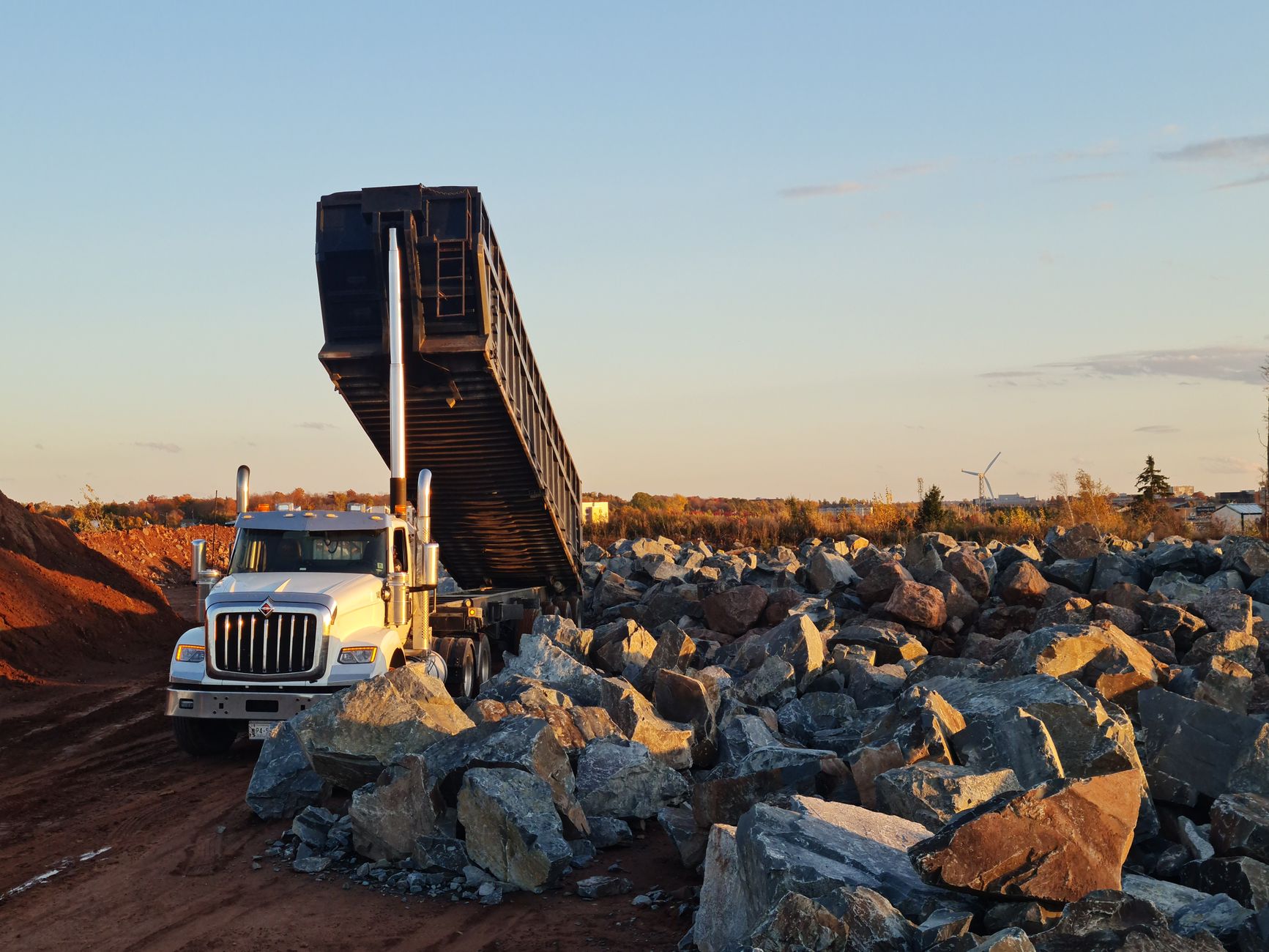
At the Vulcan Materials quarry in Norcross, Georgia, the stone has been leaving by truck since 1970. The deposit still holds 49 years of supply. This longevity is not unusual; across 400 sites in 22 states, Vulcan sits on 16 billion tons of reserves, enough to last six decades at current extraction rates. Yet the geological abundance is misleading. Vulcan does not compete as a mining company. It competes as a logistics firm that happens to sell rock, and its competitive perimeter is drawn not by property lines but by the fuel economy of heavy-duty trucks.
The physics are uncompromising. Hauling aggregates costs roughly $0.25 per ton-mile by truck. Every 40 miles, transportation expenses double the delivered price of the material. By comparison, barge transport runs $0.01 per ton-mile and rail $0.08 to $0.10, but these modes handle only 20 percent of Vulcan’s volume; the rest moves by truck from quarry to job site. The result is a hard boundary: customers cannot economically source aggregates from competitors beyond a roughly 40-mile radius. Inside that circle, the market is captive. Outside it, the product does not exist.
This geographic captivity defines everything about Vulcan’s economics. The company positions its 400 quarries to reach 60 percent of the U.S. population, creating a network of local monopolies where each deposit serves as the sole viable supplier for nearby construction projects. The moat is not the stone itself, crushed limestone is chemically identical whether it emerges from a Vulcan pit or a competitor’s, but the impossibility of arbitraging away the distance. A contractor in Atlanta cannot buy cheaper rock from Birmingham and absorb the $20-per-ton penalty to truck it 80 miles. The quarry at Norcross has lasted 54 years not because the stone is unique, but because it is close.
The implications are stark. Vulcan’s aggregates generate 38 to 40 percent gross margins, while downstream products like asphalt and concrete, where transportation economics matter less and competition is fiercer, yield 10 to 15 percent. Aggregates represent 60 percent of revenue but 90 percent of gross profit. The business is, in essence, a toll collection on the weight of distance.
The Oligopoly Mechanism
Within each 40-mile radius, the market structure rarely approaches perfect competition. Vulcan holds the number one or number two position in over 90 percent of its markets, and in most geographies, the entire competitive landscape consists of one to four players. Markets with this concentration sustain gross margins of 25 to 40 percent, while fragmented markets with numerous competitors see margins compress to 10 to 25 percent. The difference is not operational excellence but the sociology of oligopoly.
The mechanism that preserves these margins is peculiar to the physical nature of the product. Unlike cement or steel, aggregate production can be halted in approximately 15 minutes. There are no blast furnaces to keep running, no chemical processes that require continuous operation. When demand softens, Vulcan can shut down crushers instantly, preventing the inventory dumping that typically destroys pricing in cyclical industries. During the 2008 financial crisis, industry volumes collapsed 55 percent; in the early 1990s recession, volumes fell 15 to 20 percent over two to three years. Yet pricing discipline held because suppliers turned off the machines rather than flood the market with cheap stone to cover fixed costs.
This supply control interacts with demand inelasticity to create extraordinary pricing power. Aggregates constitute only 5 to 10 percent of total construction costs for infrastructure projects. When Vulcan raised prices 19 percent in a recent year, following a competitor’s 20 percent increase, contractors had limited ability to push back. The material is too cheap relative to the total job to justify project redesigns, and too heavy to source from farther away. The price increases stick.
But this equilibrium is fragile. It depends on what economists call rational collusion without communication: the mutual understanding that market share gains from undercutting will be temporary and mutually destructive. If a competitor breaks ranks during a downturn, offering material at a 10 percent discount to capture volume, the local oligopoly unravels. Because quarries carry high fixed costs, equipment, permitting investments, maintenance, once price discipline breaks, it is difficult to restore. The model assumes that competitors will remain disciplined, raising prices in tandem even when volumes contract. When they do not, Vulcan’s 38 percent margins evaporate.
The Operational Compound
The durability of Vulcan’s returns rests on more than geographic luck and cooperative rivals. Over the past decade, the company has engineered a widening cost advantage through operational discipline that smaller competitors cannot replicate. Internally called the “Vulcan Way,” this system treats quarries as precision manufacturing sites rather than extraction pits.
The evidence lies in specific metrics. Cash gross profit per ton has risen from roughly $9 to between $11 and $12, even as production throughput increased from 220,000 tons to 250,000–260,000 tons per facility. The gains come from digital monitoring of crusher performance, real-time inventory tracking at customer sites, and logistics coordination that reduces idle time. Perhaps most tellingly, the company reduced Sunday overtime from 20 days per year to 2 days per year, extracting more output from fewer labor hours.
These efficiency gains compound the pricing power. While competitors struggle with rising input costs, Vulcan expands margins through operational leverage. The technology requires scale to justify, igital twins of crushing operations and precision delivery systems demand capital investments that smaller, fragmented operators cannot amortize across thin volumes. The result is a bifurcated industry: Vulcan and a handful of large competitors capture the high-margin, technologically efficient production, while smaller players compete on price in fragmented markets with inferior cost structures.
This operational excellence is the underappreciated engine of the business. The quarries themselves are ancient; some have operated since the 1950s. The competitive advantage is not the dirt but the system that moves it: n organizational capability embedded in capital assets and managerial routines that improve incrementally each year.

The Permitting Paradox
The barriers to entering this business are geological, regulatory, and social. Opening a new quarry requires approximately $50 million in capital and, more critically, 10 to 20 years to secure permits. NIMBY opposition has intensified since the industry peak of 12,600 quarries in 1976; today, roughly 10,000 remain, and the number declines annually. Vulcan itself greenfields only one to two quarries per year, relying instead on its existing 16 billion tons of reserves.
This scarcity creates the moat. As urbanization expands toward Vulcan’s deposits, many of which were established on rural peripheries decades ago, the quarries become more valuable. The land cannot be replicated; the permitting timeline cannot be accelerated. Competitors cannot simply build a new plant when margins look attractive.
Yet the same feature that protects Vulcan also imprisons it. Quarries have 50- to 70-year productive lives, and their assets are geographically fixed. If population migrates away from the Southeast toward the Southwest, or if federal infrastructure spending shifts from highway construction to rail projects that use fewer aggregates, Vulcan cannot relocate its crushers. The $50 million permitting investment becomes a stranded asset, extracting fixed costs while generating declining revenue. During the 2008 crisis, volumes fell 55 percent, but the quarries remained, requiring maintenance and carrying costs even as cash flow collapsed. The business is a bet on the permanence of American construction geography: reasonable wager, perhaps, but an irrevocable one.
The Margin Squeeze
Strategic temptation lurks at the boundary of the core business. Contractors increasingly prefer integrated suppliers capable of delivering not just raw stone but finished asphalt and concrete. Vulcan resists this pull with disciplined selectivity. Vertical integration into these downstream products destroys margins: asphalt and concrete generate 10 to 15 percent gross margins versus the 38 to 40 percent of pure aggregates. They require working capital, carry higher customer service costs, and expose Vulcan to competition beyond the 40-mile radius that protects its stone business.
Yet complete abstention is not an option. In some markets, offering only aggregates risks losing the customer relationship entirely to integrated competitors. Vulcan deploys downstream capacity only where it controls the critical input, either the aggregates themselves or, in the case of cement, the supply chain, and only where the integration fills a structural gap rather than chasing market share. This is a high-wire act: integrate too little, and lose volume to competitors who bundle products; integrate too much, and dilute returns on capital while diverting management attention from the high-margin core.
The tension is economic, not operational. Every ton of asphalt sold is a ton of aggregates not sold at double the margin. The leadership’s willingness to cede downstream volume in favor of upstream profitability is a cultural decision that directly affects shareholder returns. It requires accepting lower top-line growth to protect unit economics: restraint that few industrial companies manage successfully over long periods.
The Discipline Premium
Vulcan’s business model ultimately rests on a behavioral assumption: that local competitors will remain rationally constrained, maintaining pricing discipline even when volumes contract. This assumption is tested cyclically. Approximately 40 percent of revenue derives from government-funded infrastructure projects, roads, bridges, schools, whose budgets reflect political cycles rather than economic demand. When federal spending contracts or state budgets seize during recession, the steady revenue base that anchors the oligopoly weakens.
The company’s culture serves as the final bulwark against model collapse. Management must maintain the discipline to shut down production in 15 minutes rather than chase volume during downturns. They must resist the urge to integrate vertically into low-margin concrete to capture fleeting market share. They must continue raising prices 4 percent annually (recently 19 percent) while ensuring competitors follow suit, never breaking ranks to dump excess supply. These are not soft leadership qualities; they are economic variables that determine whether the 38 percent margins are sustainable or illusory.
The fragility is specific. If recycled aggregates gain regulatory parity and bypass the permitting moat, or if modular construction reduces aggregate intensity, or if a single major competitor decides to maximize volume over price, the local oligopolies crack. Vulcan would remain with 400 quarries, 16 billion tons of stone, and a cost structure designed for premium pricing in a commodity market.
For now, the equilibrium holds. The trucks continue to haul from Norcross at $0.25 per ton-mile, the crushers monitor their own efficiency, and competitors raise prices in quiet tandem. Vulcan compounds its returns not through disruption but through the patient extraction of rents from distance, scarcity, and the restraint of rivals. It is a machine designed to run for 60 years, provided no one touches the off switch.
The 19 percent price increase did not arrive in a vacuum. It emerged from a specific choreography that repeats across Vulcan’s markets with seasonal regularity. In October, as highway departments finalize next year’s paving schedules and contractors lock in spring project estimates, the company issues its price sheets for the coming year. These are not negotiations; they are notifications. The customer’s alternative is to truck material from the next county, doubling the delivered cost through transportation burn. Yet the increase holds only if the competitor across town, often Martin Marietta or a regional operator like Summit, issues a parallel sheet with parallel numbers. The silence between these companies is the market’s most important communication.
This coordination fails rarely, but when it does, the damage is immediate and lasting. Consider the mechanics of a price war in aggregates. Because the product is heavy and cheap, customers do not stockpile it in anticipation of fluctuating prices; they buy for immediate use. When one supplier cuts list price by 8 percent to capture volume, the competitor cannot respond by offering superior quality, the stone is chemically identical, nor by delivering faster, oth plants sit roughly equidistant to the job site. The only available response is a deeper cut. Within weeks, a market that sustained 35 percent margins collapses toward cash cost. Recovery takes years because the annual price-setting ritual resets only once; a supplier who breaks ranks in November locks in disadvantage for twelve months.
The discipline holds because the players are few and the game repeats indefinitely. In the Atlanta metro area, Vulcan and Martin Marietta dominate. Each knows the other’s plant capacities, shift schedules, and reserve qualities. Each recognizes that a volume gain captured through discounting will be temporary, the competitor will retake the customer next year with a matching price, while the margin sacrifice is permanent. This is not collusion in the legal sense; no emails coordinate the increases. It is mutual assured destruction refracted through local market structure. The 19 percent increase stuck because Martin raised 20 percent, and Martin raised 20 percent because they, too, faced inflation in diesel, labor, and replacement parts, and because they calculated, correctly, that Vulcan would not undercut them.
The fragility lies in the asymmetry of pain. If a competitor faces a liquidity crisis, a leveraged buyout gone wrong, an environmental remediation charge, a sudden need to generate cash, they may rationally choose to harvest market share through discounting despite the long-term consequences. Vulcan’s margins are vulnerable to the solvency of its rivals. During the 2008 crisis, this dynamic did not break down only because the demand collapse was so universal, 5 percent volume declines left no one with spare cash to fund a price war. Everyone turned off the crushers simultaneously. But in a milder recession, where volumes fall 15 percent and one player faces a debt maturity, the equilibrium strains.
The geographic fixity of the assets amplifies this risk. A quarry is not merely a hole in the ground; it is a 50-year commitment to a specific set of customers whose economic fortunes may diverge from the national average. Vulcan’s reserves are concentrated in corridors of American growth, the Southeast, Texas, Arizona, but also in regions experiencing relative decline. When population migrates, the quarries do not follow. The Norcross facility will continue shipping stone to Gwinnett County regardless of whether Atlanta’s growth shifts exurban development to the south or west. If federal infrastructure spending reallocates from highway expansion, which consumes massive tonnage, to rail maintenance, which uses ballast but in different specifications and volumes, Vulcan’s 60-year reserves become a liability, extracting fixed costs while revenue migrates.
This is the stranded asset scenario that haunts long-cycle resource businesses. Unlike oil reserves, which can be left in the ground when prices fall, quarries require maintenance even when idle. Equipment rusts, berms erode, and environmental monitoring continues. The $50 million permitting investment that created the moat becomes a sunk cost anchor if the local construction economy contracts permanently. Vulcan experienced a preview of this in the early 1990s, when the Resolution Trust Corporation crisis froze commercial construction in Texas. Volumes fell 15 to 20 percent over two years, not because of national recession but because regional overbuilding in real estate collapsed. The Texas quarries kept operating at reduced capacity, bleeding cash, unable to relocate to Florida where construction boomed. The 40-mile radius is a prison as much as a fortress.
The vertical integration question complicates this geographic risk. In markets where Vulcan lacks dominant share, where it is number three or four, or where the local competitor is aggressively integrated, the company faces a choice that tests its strategic discipline. Take the asphalt business. Hot-mix asphalt requires aggregates, liquid asphalt cement, and proximity to the paver. If a competitor owns the asphalt plant adjacent to the highway project, they can bundle the stone and the mix, effectively locking Vulcan out of the aggregate sale even if Vulcan owns the nearest quarry. In these pockets, Vulcan builds asphalt plants not to capture the 10-15 percent margins of downstream manufacturing, but to defend the 38-40 percent margins of upstream supply. It is a defensive perimeter, economically irrational on its own terms but necessary to protect the core.
This creates strange territorial logic. In some counties, Vulcan operates concrete plants; in adjacent counties, it refuses, selling only aggregates to independent ready-mix producers. The decision hinges on whether Vulcan controls the cement supply (often imported through coastal terminals where Vulcan has long-term contracts) or whether the local cement market is dominated by competitors like LafargeHolcim or Heidelberg. Where Vulcan lacks cement advantage, integrating into concrete merely invites retaliation, ement suppliers cut off Vulcan’s concrete plants, forcing them to buy cement at premium spot prices, erasing the thin margin while alienating the independent ready-mix customers who were buying Vulcan’s stone. The company must map these territorial waters with precision, maintaining the posture of a supplier to its customers while simultaneously competing with them in select geographies.
The operational improvements, the “Vulcan Way”, intensify these territorial defenses. Digital monitoring of crushers allows for real-time adjustment of jaw gaps and conveyor speeds, reducing variance in product gradation. This matters because highway specifications for road base are exacting; material that is too fine requires additional processing, too coarse requires waste. Consistency allows contractors to bid tighter margins on public jobs, knowing that Vulcan’s stone will meet spec without the safety buffers required for less precise suppliers. The real-time inventory monitoring at customer sites, essentially, sensors in contractor stockpiles, allows Vulcan to schedule deliveries just-in-time, reducing the customer’s working capital needs. These are not merely efficiency gains; they are switching costs. Once a contractor’s inventory system is integrated with Vulcan’s logistics, migrating to a competitor requires ripping out telemetry and reverting to manual ordering, a friction that preserves accounts even when competitors offer modest price concessions.
Yet technology cuts both ways. If the digital integration becomes industry standard, if every quarry offers real-time inventory monitoring and precision delivery, the advantage commoditizes. Vulcan must then invest continuously merely to maintain parity, a Red Queen’s race where the prize is not premium returns but survival. The company bets that its scale allows it to amortize these systems across more tons than regional competitors, who may lack the IT infrastructure or capital to replicate the sensor networks. But the risk remains: capital intensity rises industry-wide, and the margin gap between Vulcan and the second-tier players narrows as technology diffuses.

The permitting timeline, 10 to 20 years, $50 million, deserves closer examination because it explains both the moat’s depth and its potential brittleness. The process begins with geological surveys, but the consuming phase is regulatory and social. A proposed quarry must secure air quality permits for particulate matter, water permits for storm runoff, zoning variances for industrial use of rural land, and often specific legislative exemptions for blasting within populated areas. Each permit is contestable; each contestation triggers environmental impact studies that take 18 months to complete. Meanwhile, local residents organize. The “Not In My Backyard” opposition to quarries is visceral and permanent; no one wants a 500-foot deep pit, daily truck traffic, and periodic blasting near their subdivision, even if they drive on the roads built from that stone.
Vulcan’s existing quarries benefit from grandfathering. Many opened before modern environmental review, operating under permits that would be impossible to replicate today. The Norcross quarry, opened in 1970, predates the Clean Air Act amendments that govern modern particulate standards. If it were proposed today, it would likely be rejected or delayed into economic irrelevance. This creates a strange dynamic: the existing asset base becomes more valuable as permitting tightens, but also more politically vulnerable. A single environmental incident, a diesel spill into a watershed, a blasting vibration that cracks foundations, can trigger re-examination of grandfathered permits, threatening the very authorization that allows operation. The 60-year reserve life assumes regulatory continuity; a change in environmental law, or a shift in enforcement priority, could shutter specific sites prematurely, stranding the capital invested in their crushers and conveyors.
The transportation economics also contain subtleties that threaten the 40-mile radius. While 80 percent moves by truck, the 20 percent that moves by barge or rail first, then truck, creates arbitrage opportunities that can puncture local pricing power. Where Vulcan has barge access on the Mississippi, Ohio, or Tennessee river systems, it can theoretically serve markets 200 miles inland at effective transport costs lower than truck-only competitors. Conversely, competitors with rail sidings can ship into Vulcan’s markets if the delivered price differential exceeds the modal switching cost. Vulcan maintains this perimeter by controlling terminal infrastructure, locking in exclusive use of river terminals or rail loops, but these are specific, capital-intensive checkpoints. A competitor who secures similar multimodal access in a Vulcan stronghold can erode the local monopoly, forcing price convergence toward the fragmented-market baseline of 10-25 percent margins.
The public spending dependency, 40 percent of revenue from government-funded projects, introduces political volatility that operational excellence cannot hedge. Highway spending is not merely cyclical; it is episodic and arbitrary. The Infrastructure Investment and Jobs Act of 2021 injected billions into roadbuilding, but the allocation formulas favor specific categories, bridge replacement, EV charging corridors, that may not align with Vulcan’s quarry locations. A bridge project in rural Pennsylvania requires aggregates, but perhaps from local, non-Vulcan sources. An EV corridor along Interstate corridors may use different base specifications than traditional highway paving. The “shovel-ready” projects that characterized the 2009 stimulus were often maintenance, requiring minimal new stone, rather than greenfield construction.
Moreover, the federal fiscal position creates tail risk. State departments of transportation, which account for the majority of public aggregates demand, face pension obligations and Medicaid costs that crowd out infrastructure budgets during fiscal stress. When Illinois or Connecticut faces budget crisis, the first cuts hit discretionary capital projects. Vulcan’s 40 percent revenue base is thus exposed not merely to recession but to specific state fiscal crises unrelated to national economic conditions. The company diversifies across 22 states precisely to mitigate this idiosyncratic risk, but concentration remains; Vulcan’s market share is highest in the Southeast, where state DOT budgets are growing, but a regional fiscal contraction would disproportionately wound the company’s strongest markets.
The historical record of cyclicality reveals how these forces interact. During the 1990-1992 recession, the threat was not price war but demand evaporation in specific regional markets. Vulcan’s Texas operations, leveraged to the savings and loan crisis and subsequent commercial real estate collapse, saw volumes fall while Southeast operations remained stable. The company could not shift Texas stone to Florida; the transportation economics forbade it. Instead, it idled plants, reduced headcount, and waited. The 2008-2009 crisis was different, niversal and severe. Volumes fell 55 percent, yet pricing held because every supplier faced existential threat simultaneously. No one had the liquidity to fund a market share grab. The lesson is that moderate, regional recessions are more dangerous to Vulcan than systemic crashes, because in moderate downturns, healthy competitors in stable regions can afford to discount into distressed markets, while in systemic crashes, everyone is equally wounded.
The recent 19 percent price increase thus represents a high-stakes test of the model’s limits. In an inflationary environment with construction labor costs rising and interest rates increasing project finance costs, contractors face margin compression. While aggregates remain 5-10 percent of job costs, if that ratio creeps toward 15 percent through successive double-digit price increases, customers will seek substitutes. Recycled concrete aggregate (RCA), historically limited to low-spec applications like backfill, is improving in quality. Synthetic lightweight aggregates, while expensive, become viable when traditional stone prices escalate rapidly. Prefabricated bridge elements, manufactured off-site with minimal field stone requirements, reduce aggregate intensity. None of these substitutes threaten Vulcan at historical 3-4 percent annual price increases, but at 19 percent, the substitution elasticity activates.
The bear case, then, is specific: a regional competitor with distressed balance sheet or private equity ownership breaks price discipline to generate cash; simultaneously, state DOTs facing fiscal cliffs delay projects; contractors, squeezed by the 19 percent increase, experiment with recycled materials; and Vulcan, unable to idle quarries selectively because of fixed costs and union contracts, faces volume losses at the precise moment it raised prices to cover inflation. Margins compress not gradually but suddenly, as the 40-mile radius that protected pricing becomes a noose that prevents volume escape. The cash gross profit per ton falls from $12 toward $6, and the operational excellence, digital twins, reduced Sunday overtime, cannot save the economics because the top-line price has collapsed.
Against this, Vulcan’s leadership offers only discipline and the long view. They have demonstrated willingness to sacrifice volume for price, idling plants rather than chasing market share. They have shown restraint in vertical integration, tolerating customer complaints about availability in order to preserve margin structure. They have invested in the 60-year reserve base, accepting that some quarries may become stranded but betting that the portfolio as a whole appreciates as permitting tightens. The machine runs on the assumption that distance is immutable, that stone is indispensable, and that competitors will remain rational. These are strong assumptions, but they have held for half a century at Norcross, where the trucks still haul, year after year, from the same pit that supplied the interstates of the 1970s. The question is whether the next half-century will forgive the same bet.
The digital infrastructure that extracts $2-3 per ton in additional margin is invisible to the contractor standing at the job site. Beneath the steel housing of a primary gyratory crusher, sensors monitor mantle wear and feed distribution in real time, adjusting stroke speed to maintain optimal gradation. This is not merely automation; it is the conversion of geological variance into manufacturing precision. The Norcross quarry processes granite that ranges from 6.5 to 7.0 on the Mohs hardness scale depending on the bench being blasted. Harder stone burns manganese crushing liners faster, threatening to produce excessive fines that fail state DOT specifications. The digital twin, essentially a computational model of the crushing circuit updated by vibration sensors and power-draw monitors, predicts liner degradation 48 hours before it affects product quality, allowing maintenance to schedule changeouts during planned downtime rather than emergency shutdowns. The result is the throughput increase from 220,000 to 260,000 tons annually while reducing labor hours, specifically the elimination of 18 Sunday shifts per year.
Yet this advantage carries the seeds of its own decay. The telematics that monitor customer stockpiles, radio-frequency sensors buried in contractor yards that report tonnage and moisture content via cellular networks, were proprietary five years ago. Today, they are available from third-party logistics providers who will install them on any supplier’s stone. When every quarry offers just-in-time replenishment triggered by inventory thresholds, the service becomes table stakes, not differentiation. Vulcan then faces a capital allocation trap: stop investing in the sensor networks and lose the customer stickiness that justifies the 19 percent price increase; continue investing and convert gross margin into maintenance capex that yields no competitive return. The $50 million permitting moat protects the stone, but not the technology. A crusher is physical capital with a 20-year depreciation schedule; the software that optimizes it obsoletes in three to five years. The mismatch creates a reinvestment treadmill. Vulcan must spend continuously merely to prevent the margin compression that would otherwise erode the quarry’s economics, a Red Queen’s race where the prize is not growth but the preservation of 1980s-era returns in a digitized market.
Governance becomes the critical variable in this equation. The temptation to solve competitive pressure through vertical integration, to buy the troubled asphalt plant rather than lose the aggregate sale, surges precisely when technology investments are demanding cash. A leadership team compensated on revenue growth or market share will rationalize the concrete plant acquisition as “strategic” or “customer-focused,” diluting returns. Vulcan’s board has historically constrained this impulse through capital allocation committees that evaluate downstream investments not on incremental EBITDA but on the change in return on invested capital for the entire regional cluster. If the asphalt plant earns 12 percent but drags the aggregate margin down by 3 percentage points through cannibalization or customer conflict, the proposal dies regardless of top-line appeal. This is culture as economic infrastructure: the willingness to report lower revenue numbers to sustain higher capital returns.
The fragility of this system appears in succession planning. The quarry managers who reduced Sunday overtime from 20 days to 2 days did so not through algorithmic scheduling but through tacit knowledge of haul truck maintenance windows and union negotiation patterns accumulated over decades. When these managers retire, the digital systems must institutionalize their judgment, yet the systems themselves require continuous upgrading. If a new leadership team, facing activist pressure for margin expansion, defers the technology capex to fund share buybacks, the operational advantage decays rapidly. Competitors using cloud-based analytics services, renting rather than owning the computational infrastructure, can close the efficiency gap without Vulcan’s sunk investment. The 60-year reserve life then becomes a curse: Vulcan is locked into markets where it must compete with leaner, more technologically agile operators who have no legacy crusher footprints to maintain, only mobile processing units and third-party logistics contracts.
The bear case is thus specific and operational, not merely cyclical. It is not a recession that kills the model, but a gradual normalization of the efficiency gap, a permitting reform that allows recycled aggregates to bypass the quarry moat, and a cultural shift that prioritizes volume stability over price discipline. In that scenario, the $11-12 cash gross profit per ton drifts back toward $6, and the 38 percent margins converge on the 15 percent of the downstream businesses Vulcan wisely avoided. The stone remains at Norcross for another 49 years, but the economics of extracting it revert to those of a commodity pit, where distance is merely a cost, not a fortress.