
Dino Polska: From One Store to 1,000
The Store as Machine
In 1999, a twenty-six-year-old named Tomasz Biernacki opened a grocery store in Krotoszyn, a town of twenty-nine thousand in central Poland. The store occupied 4,300 square feet. It stocked roughly the same assortment of goods, produce, packaged goods, and fresh meat, that it stocks today. The layout was fixed: entrance to the right, dairy at the back, meat counter to the left. What Biernacki built was not a shop but a template. Twenty-five years later, Dino Polska operates 1,880 stores, every one of them built to the same specifications, on land that Dino owns, constructed by a company that Biernacki controls exclusively. The business has never closed a location since 2007.
This is not retail as fashion or merchandising. It is retail as industrial engineering. Dino’s economic engine runs on the elimination of variance. Each store costs $650,000 to build, takes seventeen months to permit and six months to construct, and begins generating predictable returns within three years. A mature unit produces $1.8 million in annual revenue at 25 percent gross margins and 8 percent operating margins, yielding returns on invested capital between 20 and 30 percent. These are not estimates; they are results, repeated across nearly two thousand iterations. The standardization is so complete that management claims they can forecast a store’s sales and profitability simply by analyzing the surrounding population density. They have not been wrong enough to close a store in seventeen years.
The model works because Dino treats geography as a variable and everything else as a constant. The 4,300-square-foot format is small enough to fit on inexpensive edge-of-town plots in municipalities with populations below twenty thousand, yet large enough to carry a full grocery assortment. By owning the real estate, 95 percent of stores are on Dino’s balance sheet, the company avoids rent inflation and captures a 3 percent annual cost advantage over leased competitors. By building identically, Dino eliminates the operational friction that typically slows expansion. Store managers do not decide where to place the dairy case. Regional managers do not negotiate lease terms. The construction timeline does not vary. The result is a compounding machine that has grown store count at a 29 percent compound annual rate since 2010 while funding itself entirely through reinvested profits and founder capital.
But mechanical perfection creates its own fragility. A machine that requires every gear to turn in synchronization breaks catastrophically when sand enters the casing. Dino’s sand is time, demography, and the mortality of its creator.
Land Ownership and the Illiquidity Premium
The most consequential decision in Dino’s capital structure is not the product assortment or the pricing strategy. It is the refusal to lease. When Dino enters a town, it buys land, builds a store, and holds the asset indefinitely. The mathematics are compelling: after nine years, the avoided rent exceeds the initial construction cost, and every year thereafter adds three percentage points to operating margins. Over a thirty-year horizon, the owned-store model generates substantially higher cash-on-cash returns than leasing.
The mathematics, however, assume the store remains profitable for thirty years. This assumption is baked into every investment decision Dino makes, yet it is the least interrogated aspect of the thesis. Small-town Poland, here 80 percent of the population lives, where the median income is one-fifth of American levels adjusted for purchasing power, and where demographic stability has persisted since the 1980s, as provided a favorable environment for this bet. Dino’s stores become embedded in local infrastructure, the default provisioner for communities with limited retail choice. The zero-closure record suggests operational excellence, but it may simply reflect favorable tailwinds. Dino has never tested its model in a declining market.
Here lies the defining structural constraint. Unlike competitors who lease and can exit unprofitable locations by declining to renew, Dino owns stranded assets in waiting. If small-town Poland experiences accelerated urbanization, if younger populations migrate to Warsaw or Wrocław, if local economies deteriorate, Dino cannot retreat. It carries the real estate at historical cost, but the economic value is fixed to the vitality of towns it does not control. The 9-year breakeven calculation assumes stability; the 30-year asset life assumes permanence. Should either assumption fail, the owned-real-estate model inverts from a competitive advantage to a balance sheet trap. The company would own thousands of obsolete concrete boxes on the wrong side of demographic gravity, generating neither rent savings nor operating cash flow, yet still requiring maintenance capital.
The irony is that Dino’s confidence in its predictive capability, its belief that it can select sites with near-perfect accuracy, encourages increasingly irreversible commitments. Each successful store validates the model and emboldens the next purchase. But predictive models trained on stable data fail precisely when stability ends. Dino has optimized for a world that does not change, accumulating assets that assume the future resembles the past.
The Construction Company Inside the Business
Most analyses of Dino focus on the real estate ownership and the vertical integration into meat processing. They miss the more subtle machinery: Krot-Invest, the construction company that builds every Dino store, owned 100 percent by Biernacki. At first glance, this appears to be a corporate governance concern: related-party transaction that enriches the founder at shareholder expense. Auditors have reviewed the pricing twice and found no irregularities. But the economic significance of Krot-Invest lies not in the price Dino pays, but in the variance it eliminates.
Commercial construction is typically the enemy of standardization. Different contractors deliver different quality, different timelines, and different interpretations of architectural plans. For a retailer attempting to replicate identical stores across hundreds of municipalities, construction variance creates operational drag. Store openings delay. Build-out costs fluctuate. Layouts deviate from the optimal format, degrading inventory turns and labor efficiency.
By using a single captive builder that constructs nothing but Dino stores, the company has industrialized the rollout process. Krot-Invest knows exactly how to pour the foundation for a 4,300-square-foot grocery, how to position the refrigeration, how to sequence the electrical work. There is no learning curve with new contractors, no negotiation, no variance. This is why Dino can open stores at a pace that would break a conventional retailer. The construction company is not merely a vendor; it is the enabling technology that makes the replication engine possible.
Competitors attempting to replicate Dino’s format face a chicken-and-egg problem. To achieve the construction efficiency, they must build hundreds of stores. To build hundreds of stores, they must first solve the construction efficiency. Dino’s fifteen-year relationship with Krot-Invest, developed privately before the 2017 IPO, created a moat that capital alone cannot cross. The related-party structure, while creating governance risk, aligns the founder’s incentives with flawless execution. Biernacki profits from construction efficiency, but only if Dino continues to expand profitably. The arrangement concentrates control, but it also concentrates accountability for the standardization that drives returns.
Pricing Power Without Pricing Power
Dino’s competitive position rests on a delicate equilibrium. The company targets price-sensitive consumers in small towns where purchasing power equals roughly 35 percent of American consumer spending. These households cannot absorb premium pricing, yet they demand full assortment convenience. Dino’s response is to match the prices of hard discounters, Biedronka, Lidl, on the top 500 stock-keeping units weekly, while maintaining a 25 percent gross margin, roughly three percentage points higher than American grocery chains and seven points higher than pure discounters.
This margin is not extracted from customers. It is manufactured through operational architecture. The 3 percent rent avoidance from owned real estate contributes directly to margin. More significantly, Dino operates two meat processing plants that supply fresh cuts to its stores. While competitors sell packaged meat sourced from distributors, Dino offers fresh meat, a staple of the Polish diet, at lower cost and higher margin. The vertical integration reduces spoilage, improves quality perception, and creates switching costs for customers who value the freshness differential.
Yet this equilibrium depends on scale effects that may not persist indefinitely. Dino’s ability to match discounter prices while earning superior margins relies on bargaining power with suppliers that grows with store count. As the company saturates small-town Poland, the marginal store adds less volume leverage. If discounters expand aggressively into Dino’s geographies, opening small-format stores in the very towns Dino has colonized, the price-matching strategy becomes a margin compressor. Dino would be forced to maintain low prices without the volume to extract supplier concessions, or to surrender price parity and lose the value proposition that defines its brand.
The meat processing advantage, rooted in Biernacki’s family history in the trade, is similarly contingent. Competitors cannot easily replicate the capacity, but they could erode the freshness differential through supply chain innovation, or consolidate purchasing power to match Dino’s cost position. The 25 percent gross margin is not a natural law. It is a temporary equilibrium maintained by Dino’s current scale and the inertia of competitors. Should that inertia break, Dino would face the choice of surrendering margin or surrendering customers, neither of which supports the 20-30 percent ROIC that funds the expansion.
Operating in a Frozen Demography
Dino’s addressable market is defined by a single, uncomfortable fact: small-town Poland has not changed much. The population distribution has remained stable since the 1980s. Urbanization has proceeded slowly. The median town has not grown rich, but it has not collapsed either. This stasis is the invisible foundation of Dino’s economics. The business model assumes that a store built today will serve the same community, with the same purchasing power, for three decades.
The constraint is not merely demographic but economic. With median incomes at one-fifth of American levels, Dino’s customers have no capacity for trading up. Same-store sales growth is therefore capped by wage growth in rural Poland, which has been modest. Dino cannot drive revenue through premiumization, basket expansion, or convenience pricing. It can only grow by adding stores. This creates a structural ceiling. When Dino saturates the small towns, when every municipality of ten thousand people has its 4,300-square-foot box, growth stops. The company will have transformed itself from a compounding engine into a mature utility, generating cash but not expansion.
The timing of this saturation is uncertain but approaching. From 111 stores in 2010 to 1,880 in 2022, Dino has captured a significant portion of the viable small-town footprint. The remaining opportunities are increasingly marginal, maller towns, thinner demographics, longer payback periods. Each new store now tests the limits of the demographic assumption. If Poland’s urbanization accelerates, if EU labor mobility drains the provinces, if remote work concentrates wealth in cities, Dino’s final wave of construction could coincide with the hollowing out of its customer base.
The company’s response to this constraint is to build faster, to capture the remaining real estate before competitors or before the demographics shift. This creates a race against time that favors speed over selectivity. The same standardization that enables rapid expansion may eventually lead to overbuilding in towns that cannot support thirty years of grocery sales. When the music stops, Dino will own not just stores, but the land beneath them.
The Founder as a Depreciating Asset
Beneath the mechanical precision of the store format lies a human variable that resists standardization. Biernacki is forty-nine years old. He has run Dino since its founding, retaining 51 percent ownership and active management control. Two executives have served alongside him since 2002, predating the modern expansion by nearly a decade. Together, this trio holds the institutional knowledge of site selection, supplier negotiation, and operational discipline that the replication machine requires.
The risk is not merely that Biernacki might sell shares or retire. It is that the specific judgment required to sustain the model, nowing which towns have the demographic stability to justify permanent real estate investment, knowing how to pressure suppliers without breaking relationships, knowing when the construction timeline is slipping, annot be easily codified. Dino’s standardization works because the strategic decisions that precede the standardization are made correctly. Those decisions are currently concentrated in three individuals.
Succession planning has not been disclosed. For a business that assumes thirty-year asset lives, this is a material gap. If Biernacki exits, or if the two long-tenured executives depart, the standardization engine could stall not because the template breaks, but because the judgment that selects where to place the template degrades. A new management team, even if competent, might lack the founder’s tolerance for illiquidity, his relationships with meat suppliers, or his control over Krot-Invest. The construction company, privately held by Biernacki, exists outside the corporate structure entirely. Its continued exclusive service to Dino depends on the founder’s continued interest in both entities.

Governance thus functions as an economic variable directly tied to returns. The 51 percent stake aligns Biernacki with long-term value creation, but it also concentrates risk. The related-party construction arrangement, while operationally efficient, creates a single point of failure. If the founder’s interests diverge from minority shareholders, if he chooses to extract value through Krot-Invest rather than Dino, or if he slows expansion to preserve his ownership percentage, the mechanical perfection of the store model cannot compensate for the misalignment at the top.
When the Model Meets Its Limits
Dino Polska represents a pure bet on stasis executed with maximum aggression. The company assumes that small-town Poland will remain frozen in time, emographically stable, economically static, permanently in need of exactly 4,300 square feet of standardized grocery retail. It assumes that competitors will continue to cede these territories, that supplier power will not consolidate, and that the founder and his lieutenants will remain in place to make the irreversible decisions that each new store requires.
These assumptions are not unreasonable given the last two decades. But they are fragile precisely because they have not been tested. Dino has never operated through a regional recession in rural Poland. It has never faced a determined discounter targeting its specific geographies. It has never managed a transition of power. The zero-closure record is impressive, but it may reflect a favorable environment rather than antifragile operations.
The business compounds at 20-30 percent returns because it combines high-margin vertical integration, zero rent inflation, and operational replication at scale. These advantages are real, but they are contingent on the continued stability of the social and economic landscape they occupy. When that stability cracks, when a town’s young people leave for Warsaw, when a competitor finally builds across the street, when Biernacki steps aside, Dino will discover that mechanical perfection provides no escape from strategic gravity. The stores will remain, permanent and identical, anchored to the Polish earth, generating returns or gathering dust depending on forces the machine cannot control.
The stores will remain, permanent and identical, anchored to the Polish earth, generating returns or gathering dust depending on forces the machine cannot control.
The Meat Processing Inheritance
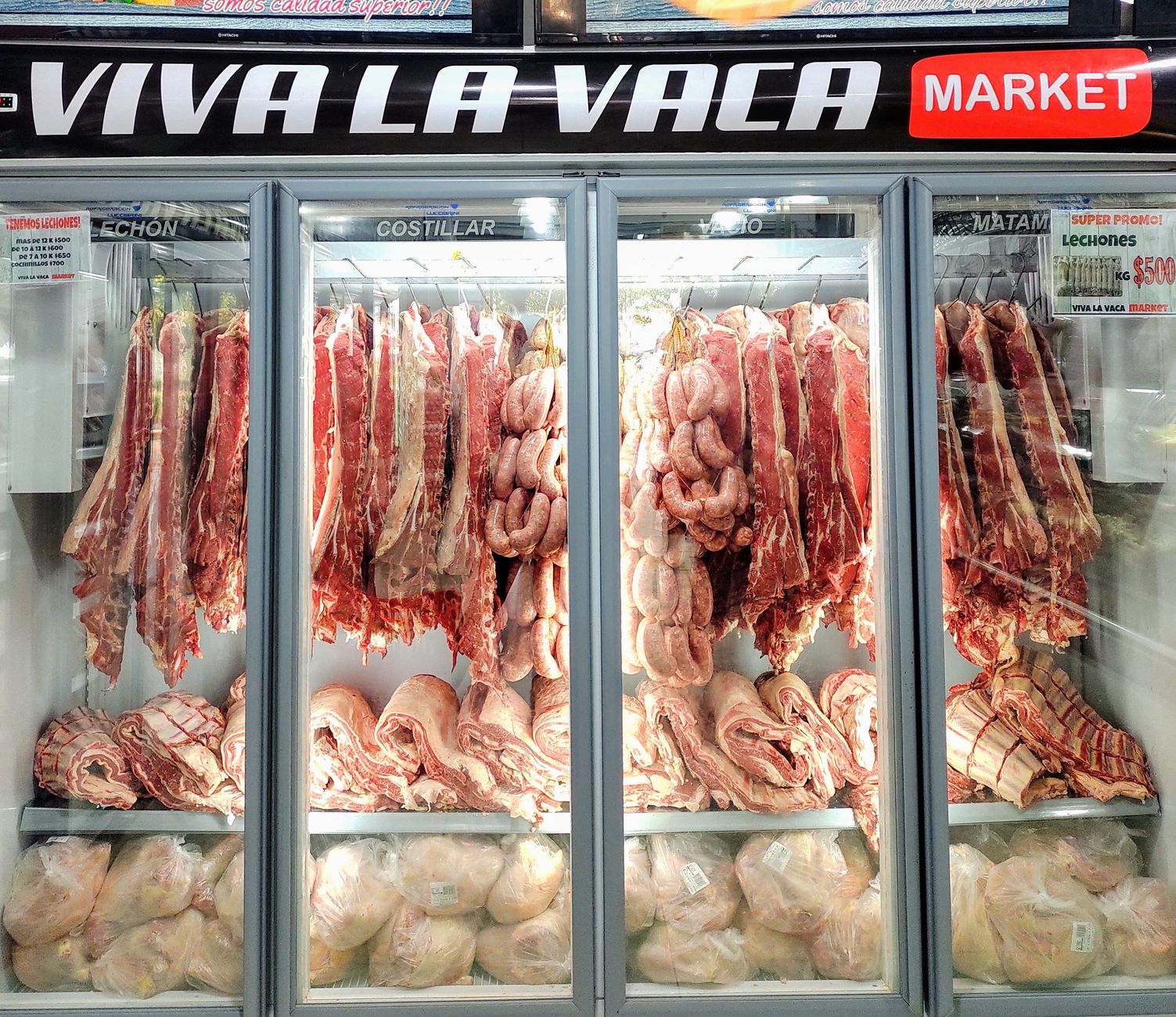
To understand why Dino’s gross margins exceed those of larger competitors, one must look past the real estate and into the cooler. Dino operates two meat processing plants, a legacy of Biernacki’s family history in the trade before 1999. These facilities do not merely supply stores; they alter the physics of fresh food retail. While competitors source packaged meat from national distributors, Dino butchers on-site, delivering cuts to stores daily. The vertical integration captures the margin that would otherwise flow to processors and distributors, but more critically, it eliminates the spoilage losses that plague standard grocery models.
Fresh meat constitutes a disproportionate share of the Polish grocery basket, istorically higher than Western European norms, rooted in dietary traditions that survived both communist shortages and post-1989 abundance. By controlling the slaughtering and cutting operations, Dino ensures that what appears in the display case was processed within hours, not days. This creates a quality differential that justifies traffic in small towns where the alternative is often frozen or packaged imports. The margin advantage, estimated at two to three percentage points of the 25 percent gross margin, derives not from charging more, but from wasting less. When a competitor orders pre-packaged cuts, they forecast demand imperfectly and absorb shrinkage. Dino’s system allows last-minute allocation based on actual morning traffic.
This advantage is non-replicable by competitors without both capital and time. Building meat processing capacity requires food safety certifications, relationships with livestock suppliers, and operational expertise in perishable logistics. A competitor could not buy this capability; they would have to build it over years while operating at a cost disadvantage. Yet the advantage is also non-transferable. It depends on Biernacki’s specific knowledge of the meat trade and his willingness to operate industrial facilities that most retailers would outsource. If the founder departs, the plants require management with skills distinct from retail operations, laughterhouse expertise, agricultural supply chain management, regulatory compliance for food safety. Dino has not disclosed whether this operational layer has been institutionalized or whether it remains dependent on the founder’s personal oversight.
The Private Equity Interlude
In 2010, Biernacki accepted a $66 million investment from Enterprise Investors, a Warsaw-based private equity firm, in exchange for 49 percent of Dino. The timing reveals the economics of the model at scale. By 2010, Dino had grown from the original Krotoszyn store to 111 locations, enough to prove the replication thesis but not enough to exhaust the addressable market. Enterprise Investors provided the capital to accelerate the rollout, but more importantly, they provided external validation. Their due diligence examined the Krot-Invest relationship, the real estate ownership model, and the meat processing vertical integration, nd found no material irregularities.
The firm exited in April 2017 via IPO at 34.5 zloty per share, realizing an 8-9x return in seven years. This transaction established the public market’s framing of Dino: not as a retailer subject to cyclicality and competition, but as a compounder with unit economics resembling a consumer staple. The IPO price implied confidence that the 29-30 percent store CAGR could continue indefinitely, and that the 20-30 percent ROIC per store was not a temporary arbitrage but a permanent structural advantage.
But the private equity interlude also revealed the constraints. Enterprise Investors could exit because the business had reached sufficient scale to fund its own growth. Dino’s post-IPO expansion has required no external equity capital; it funds construction through operating cash flow and debt secured by the owned real estate. This self-funding capability is elegant but creates a closed loop. Without external capital partners demanding governance changes or strategic reviews, the company has faced limited pressure to address succession planning or to reduce the related-party exposure with Krot-Invest. The founder’s 51 percent stake, while aligning his interests with long-term value creation, also insulates the company from market discipline regarding these structural vulnerabilities.
The Permitting Horizon
Each Dino store requires seventeen months to permit and six to seven months to construct. These timelines are not arbitrary; they reflect the administrative reality of Polish municipal governance in small towns. The seventeen months involve zoning approvals, environmental impact assessments for the refrigeration systems, and negotiations with local authorities who view grocery retail as both essential infrastructure and a source of employment. Dino’s success in navigating this bureaucracy at speed, opening hundreds of stores annually, depends on relationships and templates developed over fifteen years.
This creates a subtle moat. A competitor attempting to enter small-town Poland would face the same seventeen-month timelines but without Dino’s accumulated knowledge of which municipalities approve projects efficiently, which local officials require specific documentation, and how to structure applications to avoid delays. Dino’s real estate team has likely mapped the permitting landscape of rural Poland with military precision, identifying towns where approvals flow quickly and avoiding those with administrative bottlenecks.
However, this advantage assumes regulatory stability. If Polish land-use regulations tighten, if environmental standards for commercial refrigeration become more stringent, or if EU subsidy programs alter the economics of rural development, the seventeen-month timeline could extend. Dino’s expansion rate is mechanically constrained by the permitting pipeline. A six-month delay across the portfolio would reduce store openings by 15-20 percent, directly impacting revenue growth. The company cannot accelerate construction to compensate; the six-to-seven-month build time is physically fixed by Krot-Invest’s capacity and the standardized format. The model assumes that Polish administrative capacity remains constant, a fragile assumption in an era of increasing regulatory complexity.
The Discipline of the 500 SKUs
Dino’s price-matching strategy operates with mechanical precision. Each week, the company surveys the prices of the top 500 stock-keeping units at major discounters, primarily Jeronimo Martins’ Biedronka and Schwarz Group’s Lidl, and adjusts its own prices to match. This is not promotional pricing; it is a permanent structural commitment to price parity on essential goods. The strategy sacrifices margin on high-velocity items to maintain traffic and basket size, recovering margin on the long tail of SKUs where price comparison is less rigorous.
The operational burden is significant. Price adjustments on 500 SKUs weekly across 1,880 stores require sophisticated data infrastructure and supplier flexibility. Dino must negotiate with consumer packaged goods companies not for static pricing, but for dynamic terms that allow rapid repricing without margin destruction. This requires scale; a smaller chain lacks the volume to demand such flexibility from Unilever or Procter & Gamble. Dino’s growing store count provides the leverage to insist on these terms, creating a self-reinforcing cycle: more stores enable better supplier terms, which enable lower prices, which drive traffic, which justifies more stores.
But this equilibrium assumes supplier fragmentation. If Polish grocery supply consolidates, if multinational manufacturers merge or if local distributors gain monopoly positions in specific categories, the bargaining dynamic shifts. A consolidated supplier can refuse dynamic pricing demands, forcing Dino to either absorb margin compression or surrender price parity. The 25 percent gross margin provides a cushion, but not an infinite one. A two-percentage-point increase in cost of goods sold, easily achievable if suppliers gain pricing power, would reduce operating margins by 25 percent, bringing Dino closer to the 1-3 percent industry average that makes the owned-real-estate model economically questionable.
The Geography of Stasis
Small-town Poland’s demographic stability is not accidental; it is the legacy of post-communist transformation. When Poland transitioned to a market economy in 1990, agricultural land ownership patterns frozen by communist collectivization were partially restored. Small towns retained their function as administrative and service centers for surrounding agricultural areas, while rapid urbanization was tempered by EU structural funds that improved rural infrastructure. The result has been a frozen population distribution: towns of 10,000 to 20,000 inhabitants that neither grow nor collapse, serving as permanent waypoints in a landscape that modernized without agglomerating.
Dino’s store placement targets these specific demographic bands. A town of 15,000 provides sufficient population to support a 4,300-square-foot store, but insufficient density to attract hypermarket competitors. Tesco and Carrefour, which entered Poland in the 1990s with large-format models, found these towns economically inaccessible. The catchment areas were too small to justify 100,000-square-foot stores, while the transportation infrastructure made weekly trips to regional cities feasible for big-ticket purchases. The result was a competitive vacuum: small towns had independent grocers with high prices and limited assortment, but no modern, efficient, full-range proximity retail.
Dino filled this vacuum by assuming the permanence of the vacuum. It assumed that Tesco would not downsize to small formats, that Biedronka would not aggressively target towns below 20,000 population, and that e-commerce grocery delivery would not penetrate rural markets. These assumptions have held for fifteen years, allowing Dino to establish density that now protects against entry. A competitor entering a Dino-saturated town faces not just one store, but a network of stores in adjacent towns that share distribution costs and marketing efficiency. The network effect is geographical: Dino’s store in Town A is more profitable because it shares a distribution route with the store in Town B, ten kilometers away.
Yet this density strategy increases the correlation of risk. If demographic decline hits small-town Poland, it will not hit one store; it will hit the entire network simultaneously. Dino’s cash flows are geographically concentrated in a way that makes the company vulnerable to regional economic shocks. A drought affecting agricultural incomes, a mine closure in Silesia, or a demographic shift accelerated by remote work policies that favor urban centers would affect hundreds of stores concurrently. The company cannot diversify its risk through geographic dispersion; its entire thesis is geographic concentration.
The $6,000 Maintenance Fiction
Dino reports maintenance capital expenditures of approximately $6,000 per store annually. This figure, roughly 0.3 percent of a mature store’s revenue, suggests that the standardized concrete boxes require almost no upkeep. The refrigeration systems, the roofing, the parking lot paving, all apparently operate with minimal intervention. If accurate, this represents extraordinary asset efficiency; if optimistic, it represents a future liability.
Commercial real estate typically requires capital reserves for roof replacement, HVAC refurbishment, and parking lot resurfacing every ten to fifteen years. At $6,000 annually accumulated over fifteen years, Dino reserves $90,000 per store for these eventualities. Given that construction costs are $650,000, this implies that major structural components require replacement every century: claim that strains credulity for retail infrastructure subject to Polish winters and heavy daily traffic.
The low maintenance figure likely reflects accounting classification rather than economic reality. Dino may classify certain repairs as operating expenses rather than capital expenditures, or it may defer major maintenance until stores require full refurbishment. Alternatively, the standardization may genuinely enable cost efficiencies, bulk purchasing of refrigeration components, standardized repair procedures, in-house maintenance teams, that reduce costs below industry norms.
But if the $6,000 figure understates true economic depreciation, Dino’s ROIC calculations are overstated. A mature store generating $144,000 in operating profit ($1.8M revenue × 8% margin) on $650,000 invested capital appears to earn 22 percent returns. If true maintenance costs are $20,000 annually, still below typical retail standards, returns drop to 19 percent. If major structural investments are required every twenty years at $200,000 per store, the long-term returns approach 15 percent, still attractive but no longer extraordinary. The owned-real-estate model assumes these assets appreciate or hold value indefinitely; if they require substantial reinvestment to remain operational, the nine-year breakeven extends toward fifteen years, and the illiquidity premium becomes a trap.
The Succession Black Box
Biernacki’s two long-tenured executives, both in place since 2002, hold knowledge that is not documented in operating manuals. One likely manages the real estate acquisition pipeline, nowing which landowners to approach, which municipal officials to consult, how to assess the traffic patterns of small towns based on church locations and bus stops. The other likely manages the supplier relationships: he meat processors, the packaged goods distributors, the logistics contractors who maintain the fleet that supplies stores daily.
This knowledge is tacit. It cannot be transferred through PowerPoint presentations or standard operating procedures. It resides in the pattern recognition developed over two decades of opening stores, in the relationships built with mayors and meat inspectors, in the intuition about which towns have sufficient “stickiness” to justify permanent real estate investment. When these individuals depart, Dino will not merely lose experienced managers; it will lose the judgment that enables the standardization.
The company has not disclosed succession plans. This is not unusual for a controlled company, but it is material given the business model’s dependence on specific human capital. A new CEO, whether internal or external, would lack the founder’s tolerance for illiquidity, his relationship with Krot-Invest, and his specific expertise in meat processing. The board, dominated by Biernacki’s appointees, has not demonstrated independence regarding these matters. The 51 percent voting stake ensures that Biernacki determines the timing and nature of any transition, but it does not ensure that the transition will be smooth.
If Biernacki exits unexpectedly, through health issues, personal decision, or external circumstance, the stock would likely face immediate pressure not because of operational disruption, but because of the realization that the standardization engine requires a specific fuel that may no longer be available. The market has priced Dino as a perpetual motion machine; it is, in fact, a handcrafted instrument requiring a specific conductor.
The End of Expansion
When Dino reaches saturation, when every viable small town in Poland has its store, the growth algorithm breaks. At that point, the company will generate substantial free cash flow, but it will lose the narrative that has supported its premium valuation. The 30 percent EPS CAGR, driven by store openings and operating leverage, will decelerate toward the rate of same-store sales growth plus modest margin expansion. Given the constraints on pricing power and the limited purchasing power of the customer base, same-store sales growth will likely track Polish inflation and wage growth, odest by Western European standards.
The company will then face a capital allocation decision that it has not previously confronted. With no new stores to build, Dino could return cash to shareholders through dividends or buybacks. But the founder’s 51 percent stake complicates this; buybacks disproportionately benefit him, while dividends are taxed immediately. Alternatively, Dino could diversify into adjacent categories, pharmacies, convenience stores, or urban formats, but each of these would abandon the specific advantages (owned real estate, meat processing, small-town demographics) that created the excess returns.
The most likely outcome is that Dino continues building stores beyond the point of economic viability, extending into towns too small to support the model, driven by the institutional imperative to maintain growth rates. The zero-closure record would then become a liability; the company would own stranded assets not because of demographic shifts, but because of overbuilding. The standardization that enabled efficient expansion would become a rigidity preventing adaptation.
This future is visible from the present. The store count of 1,880 in 2022, growing at 30 percent annually, approaches the limits of the addressable market within five to seven years. The investment case for Dino assumes that the company can continue opening stores indefinitely, or that it can successfully transition to a mature cash-flow business. Neither assumption has been tested. The first assumes an infinite supply of viable small towns; the second assumes that management can abandon the expansion psychology that has defined the company’s culture for two decades.
Dino Polska is therefore a temporal anomaly: a business optimized for a specific moment in Polish economic history, executing with extraordinary precision, yet potentially approaching the end of its relevant horizon. It has standardized the small-town grocery so completely that it has eliminated the variation that might have provided adaptive flexibility. When the environment changes, when demographics shift, when competitors arrive, when the founder departs, the stores will remain, identical and permanent, monuments to a model that assumed the world would stay still long enough to complete its work.