Why Consumer Electronics Fail on the Fireground
Consumer electronics fail on the fireground with predictable regularity. NFPA 1805 establishes that wearable electronics must survive exposure to 260°C for at least five minutes, yet standard lithium-polymer batteries enter thermal runaway at 150°C and begin capacity degradation above 60°C. GPS modules lose lock when crystal oscillators drift. Antenna tuning shifts as dielectric properties change in heat.

This means heat-resistant wearable design begins with chemistry selection, not mechanical packaging. Phase change materials (PCMs) with melting points between 45°C and 60°C can absorb metabolic heat pulses, but they add mass and require regeneration between alarms. Solid-state batteries offer higher thermal tolerance but trade energy density for cycle life. The teams that pass NFPA certification treat the battery as a consumable thermal load that must be isolated from sensors, not merely a power source.
Managing Two Heat Sources at Once
That thermal protection problem worsens once the device generates its own heat. A fire service body-worn device running LTE, GPS, and biometric sensors can dissipate 3-5 watts continuously, making passive cooling impossible in environments exceeding the boiling point of water.
The solution is architectural. Motorola Solutions addressed this in their APX Next series by distributing thermal mass across the radio chassis, using the aluminum housing itself as a heat sink while maintaining IP68 sealing. For physiological monitors, this means separating the sensor pod from the processing unit. The thermal monitoring wearable must sit against skin to capture core temperature trends, but the RF amplifier and application processor should reside in a thermally isolated module mounted on the exterior of the turnout coat. Separation adds wiring complexity. It also prevents the processor from cooking the sensor site.
When the Device Becomes a Thermal Bridge
That distributed architecture introduces a failure mode most hardware teams miss. When the processing unit mounts on the chest or shoulder harness, the mounting interface becomes a thermal bridge. Metal fasteners conduct exterior radiant heat directly toward the body. Plastic housings deform under combined mechanical and thermal load, compromising the seal.
MSA Safety solved this in their G1 SCBA units by using glass-reinforced polymers with continuous service temperatures above 200°C for mounting clips, combined with thermal interface materials that phase-change to insulate above 100°C. The device must not become the hottest point of contact against the sternum. During a mayday event, when the firefighter is stationary and heat transfer shifts from convective to conductive, that interface determines whether the device remains a lifeline or becomes a burn hazard.
Maintaining Signal Through Thermal Barriers
RF transparency creates the next contradiction. Ceramic antennas and GPS receivers require line-of-sight or near-line-of-sight to satellites and towers. Yet the device lives under turnout coats, SCBA units, and often inside structures with Faraday-cage-like metal framing.
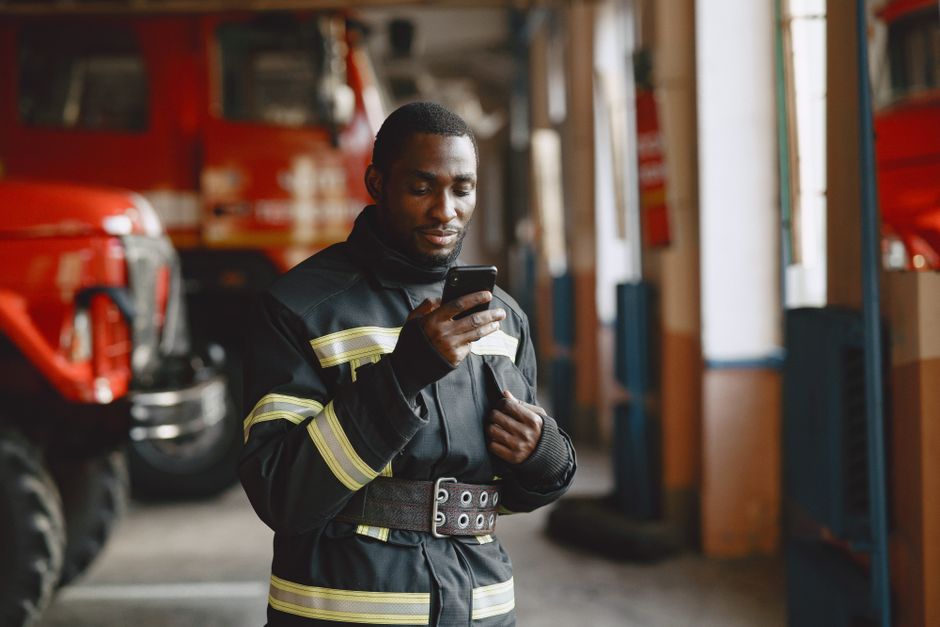
Photo by Gustavo Fring on Pexels
3M Scott Safety has learned that firefighter safety equipment cannot rely on standard cellular bands alone. The 700MHz LTE Band 14 (FirstNet) propagates better through building materials than higher frequencies, but antenna efficiency drops as temperature rises, meaning efficiency loss at the exact moment connectivity matters most. This forces a choice: the antenna window cannot be buried under thermal insulation. Design teams must specify high-temperature dielectric windows, often mica or ceramic composites, that maintain RF transparency while blocking infrared radiation.