GaN Travel Adapter Engineering Starts with Heat, Not Ports
The transition from silicon to GaN semiconductors allowed manufacturers to shrink 65W chargers into volumes previously occupied by 12W phone bricks. In digital nomad travel adapter design, this density is a liability disguised as a feature. When a user plugs a MacBook Pro and an iPhone into a dual-port adapter drawing maximum load, internal components can reach 85°C in a 25°C ambient room. Without active cooling, heat conducts directly into the housing. Anker’s GaNPrime series addresses this using thermally conductive plastics and internal copper shielding that doubles as a heat spreader; most competitors shrink component size without expanding thermal mass. After six months of daily use across varying voltages, the plastic surrounding the prongs warps, creating loose connections that arc and fail. Your material selection determines whether the device survives a year of airport lounge cycles or becomes a fire hazard in a guesthouse.
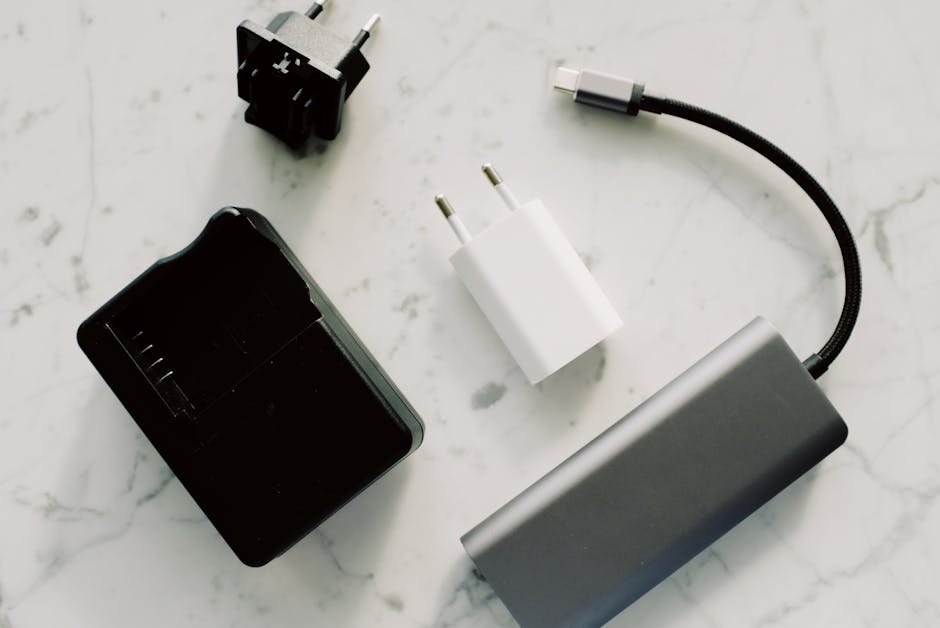
Photo by ready made on Pexels
Multi-Country Plug Adapters Force a Mechanical-Thermal Trade-off
The defining feature of universal travel adapter hardware is the sliding plug mechanism: UK pins retract, EU prongs extend, US blades deploy. This mechanical complexity competes for internal volume needed for heat sinks. Early designs like Apple’s World Travel Adapter Kit solve this by separating the plug heads entirely, but nomads lose the all-in-one convenience that justifies the price premium. Integrated designs must use metal slide tracks as thermal pathways, turning the mechanical deployment system into a heat dissipation network. This requires grounding continuity across every plug configuration, which introduces certification complexity. If the UK earth pin does not maintain continuous contact with the heat sink when retracted, the adapter fails IEC 60884 safety standards for multi-country plug adapters. Teams that navigate this successfully use beryllium copper springs for both conductivity and thermal bridging, accepting the material cost because the alternative is a plastic housing that softens at 100W in a 40°C environment.
The Moment of Use: When Specifications Meet Cafe Tables
A nomad sits at a shared table in a Lisbon co-working space with a single Schuko outlet positioned six inches above the floor. Their world travel power adapter must support the full weight of a UK plug converter plus a heavy 2-meter cable without sagging out of the socket. Simultaneously, the device is buried under a jacket in a bag, charging the laptop during a dinner break. Internal temperature climbs past safe thresholds because fabric insulates the housing. Products like the Zendure Passport II address this with a 90-degree swivel plug that distributes torque against the wall plate and firmware that throttles output when internal thermistors detect bag-constrained heat. Without this behavioral intelligence, GaN components enter thermal runaway. Design for the assumption that your device will be used in enclosed spaces at maximum load, not on open desks with ventilation.

Photo by Matheus de Souza on Pexels