Power Supply Architecture for Multi-Region Certification
That separation begins with electrons. Power standard adaptation looks deceptively simple, everyone knows about voltage ranges, but the implementation cascades through safety isolation, battery chemistry, and connector mechanics. Medical devices designed for 120V North American circuits require different creepage distances on their PCBs than their 230V European counterparts if you want to avoid redesigning the entire power supply for IEC 60601-1 compliance. The teams that win specify input stages for 90-264V universal supplies with modular IEC C14 inlets rather than hard-wired cords, and they select battery packs that satisfy UN 38.3 lithium transport rules globally rather than regionally. When your power subsystem accepts swappable input modules instead of fixed jacks, you transform a six-month recertification process into a warehouse kitting operation.

Photo by Markus Winkler on Pexels
User Interfaces and Labels Built to Change
If power is the electrical localization boundary, the user interface is the cognitive one. Multilingual industrial device requirements extend far beyond software strings. Safety standards like ISO 7000 and IEC 60417 prescribe symbol meanings, but warning label text must appear in local languages, often requiring physical space that competes with your industrial design. Philips‘ hospital bedside monitors solve this with removable fascia overlays; the underlying plastic molding stays identical, but the membrane switch graphic layer ships regionally. A technician on a Mumbai factory floor needs immediate comprehension of emergency stop functions without parsing English abbreviations under flickering fluorescent lights. Etching text into metal or plastic commits you to a SKU at the factory door. Designing for adhesive labels or snap-on bezels pushes that decision to the distribution center.
Radio Band Strategy: Multi-Band Chip vs. Modular Daughterboard
From visible surfaces to invisible signals, locale-aware device engineering faces its hardest constraint in RF architecture. A single “global” 5G modem does not exist; bands 77 and 78 for China Mobile differ from Verizon’s band 13. LoRaWAN devices must respect regional parameters, EU868 versus US915 versus AS923, or face legal transmission violations. You face a fork: integrate a multi-band chip with firmware locks, or design a modular radio daughterboard. The former reduces BOM cost but multiplies certification timelines because you must test every permutation. The latter adds connector cost but allows parallel certification tracks. For IoT fleet managers, the daughterboard approach turns a three-month regulatory delay into a two-week inventory pivot.
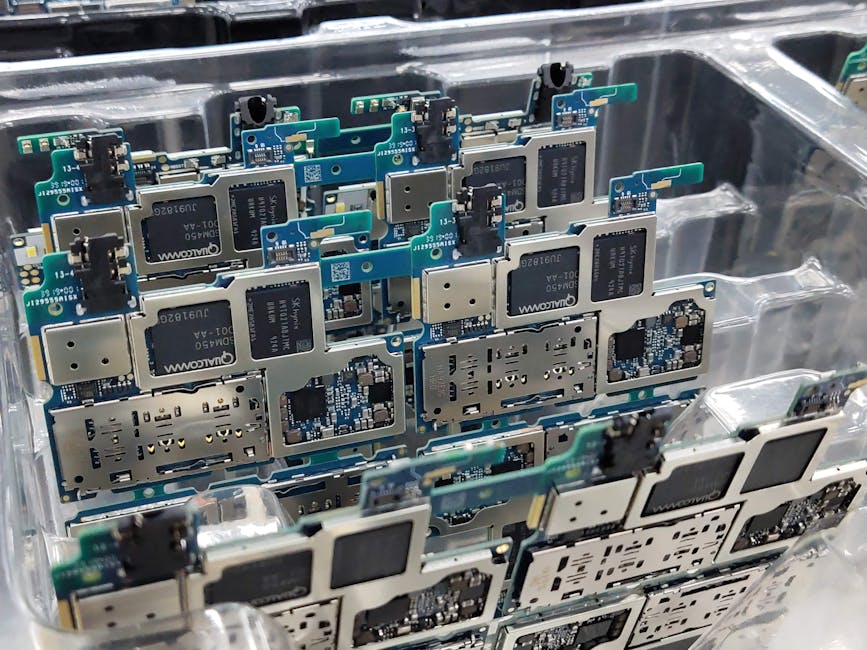
Photo by Andrey Matveev on Pexels
Running Certifications in Parallel, Not Sequence
That regulatory timeline determines market entry. Global device localization fails when teams treat certifications as sequential milestones; FCC first, then CE, then TELEC. By the time the Japanese radio lab finds your spurious emissions issue, you have already tooled the metal shielding for the American variant. Design instead for the strictest denominator upfront. If your device meets Germany’s BGV C1 safety requirements for industrial controls, it likely satisfies OSHA standards without redesign. This requires pre-scanning component libraries against regional substance restrictions, China’s RoHS 2 expansion covers four additional substances beyond EU RoHS, and documenting material declarations before the first prototype ships.