Bang Design

How to Design Health Wearables

Skin is a living organ that sheds roughly 30,000 dead cells per minute, shifts color with blood flow and emotional state, and changes its electrical properties based on sweat, hydration, and the time of day. This is the surface where health wearables must live and collect signal, which means the opportunity for continuous physiological measurement, the kind that could reshape early detection and chronic disease management, exists in an environment actively hostile to stable sensor contact. The central constraint is that the body will not hold still for you. Tissue moves beneath electrodes with every gesture, skin properties drift across hours and days, and the signal you need exists buried under noise that is genuinely biological rather than merely instrumental. The teams shipping products that pass clinical validation are the ones that accept from the start that mechanical isolation of the sensor from the body’s motion is not an optimization but the foundational design problem. Everything else follows from how you solve that first.

Optical Sensing Fails When You Ignore Tissue Perfusion Variance

That instability at the biological interface manifests first in optical systems. PPG sensors used in wearable health monitoring depend on consistent light transmission through capillary beds. But perfusion changes with temperature, hydration, and autonomic state. A sensor calibrated for office air conditioning generates garbage data during exercise vasodilation. The mechanical constraint here is contact force. Too little pressure and ambient light leaks in. Too much and you occlude the vessel you are trying to measure. This means the housing cannot be a rigid shell clamped to the wrist. It must be a compliant system that maintains constant normal force across joint flexion. Apple Watch Series 4 and later use a sensor array with flexible substrate backing to maintain optical coupling during movement. Your industrial design cannot be styled independently from the biomechanics of contact.
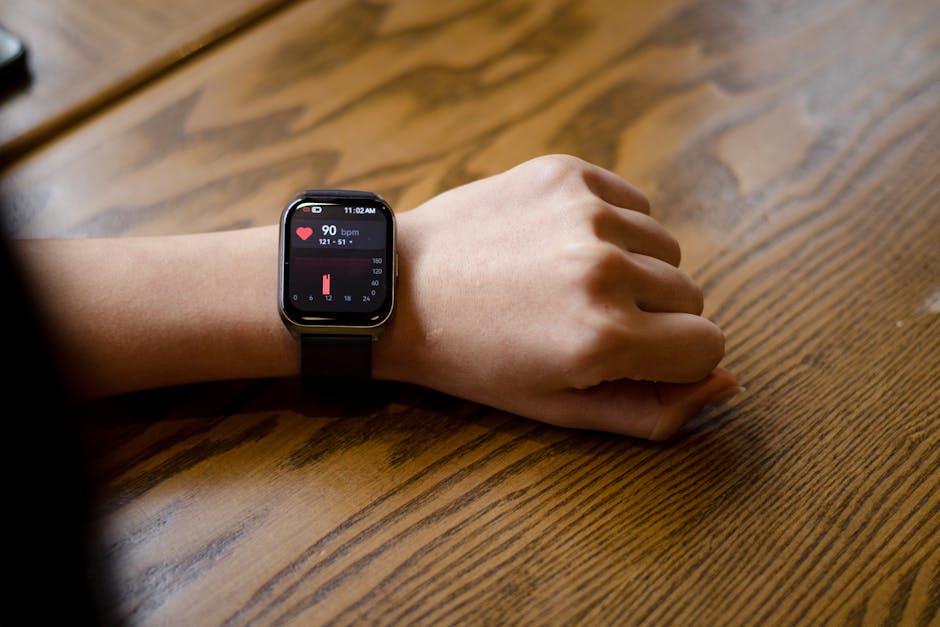
Close-up of a smartwatch displaying a heart rate of 90 bpm on a person's wrist.

Photo by ahmed akeri on Pexels

Mechanical Decoupling Is Your Primary Design Strategy

If tissue motion is the noise source, the solution is not better filtering but physical isolation. Accelerometers can subtract global motion from PPG signals, but they cannot subtract the local tissue deformation caused by skin stretching over bone. This is where medical wearable device architecture diverges from consumer fitness bands. Clinical systems use floating sensor pods or gel-coupled interfaces that allow the device chassis to move while the sensing element remains stationary relative to the tissue. Empatica builds this into their epilepsy monitoring wearables, using flexible PCB strain relief to isolate the EDA electrodes from wristband tension. The design principle extends to materials. Silicone durometer selection affects how shear forces transmit from the strap to the sensor housing. A 10 Shore A difference in strap material can change signal artifact amplitude by 30% in continuous health tracking scenarios. You are designing a vibration isolation system, not selecting a strap.

FDA Validation Exposes Design Weaknesses Across Demographics

That mechanical isolation becomes a regulatory requirement when you move from wellness to diagnosis. FDA wearable compliance for Class II devices requires validation across demographic variance that includes skin tone, body mass index, and peripheral perfusion conditions. A PPG algorithm that works on young, fit, light-skinned athletes will fail predicate device equivalence testing when confronted with darker skin tones or edematous tissue. This requires multi-wavelength LED arrays and dynamic gain control architectures that adjust for melanin absorption and subcutaneous fat depth. More critically, your clinical validation protocol must start during the proof of concept phase. You cannot retrofit biological robustness after the mechanical design is frozen. The teams that fail FDA submission typically optimized for a single user persona and discovered in pivotal trials that their contact force distribution created signal dropout on larger wrists or that their optical window geometry generated specular reflection artifacts on sweaty skin.
Person interacting with a smartwatch, showing a fitness application on the screen.

Photo by Pixabay on Pexels

Continuous Monitoring Creates a Thermal Feedback Loop

The regulatory requirement for 24-hour validation cycles creates a secondary constraint that loops back to the biological interface. Continuous health tracking requires power. Power generates heat. Heat changes the biological signal you are trying to measure. A 2C temperature rise at the sensor surface triggers local vasodilation, altering the very hemodynamics your algorithm interprets. This creates a feedback loop where the act of measurement changes the physiology. Solving this requires thermal vias in the PCB that move heat away from the skin interface, and duty cycling strategies that pulse the LEDs rather than running continuous illumination. Whoop addressed this in their 4.0 strap by moving the processing electronics to a pod away from the sensor array, reducing local heat flux. The trade-off is mechanical complexity. You are designing a distributed system with flex interconnects and secondary enclosures rather than a single rigid PCB. The alternative is data drift that looks like physiological change, and no amount of machine learning can fix thermal artifacts introduced at the analog front end.

Health wearable design ultimately succeeds when teams accept that they are building physiological interface systems rather than wearable computers. The sensors are commodities. The architecture that stabilizes them against biological reality is the product.

If you’re navigating the transition from fitness tracker to clinical-grade wearable product, Bang Design has spent 25 years taking medical wearable devices from concept to manufactured reality across consumer, medtech, and industrial sectors. Their subscription-based model means you get a full-stack team, industrial design, mechanical engineering, and manufacturing support, without the overhead of a traditional agency. Explore their work or start a project.

See all plans

Get in touch with us

By registering, you confirm that you agree to the processing of personal data by BangDesign as described in our privacy policy