When the Grid Fails: Energy as a Safety Specification
If charging stations are offline, every device becomes a countdown timer. Consumer rugged devices prioritize processing power; **emergency management hardware** must prioritize joules-per-operation. The Sonim XP8 achieves multi-day operation not through larger batteries alone, but through stripped-down Android kernels, aggressive sleep states, and removable 3180mAh cells. When a responder cannot reach a generator for 72 hours, battery architecture determines whether they maintain situational awareness or carry dead weight.
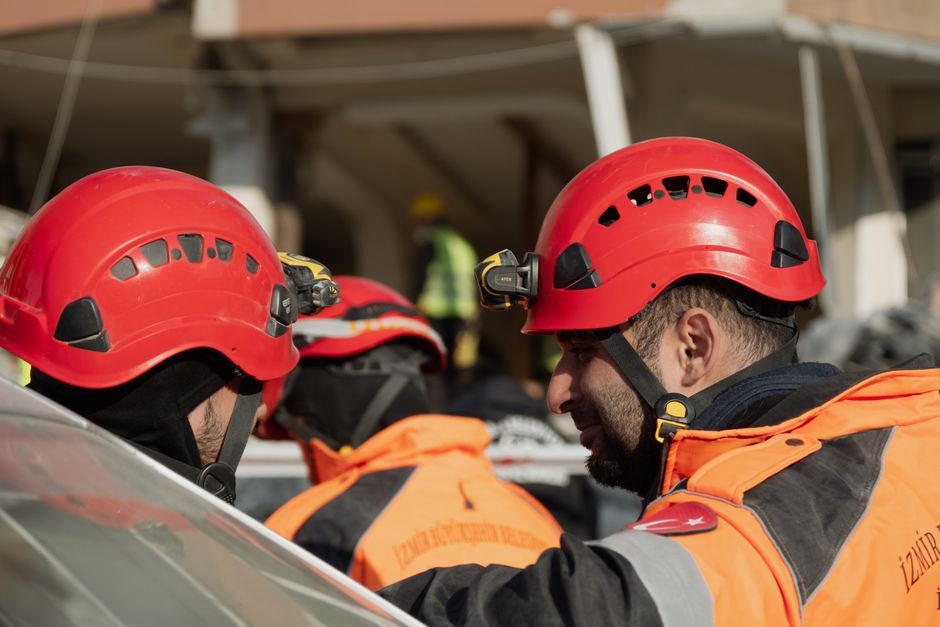
Photo by Doruk Aksel Anıl on Pexels
This shifts the design target from milliamp-hour capacity to total watt-hour efficiency and hot-swappable power systems. Lithium-polymer pouch cells may offer energy density, but they require sophisticated charging circuitry that fails first in moisture intrusion. Simpler cylindrical cell formats with mechanical retention clips allow field replacement in darkness. A device optimized for disaster zones will be thicker than consumer equivalents because the power subsystem must assume zero access to alternating current.
Mesh Networks Over Tower Dependency
When cell towers fail, traditional smartphones become useless. Disaster response devices must create their own networks through peer-to-peer meshing rather than attempting to reach distant infrastructure. GoTenna’s Mesh devices demonstrate the principle: **off-grid devices** must use radios optimized for horizontal propagation through rubble rather than vertical transmission to satellites. This demands hardware sacrifices, lower data throughput, simpler modulation schemes, and antenna selection that reflects real propagation paths.
Whip antennas snag in confined spaces, while internal ceramic antennas attenuate through concrete and steel. Some solutions deploy dipole antennas that extend only when the unit is stationary, trading durability for propagation efficiency. Mesh networking also alters processor selection. Routing protocols for disrupted networks require computational overhead, which increases draw on the already-constrained power budget. The device must balance the CPU cycles needed for mesh routing against the sleep states required for longevity.
Field Repair Beats Factory Precision
In a disaster zone, supply chains fracture. Devices often fail not from impact but from the inability to replace a cracked screen or degraded gasket. Panasonic‘s Toughbook 40 addresses this with modular components, keyboards, batteries, and I/O ports field-replaceable with a Phillips screwdriver. For **disaster relief handheld units**, the ability to swap a charging port with a knife and a spare part from a Pelican case matters more than IP68 certification.
Photo by Doruk Aksel Anıl on Pexels
Standardize on Phillips and Torx screws rather than adhesive or proprietary fasteners, tools found in a fire apparatus compartment. Gasket grooves must be wide enough to accept field-cut replacements when the OEM seal is compromised by hydraulic fluid or smoke particulate. This modularity increases manufacturing cost but decreases total cost of ownership in disaster contexts, where a $2,000 device that lasts six months with field repairs outperforms a $1,000 disposable unit that cannot be serviced.