The Three-Second Competition
In telecom retail, your device sits millimeters from direct substitutes under lighting designed to eliminate shadows. A customer scanning the wall of devices at an AT&T store makes the initial keep-or-dismiss judgment in under three seconds. This means surface finishes, aspect ratios, and display positioning are not marketing considerations applied after engineering—they are physical design constraints. Samsung’s Galaxy devices often win this scan test through saturated colorways that pop against neutral fixtures, while Google’s Pixel line relies on distinctive camera bars that create recognizable silhouettes even when the screen is off. Without a distinctive visual signature in the retail environment, the device disappears into chromatic noise and loses the conversion opportunity before the customer ever touches it.
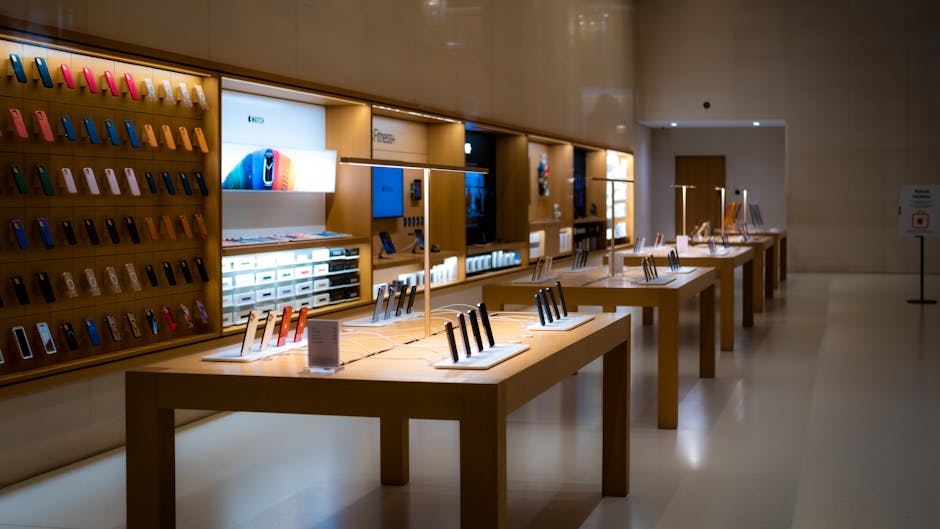
Photo by Mathias Reding on Pexels
Heat Dissipation When the Back is Covered
That visibility challenge becomes a thermal crisis once the device mounts vertically against a security backplate. Most consumer hardware assumes the back surface faces open air. In carrier stores, the back is mated to an alarm sensor and charging pad, creating an insulated sandwich that traps processor heat. Devices like the Nothing Phone, with its transparent back exposing internal components, require careful thermal modeling for retail environments—the transparent aesthetic that sells the story to consumers becomes a liability if the security mount blocks the graphite spreaders and causes the unit to throttle during a customer’s speed test. Teams must validate thermal performance in the tethered state, not just the handheld state, because a demo unit that throttles never converts to a sale.
The Tether as Structural Requirement
The thermal constraint compounds the mechanical reality of anti-theft systems. Carrier store merchandising hardware operates on proprietary standards that vary by operator—some use retractable coiled cables, others use rigid goosenecks, and flagship displays often use flush magnetic mounts with alarm loops. The device must accommodate these attachment points without compromising the industrial design language that defines the brand. Apple solves this by controlling the entire fixture, designing tables where the tether is invisible. For everyone else, the tether point becomes a structural engineering decision that directly affects durability. Retail variants must include dedicated recesses or reinforced bosses specifically for security screws, ensuring the theft-detection system does not crack the housing during the hundreds of daily handling cycles that characterize high-traffic stores. These attachment points must survive fatigue testing that exceeds normal consumer use by an order of magnitude.
Photo by Mathias Reding on Pexels
Packaging as the Silent Salesperson
When the tether prevents customers from hefting the device, the box becomes the tactile interface. Telecom retail packaging must satisfy two opposing conditions: it must protect the unit through global logistics, yet communicate premium value when stacked on a backbar or end-cap. The packaging system also determines how quickly store staff can perform “flips”—swapping demo units for sale stock without disrupting the display. Samsung’s recent retail boxes use tear strips that separate the outer shipping carton from the inner presentation case, allowing associates to transition units from shipping mode to display mode in seconds. Packaging that requires scissors or generates excess void fill slows down retail operations and risks non-compliance with carrier merchandising standards.