How Aging Skin Changes PPG Sensor Accuracy
Standard PPG sensors in consumer wearables assume dermal consistency. Between ages twenty and seventy, epidermal thickness decreases by as much as twenty percent, and subcutaneous fat redistribution alters optical path length. For senior exercise gadget design, this means the signal-to-noise ratio that worked for twenty-five-year-old wrists becomes unusable without mechanical intervention.

Photo by Kampus Production on Pexels
Apple Watch Series 9 and Samsung Galaxy Watch 6 use multi-LED arrays to compensate for motion artifacts, but they don’t account for age-related skin opacity changes that attenuate green light differently than infrared—a gap that forces designers to choose between higher LED power and shorter battery life. An active aging device must either increase LED power, draining battery faster, or relocate sensors to areas with better vascular density, like the upper arm rather than the wrist.
The mechanical solution usually involves increasing contact pressure through stiffer strap materials or larger sensor windows. But stiffer straps create their own problems for skin integrity. Product design teams must prototype with silicone durometers between 40-60 Shore A, soft enough to prevent pressure injuries during sleep tracking but firm enough to maintain PPG coupling during brisk walking. This is not material selection. It is medical device engineering disguised as consumer electronics.
Get this wrong and you ship a device that reports phantom heart rate spikes during gentle walking, triggering unnecessary medical anxiety.
Gait Variability as a Design Input, Not a Filter Error
That sensor uncertainty compounds once the user starts moving. Healthy aging produces gait speed variations of up to twelve percent step-to-step, compared to three percent in younger adults. Standard step-counting algorithms interpret this variability as GPS drift or shuffling, filtering it out as error.
Elderly active lifestyle hardware must treat gait variability as meaningful data. The Oura Ring Gen 3 captures this by focusing on nighttime HRV rather than daytime motion, sidestepping the problem entirely. But for daytime activity tracking, the engineering response is different: wider inertial measurement unit filtering bands and explicit confidence metrics displayed to the user.
Imagine Margaret, seventy-two, walking her dog on an uneven sidewalk. Her step pattern is irregular because she is navigating ice patches, not because she is unwell. If her device vibrates with a false positive fall alert, she may stop wearing it. The UnaliWear Kanega Watch approaches this by requiring voice confirmation before alerting emergency contacts, turning a hardware sensor decision into a UX trust protocol.
Each false positive incurs real cost: either emergency dispatch fees or family anxiety that degrades trust. In age-friendly fitness device UX, specificity matters more than sensitivity. It is better to miss one real fall than to generate ten false alarms, because the tenth false alarm results in permanent disuse.
Interface Design for Reduced Fine Motor Control
Physical exertion reduces fine motor control and near-vision acuity in older adults more steeply than in younger users. The accessible fitness wearable cannot rely on pinch-to-zoom or small touch targets. Consider the interaction loop: user raises wrist, screen must wake without the tap gesture that requires fine motor control, text must be readable without reading glasses, minimum 18pt equivalent at arm’s length, and feedback must confirm within 400 milliseconds to feel responsive. Miss any of these thresholds during prototype testing with users over seventy, and the device fails in the field.
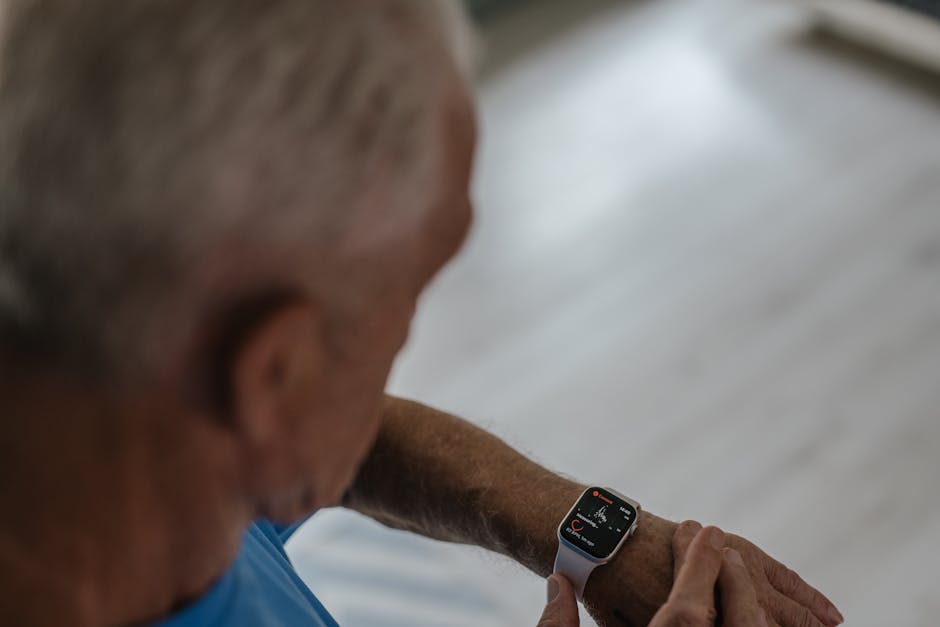
Photo by SHVETS production on Pexels
Garmin’s Vivosmart 5 uses a physical button rather than touchscreen for this reason, but even that assumes the user can locate a small control while moving—a limitation that pushes senior fitness devices toward haptic differentiation and voice-first interfaces. Distinct vibration patterns for “goal reached” versus “slow down,” and voice commands that work without cloud connectivity, become essential because seniors often exercise in areas with poor cellular coverage.
This creates a manufacturing fork. A dedicated voice processor adds BOM cost but removes the ongoing dependency on smartphone pairing, which is where many senior users drop out of the ecosystem. When the technical barriers fall, the behavioral ones remain.