The Deformation Problem: When Protection Destroys Data
Protective materials work by converting kinetic energy into deformation. Viscoelastic foams compress. Honeycombs buckle. Shear thickening fluids solidify. In each case, the material saving the wearer is experiencing strains that destroy standard MEMS packages.

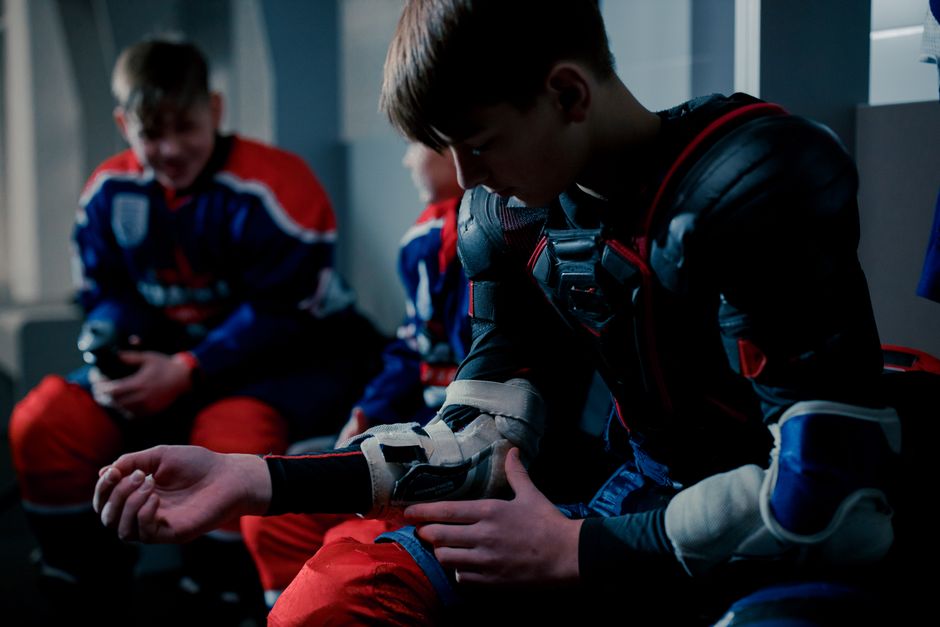
Photo by Amar Preciado on Pexels
This changes how you select materials for smart safety equipment hardware. You cannot simply embed a rigid PCB in crushable foam and expect valid data during a catastrophic impact. The board will either protect itself by creating a hard spot that transfers load to the wearer, or it will flex and fracture. Neither produces useful data.
The solution is local reinforcement that doesn’t create injury points. Teams at Xsens and McLaren Applied (working on motorsport wearables) use island architectures—rigid sensor nodes connected by flexible interconnects that can stretch 200% while maintaining signal integrity. The sensor becomes a floating datum within the padding, mechanically isolated but kinematically coupled, surviving the deformation that would fracture a traditional rigid package.
But isolation creates calibration drift. If your foam shear-thins or temperature-cycles during use, the sensor’s orientation relative to the body changes. That means your firmware must continuously recalibrate using sensor fusion—combining accelerometer data with gyroscopic drift detection to maintain spatial awareness even as the mechanical matrix shifts.
Field Calibration: Why Lab Data Misleads
Standard impact testing uses drop rigs with perfect vertical trajectories. Real impacts involve rotation, multiple contact points, and surface friction that changes the impulse profile. Connected PPE design fails when engineering teams validate against ASTM standards but ignore angular acceleration.
The NFL’s Head Health Challenge winners discovered that concussions correlate more strongly with rotational velocity than linear acceleration. Yet most instrumented helmets still optimize for straight-line drops because that is what certification requires. If you are building impact sensor gear systems for actual injury prevention, you need gyroscopes sampling at 1000Hz minimum, and you need them positioned where rotation is most severe—typically the periphery of the helmet, not the crown.
This placement choice creates manufacturing complexity. Peripheral foam is often softer to manage rotational impact, meaning your sensor node must survive higher strain rates while maintaining tighter tolerances. The 2023 Virginia Tech Helmet Ratings updates explicitly penalize designs that place electronics in high-deformation zones without strain relief engineering.
The Moment of Doubt: Smart Padding Device UX in Crisis
All of this engineering serves a human moment. Consider a construction foreman who just took a hard fall. His smart harness registered 15g of deceleration. The device vibrates against his hip, showing a yellow warning on the display.
This is where smart padding device UX becomes critical. If the alert suggests he is fine when he has a micro-fracture, he continues working and causes further damage. If it suggests evacuation for a benign impact, he learns to ignore the system. The interface is not displaying data; it is calibrating trust.
Successful instrumented protective equipment uses contextual thresholds, not absolute numbers. A 10g impact to a helmet is different than 10g to a knee pad. More importantly, the UI must show trend data—”this impact was 40% harder than your average”—rather than raw acceleration figures that mean nothing to a worker in pain.
The Spot-r clip by Triax (now used on thousands of construction sites) solves this by eliminating the screen entirely. It logs data silently and only interrupts with binary alerts: green or evacuation. The UX disappears until it matters, reducing cognitive load during emergencies while maintaining the data trail for insurers and safety officers.