Treating the Room as Your Acoustic Enclosure
In a small apartment, the wall behind the television is not a backdrop; it is a reflective surface that reinforces low frequencies by 3 to 6 dB. When a compact soundbar design places drivers four inches from drywall, the rear wave reflects in phase with the front wave below 200 Hz, creating boundary gain that conventional crossovers do not account for. Early reflections between parallel walls 12 feet apart generate standing waves that amplify 47 Hz and its multiples, exactly where small drivers struggle to control excursion. Small room soundbar hardware must therefore abandon the free-field tuning used in anechoic testing. Instead, the enclosure becomes an active acoustic element, with baffle dimensions calculated to control directivity in near-field listening distances of six feet or less. The industrial design phase must include boundary element modeling, not just aesthetic surfacing. The acoustic target response is not flat anechoic; it is a deliberate roll-off below 120 Hz that anticipates room gain, preventing the boomy coloration that makes dialogue unintelligible in studios.
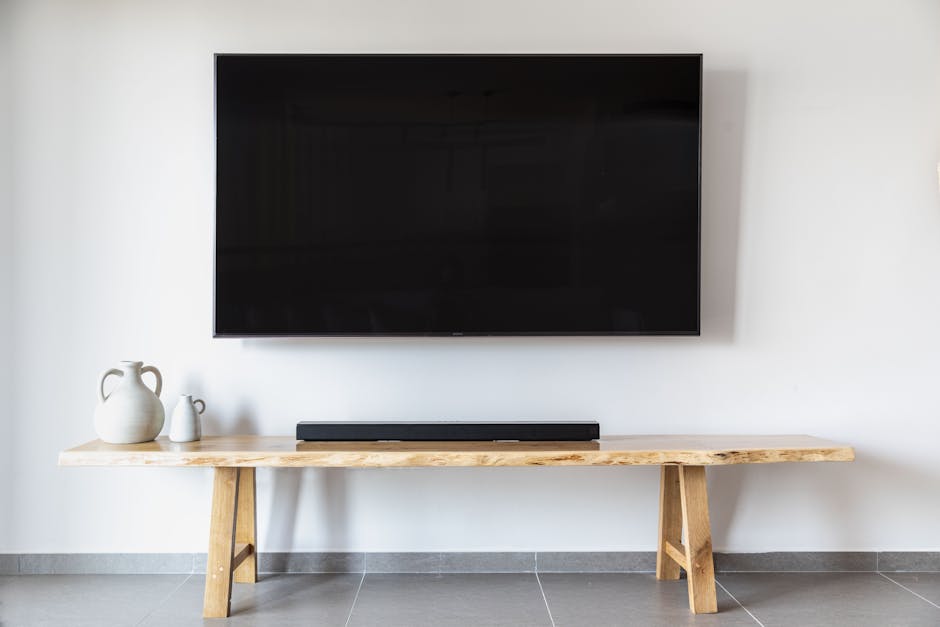
Photo by yair elgazar on Pexels
Passive Radiators Over Ports in Wall-Mount Configurations
That boundary loading creates a mechanical constraint for the enclosure itself. Bass reflex ports require clearance equal to their diameter from any surface to prevent turbulence and compression. In slim soundbar designs under 75 millimeters deep, achieving meaningful port area while maintaining wall clearance becomes geometrically impossible for wall-mount configurations. The alternative, passive radiators, eliminates the clearance requirement but introduces moving mass that must be balanced against the driver’s excursion limits to prevent bottoming out at high SPL. Apartment soundbar engineering therefore favors sealed or passive radiator systems over ported designs, accepting the 3 dB efficiency penalty to gain placement flexibility. Sony’s HT-S200F demonstrates this trade-off, using dual passive radiators to extend response without rear clearance—a choice that avoids the common failure mode where a port tuned for 80 Hz becomes a turbulence source when flush-mounted to drywall, violating the crossover’s acoustic assumptions and driving warranty claims for defective bass.
Adaptive DSP for Placement Shifts
Even with passive radiators, the frequency response shifts dramatically between shelf and wall placement. A soundbar sitting on a media console experiences half-space loading, while the same unit wall-mounted operates in quarter-space, gaining additional low-end energy that can exceed 8 dB at 60 Hz. The critical design response is adaptive DSP that measures the room response after installation and adjusts for placement changes, not just factory calibration based on a reference environment. Consider the user at 10:00 PM on a Tuesday, switching the soundbar from the TV stand to the wall to free desk space for a project. Without room correction, the bass becomes boomy enough to transmit through floor joists to the neighbor below—a social failure, not just an acoustic one. Small apartment audio product design must include microphones and processing power to run real-time analysis, compensating for modal peaks at 100 Hz caused by the 8-foot ceiling height typical of post-war apartments. The hardware cost is fixed; the user trust depends on it working correctly after every relocation.
Photo by yair elgazar on Pexels