The Proprioceptive Gap Is the Real Injury
Medical timelines create a dangerous illusion. Ligaments heal in six to eight weeks. Movement confidence rebuilds in six to eight months. When a young athlete steps back onto the pitch, their brain often restricts range of motion before pain ever registers. This neurological guarding alters gait and loading patterns, transferring stress to adjacent joints and creating the exact conditions for re-injury.

Photo by RDNE Stock project on Pexels
Child sport injury comeback equipment must address this nervous system lag. The device becomes a prosthetic confidence layer, providing sensory substitution until proprioception recalibrates. This means haptic feedback that cues proper alignment before the athlete consciously feels unstable, not alarms that trigger after the dangerous movement has occurred. Rigid braces like DonJoy or Össur stabilize anatomy but amplify this psychological barrier by blocking sensory feedback entirely. Child sports recovery device hardware must thread the needle: enough mechanical support to prevent catastrophic failure, enough sensory transparency to rebuild natural movement mapping.
Load Modulation Must Feel Like Strength, Not a Crutch
Traditional hinged braces offer binary protection: locked or free. This forces a choice between false security and real risk. Youth rehab sport devices need graduated resistance that scales with fatigue and form degradation throughout a ninety-minute session.
Consider the difference between a rigid ACL brace and a soft-sensor system using conductive thread arrays or strain gauges woven into compression fabric. The first creates dependency. The second allows the child to feel their own strength returning. Gentle return sport gear succeeds when load limits are invisible thresholds rather than mechanical stops. When a young soccer player plants their foot to cut, the device should provide just enough resistance to cue proper knee tracking without preventing the movement entirely. This preserves the neuromuscular learning that rigid immobilization destroys. The material stack matters: silicone gel pads for impact absorption, spiral stays for torsional stability, and textile-integrated sensors that measure shear forces in real time.
Feedback Loops Need Engagement, Not Clinical Metrics
Medical compliance dies when data feels like a report card. Safe comeback sports product design must borrow from gaming mechanics rather than clinical monitoring. Adolescents abandon devices that display asymmetry percentages or medical alerts. They engage with haptic rhythms, streak counters, and biofeedback that feels like skill acquisition.
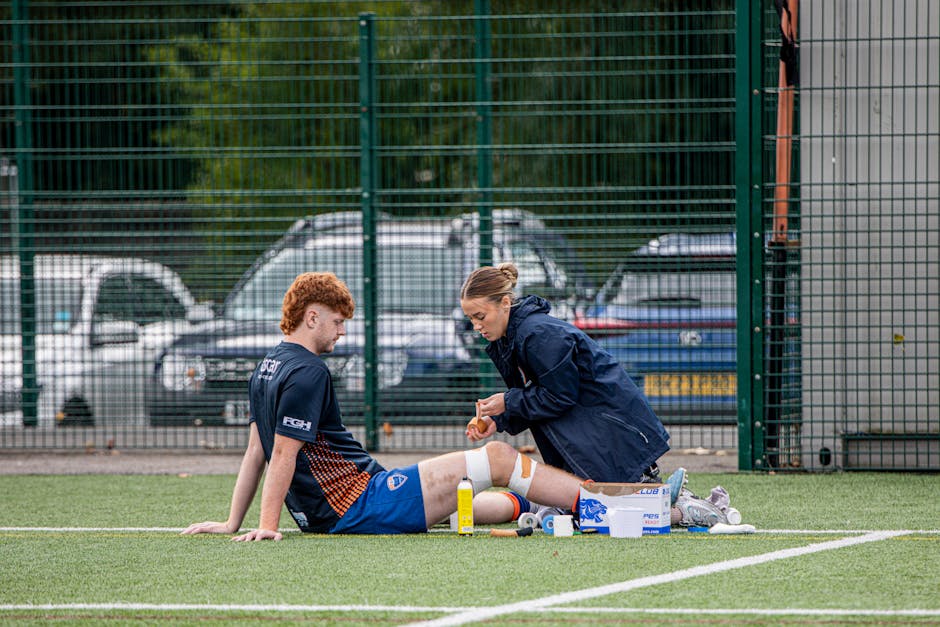
Photo by Ollie Craig on Pexels
The industrial design challenge is hiding the medical authority while preserving the clinical rigor. A child athlete recovery device that vibrates to celebrate ten proper landings in a row triggers the same dopamine pathways as beating a level. One that buzzes to warn about excessive knee valgus triggers cortisol and device removal. The sensor fusion remains identical; only the interface architecture changes. This distinction determines whether the hardware survives the full twelve-week return-to-play protocol or gets left in the locker room after week two. The physical hardware must also survive this timeline: IP67 waterproofing for showering, antimicrobial textiles for adolescent hygiene habits, and battery life that exceeds one week to avoid charge anxiety.
The Taper Is Where Products Die
The business model for youth return-to-sport product design faces a retention cliff. Young athletes abandon protective equipment exactly when pain subsides but motor control remains compromised. This is the taper phase: weeks four through twelve of return-to-play, when tissue is healed but movement patterns are still vulnerable.
Safe comeback sports product architecture must evolve. The hardware should transition from protective to performance-focused, shifting its value proposition from injury prevention to athletic enhancement. Compression sleeves that initially stabilized the ankle become performance trackers measuring explosive power asymmetry. The sensors stay on the body, but the app experience pivots from rehab to performance optimization. Systems like Whoop captured the adult performance market by starting with recovery; pediatric devices must work in reverse, starting with protection and graduating to performance data. This requires firmware architecture that supports mode shifting without hardware swaps, and a pricing model that acknowledges the six-month usage window rather than assuming permanent adoption.