How to design devices that integrate with wearable medical sensors
The shift from hospital wards to home-based chronic care has created a market for devices that do not merely display biometric data but correlate it against clinical baselines. A patient recovering from heart failure might wear a patch ECG, a finger pulse oximeter, and a blood pressure cuff simultaneously, yet without a bridge that understands how these signals interact, physicians receive isolated data points rather than diagnostic trends. The central tension is that wearable medical sensors speak proprietary protocols, transmit at irregular intervals, and drop offline unpredictably; treating them as reliable data sources requires hardware that actively manages connection state rather than passively receiving packets. The teams that succeed understand that **wearable sensor medical device integration** treats the hub as a clinical instrument subject to the same validation rigor as the sensors themselves, not a consumer electronics accessory that merely aggregates Bluetooth streams.
Protocol Translation Beyond Bluetooth Compatibility
Most wearables advertise Bluetooth Low Energy compatibility, yet the standard stops at the transport layer. The Philips Biosensor, BioIntelliSense BioButton, and Apple Watch all use BLE, but their GATT services encode physiological data differently. A **Bluetooth wearable device receiver** that treats all incoming packets identically will misinterpret arrhythmia flags as step counts or miss critical glucose alerts buried in manufacturer-specific characteristic UUIDs. This means the **health sensor gateway hardware** must embed protocol translators that map proprietary data schemas to FHIR or IEEE 11073 standards before the application layer sees them. Companies like Withings have solved this by building modular radio stacks that sandbox each sensor’s communication protocol, isolating timing jitter from one device so it does not desynchronize the others, a pattern that reveals the architectural cost of true interoperability.
Photo by Nutrisense Inc on Pexels
Edge Processing Determines Clinical Utility
Raw sensor streams require contextualization against patient history to trigger clinical alerts. A blood oxygen reading of 88% is emergent for a healthy adult but expected for a severe COPD patient. Relying on cloud processing introduces latency that can miss acute events; the **connected health hub design** must instead perform edge computing to compare incoming vitals against localized baselines. This shifts the hardware architecture toward microcontrollers with DSP capabilities rather than simple Bluetooth-to-WiFi bridges. The power budget then becomes a clinical constraint, not merely a user convenience, because a hub that sleeps to save battery might miss the 30-second desaturation event that predicts respiratory failure. When a patient deteriorates fastest at night, the hub’s processing schedule becomes a matter of clinical timing.
RF Environment as Diagnostic Accuracy
In a home environment, the integration device sits near microwaves, baby monitors, and WiFi routers competing for 2.4 GHz spectrum. For a **wearable data aggregation device**, dropped packets are not connectivity irritants; they create gaps in trend lines that physicians rely on for medication adjustments. The antenna design must prioritize robust connection maintenance over sleek aesthetics. This means external ceramic antennas rather than printed circuit traces, and shielding strategies that prevent the WiFi radio from desensitizing the Bluetooth front-end when both transmit simultaneously. The hardware decision becomes a clinical accuracy decision because interpolation algorithms cannot reconstruct missed atrial fibrillation episodes.
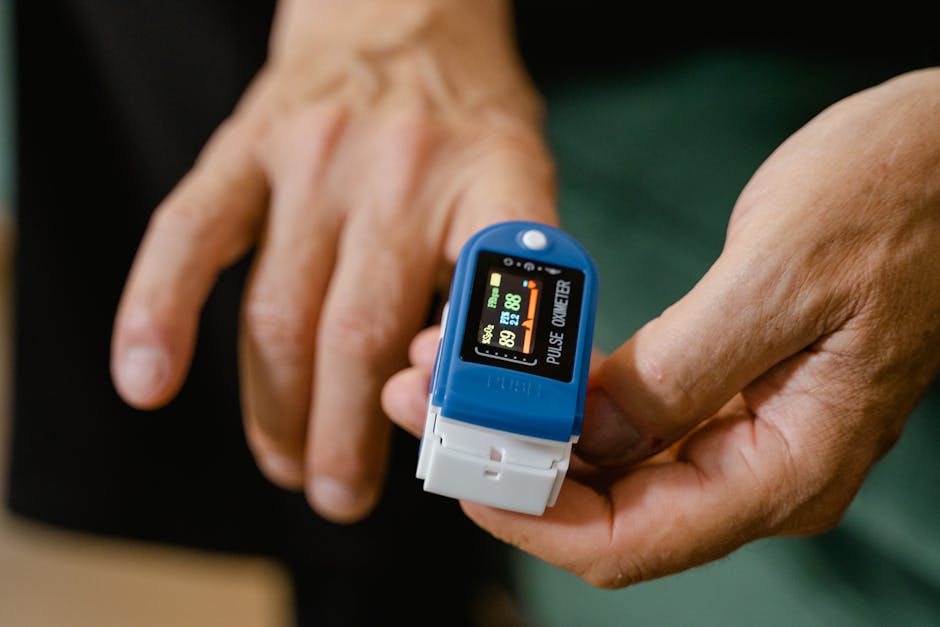
Photo by Tima Miroshnichenko on Pexels
Regulatory Parallelism
If the integration device processes signals to generate clinical alerts, regulators classify it as Software as a Medical Device (SaMD) or an accessory to the primary sensor. FDA 510(k) submissions for **wearable sensor medical device integration** hubs require evidence that packet loss, latency, and edge-processing algorithms do not introduce diagnostic errors. This validation burden means the product development cycle mirrors that of the wearables themselves, including biocompatibility testing for patient-facing surfaces and EMC testing that exceeds consumer electronics standards. The business model must account for these fixed validation costs regardless of unit volume.
Consider a patient with congestive heart failure discharged to home care. At 3:00 AM, their chest patch detects fluid accumulation through impedance changes while a pulse oximeter notes declining SpO2. The **wearable sensor data platform** must correlate these asynchronous events, recognize the pattern as acute decompensation, and alert the care team before the patient awakes breathless. If the hub has prioritized power savings over connection monitoring, or if RF interference has corrupted the impedance trace, the window for early intervention closes.
Designing these systems requires treating interoperability not as a software layer to be patched later but as a fundamental hardware architecture decision. If you are navigating the complexity of **mHealth device interoperability** or building **health sensor gateway hardware** that meets clinical validation standards, Bang Design has spent 25 years translating medical requirements into manufactured reality across consumer and health & life sciences sectors. Their subscription-based model pairs industrial design with regulatory-compliant product engineering to bring connected health devices through validation and into production. Explore their work or start a project.
Meta: Designing wearable sensor medical device integration requires clinical-grade hardware architecture, protocol translation, and edge processing for reliable connected health hub design.