Environmental Protection as Signal Integrity
Portable ultrasound hardware design for rural deployment starts with the understanding that IP54 ratings and drop tests describe survivability, not operability. Heat degrades piezoelectric crystals. Humidity corrodes connectors. Dust infiltration changes acoustic impedance at the lens surface. Early handheld systems struggled with capacitive micromachined transducers that offered lower power draw but required hermetic sealing against humidity that hospital-grade transducers never encountered in controlled environments. In rural medical device design, environmental protection isn’t a housing decision. It is a signal integrity decision because thermal drift changes the speed of sound through tissue, misregistering anatomy by millimeters that matter clinically. The device must survive drops, thermal cycling that cracks solder joints, and condensation that shorts beamformer circuits.
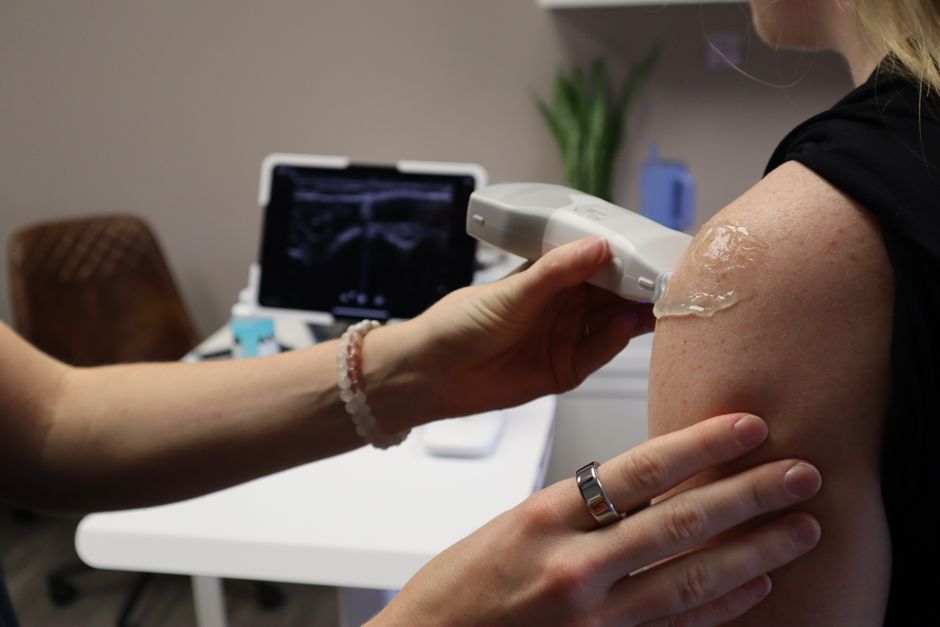
Photo by Carly Dernetz on Pexels
Power Architecture as Clinical Specification
Hospital carts plug into wall current. Handheld units carry their own grid. A battery-powered diagnostic device in rural settings must complete fifteen to twenty scans on a single charge because solar charging might be intermittent and replacement batteries unavailable. This flips the traditional design hierarchy. Instead of selecting a transducer and adding power management, you start with watt-hours and work backward. Offloading beamforming to a tablet’s processor turns the probe into a passive sensor, but that creates dependency on consumer electronics that fail in heat. The alternative is onboard processing with proprietary ASICs to reduce power per channel, accepting the engineering cost of custom silicon to gain independence from host devices. The choice between these architectures, distributed processing versus edge computing, determines whether your low-power ultrasound transducer can maintain frame rates sufficient to catch cardiac wall motion abnormalities without draining the cell before the clinic day ends. Teams often discover too late that their power budget forces a choice between penetration depth and battery life, leaving them unable to image obese patients or deep abdominal structures late in the workday. Power management isn’t a battery selection; it is the primary constraint on acoustic performance.
When Ruggedization Degrades Resolution
Ultrasound probe ruggedization typically focuses on impact resistance. Regulatory drop tests require survival from one meter onto concrete. In rural deployment, the harder problem is maintaining acoustic coupling across temperature extremes and surface contamination. Piezoelectric crystals change resonant frequency with temperature. A probe calibrated for 22°C hospital rooms drifts off-center at 45°C ambient, producing acoustic shadows that mimic pathology. The lens material must remain compliant at low temperatures while resisting UV degradation at high altitude. Thermally conductive potting compounds can stabilize crystal temperature, but they add weight that clinicians feel during extended scanning sessions in a hot clinic, creating a secondary ergonomic constraint. Sealing against dust creates a sealed chamber where humidity accumulates, requiring desiccant cartridges or active venting with hydrophobic membranes that add acoustic attenuation. This is portable ultrasound hardware design as thermal engineering: the housing that protects the electronics must also become a heat sink that stabilizes the acoustic path.
Photo by Carly Dernetz on Pexels
interface design Under Cognitive Load
The clinician using a point-of-care ultrasound device in rural settings is often a generalist, not a sonographer. They are making decisions during obstetric emergencies or trauma assessments where cognitive load peaks. Complex multi-parameter interfaces that work in teaching hospitals fail here. Scanning presets selected by body part icons rather than technical parameters hide gain and TGC controls behind advanced menus that generalists rarely need. But the deeper challenge is feedback latency. In a dimly lit clinic, screen glare and slow frame rates force the user to guess probe position. The device must provide immediate visual confirmation because there is no colleague to confirm the view. This means optimizing the imaging pipeline for latency over resolution, accepting speckle noise to maintain 30fps rather than smoothing frames and introducing lag. Battery indicators must show scans remaining, not percentage charge, because clinicians think in clinical throughput, not electrical capacity. A delayed image is a missed diagnosis when the patient is unstable.