Bang Design

How to design self-check-in terminals for clinics

The waiting room is where clinical errors begin. A patient arrives with incomplete paperwork, outdated insurance information, or symptoms too fresh to articulate clearly, gaps that propagate through triage, billing, and treatment. Self-check-in terminals promise to close these gaps at the source, capturing structured data while the patient is still motivated to correct the record. But clinics are not retail environments. The humans approaching these screens are often anxious, in pain, elderly, or navigating the interface in a second language, cognitive states that make standard touchscreen assumptions collapse. A patient self-registration terminal succeeds only when it treats physical accessibility and emotional state as primary engineering constraints, not UX polish added after the fact.

Cognitive Load as a Hardware Variable

Most touchscreen clinic terminals fail because they import retail UX patterns, flat glass, small hit targets, rapid timeouts, into a context where users read 40% slower and make three times more input errors. The hardware must compensate for reduced working memory. This means capacitive touch surfaces need higher conductivity targets for elderly users with dry skin. Screens require 30-degree downward tilt to accommodate bifocal wearers without neck strain. A patient with Parkinson’s cannot steady their hand for a signature pad; the device needs a physical ledge or stylus tether that provides proprioceptive feedback. Every input error forces a staff member to intervene, erasing the labor savings that justified the capital expense. When the physical interface compensates for the user’s state, data accuracy improves and clinic workflows accelerate.
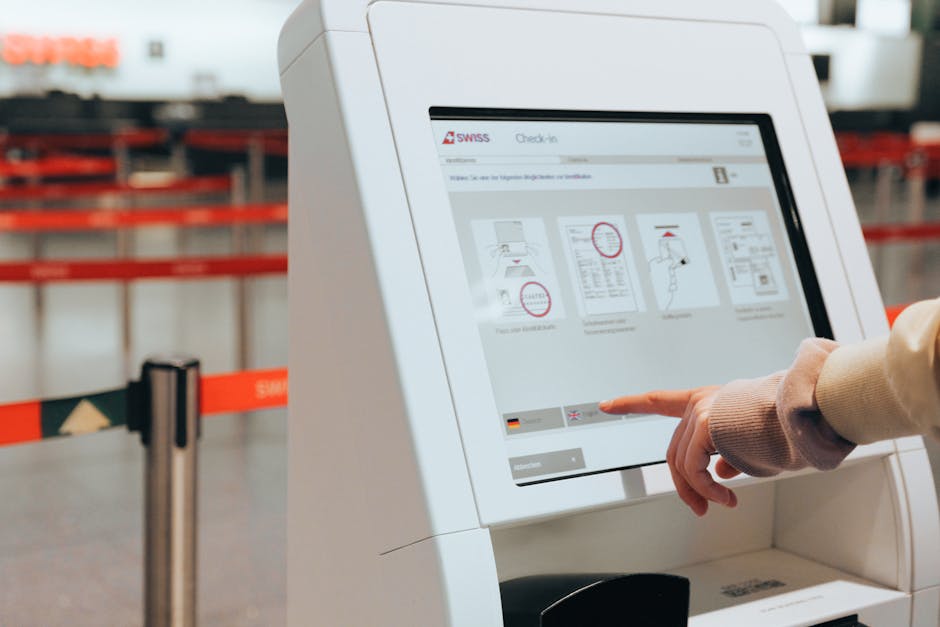
Passenger using self-service check-in kiosk at airport for convenient travel experience.

Photo by Anna Shvets on Pexels

The Sanitization-Material Paradox

Clinical environments impose material constraints that consumer kiosks never face. A clinic check-in terminal must survive 50 or more cleaning cycles daily with hospital-grade disinfectants containing quaternary ammonium compounds or bleach. These chemicals craze polycarbonate screens and degrade painted finishes within months, creating surfaces that harbor bacteria despite aggressive cleaning. The choice between antimicrobial copper alloys and sealed aluminum becomes a total-cost-of-ownership calculation, not an aesthetic one. Legacy pharmacy kiosks often use ABS plastic that turns sticky after six months of wiping; modern patient flow hardware uses powder-coated steel or anodized aluminum that maintains tactile feedback after years of abrasion. The material must feel clean to the touch while being biologically inert, a tension resolved through bead-blasted finishes that hide fingerprints without obscuring the clinic’s identity.

HIPAA Compliance is Architectural

Clean surfaces matter, but the most overlooked contamination risk in a clinic check-in terminal is visual and acoustic. HIPAA-compliant design rarely fails in SSL certificates. It fails in the waiting room sightlines. A patient entering their Social Security number while a stranger queues three feet behind them faces a privacy violation regardless of database encryption. Effective terminals use 45-degree privacy filters that narrow the viewing cone to 60 degrees, paired with acoustic dampening baffles that prevent keystroke echo in hard-surface lobbies. The enclosure itself creates a psychological territory, a partial shroud or side wing that signals “this space is yours” even in open floor plans. These are industrial design decisions: the depth of the hood, the reflectance of the screen coating, the height of the sidewalls. A terminal that ignores physical privacy trains patients to skip sensitive entries, creating incomplete records that violate clinical protocols and expose practices to audit risk.

Wide view of an airport terminal in Zagreb featuring self-service check-in kiosks.

Photo by Vladimir Srajber on Pexels

Integration and Graceful Degradation

Physical design protects privacy, but the terminal must also function when the network fails. The device lives in a clinical workflow, not in isolation. When the EHR sync fails or the queue management API times out, the patient check-in terminal cannot hang on a loading screen. Patients abandon terminals that stall; staff lose the efficiency gains that justified the capital expense, and queues back up into the parking lot. Engineering for offline resilience means local data caching with automatic reconciliation, but it also means hardware indicators, a physical LED status ring or immediate printer receipt, that confirm success even when the network disagrees. Phreesia addressed this by treating the terminal as a thin client with local session persistence, letting completed registrations survive Wi-Fi dropouts without patients losing confidence in the system. The hardware must communicate system state clearly: patients need to know if they should wait for a badge or proceed to triage, and staff need physical confirmation that the queue has updated.

A self-check-in terminal is judged not by its feature set but by what happens when a 78-year-old with arthritis and mild hypoglycemia tries to use it during flu season. The teams that get this right treat the waiting room as an extension of the examination room. Every interaction is clinical data collection, and every hardware choice affects diagnostic accuracy downstream. They build medical check-in terminals as a physical therapy, not a software interface.

If you’re navigating the intersection of clinical compliance and human factors in health technology, Bang Design has spent 25 years bridging those gaps, taking products from concept to manufactured reality across consumer and medical markets. Their subscription-based model provides a full-stack team, design, engineering, visualization, and production, without the overhead of a traditional agency. Explore their work or start a project.

See all plans

Get in touch with us

By registering, you confirm that you agree to the processing of personal data by BangDesign as described in our privacy policy