Why Standard Wearables Fail During OFF Episodes
Standard smartwatches assume functional fingers. The Apple Watch Movement Disorder API captures tremor data, but charging requires aligning a puck connector with magnetic precision, a fine motor task that becomes impossible during rigidity episodes. Global Kinetics Corporation’s PKG system avoids this with a watch-like device and simple cradle dock, but even this assumes the patient can consistently don the device on the same wrist each morning. When bradykinesia makes a two-handed clasping action exhausting, tremor monitoring hardware must eliminate every non-essential manipulation. Devices that require app navigation or touchscreen interaction fail during the exact episodes they need to capture, not because of sensor limitations, but because the patient cannot physically operate them.
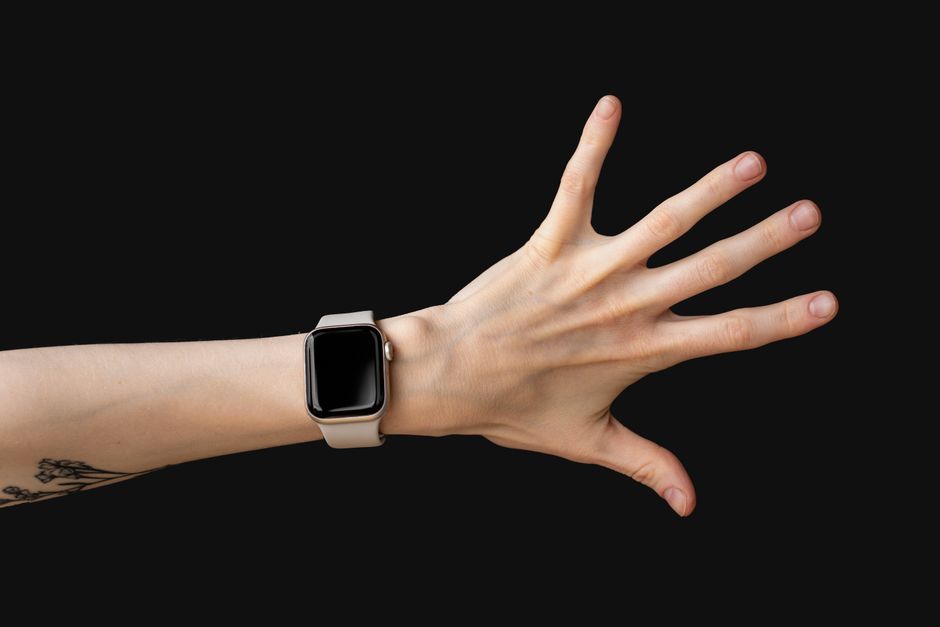
Photo by Anastasiya Badun on Pexels
Form Factor Determines Data Continuity
Adherence in Parkinson’s wearable design is a mechanical problem first. Research shows wrist-worn devices produce the cleanest accelerometry for tremor quantification, but the wrist is also where rigidity and dyskinesia are most pronounced. Empatica‘s Embrace2, designed for seizure detection, uses a stretchable band that accommodates involuntary muscle contraction without skin abrasion, a critical consideration when patients experience 4-6 Hz resting tremor for hours. Insole sensors for gait analysis capture freezing episodes accurately but introduce laundry and hygiene compliance issues that cognitive decline exacerbates.
Consider the Tuesday morning when levodopa has not yet taken effect. The patient experiences bradykinesia so severe that buttoning a shirt requires twenty minutes. If the wearable requires clasping a buckle or plugging in a micro-USB connector, it stays on the nightstand that day, creating a data void precisely when symptoms peak. The hardware decision is a trade-off between signal quality and the patient’s ability to keep the device charged and positioned through morning OFF states when freezing of gait makes bending to adjust a sensor impossible.
Algorithms Must Learn the Patient, Not the Population
Sensor fusion matters less than signal interpretation. A clinical wearable for neurological disease cannot rely on population-based thresholds for “normal” gait or tremor severity because Parkinson’s progression is non-linear and medication responses vary by individual. Rune Labs’ StrivePD leverages Apple‘s Movement Disorder API but adds disease-specific algorithms that correlate detected tremor with medication timing logs, revealing that the wearable is merely a data pipe, and value lies in longitudinal baselines that distinguish a patient’s good day from their bad day. FDA submissions increasingly focus on these algorithmic validations rather than raw hardware specifications, recognizing that a 200 Hz sensor is worthless if it cannot distinguish drug-induced dyskinesia from pathological tremor in a specific individual.

Photo by Michael Berdyugin on Pexels