The RF Front-End Becomes Your Competitive Moat
If the handset functions primarily as a service delivery surface, then radio frequency performance becomes the core user experience rather than a baseline specification. Consumer OEMs optimize for global band coverage and AnTuTu scores; carrier-customized phone hardware must prioritize the specific band combinations and carrier aggregation schemes that showcase the operator’s network superiority. Dish Network’s Boost Infinite launch required devices with standalone 5G (SA) architectures that most mid-range unlocked phones lacked, creating a tangible speed advantage in early coverage areas. Similarly, Reliance Jio’s affordable 5G lineup prioritizes bands n28 and n78 to match their specific spectrum holdings, ensuring consistent indoor penetration that generic import devices cannot guarantee. This makes the RF front-end module—particularly the power amplifiers and antenna tuners—the primary bill-of-materials cost driver, often exceeding the application processor. Teams that treat RF as a commodity component discover during field trials that dropped calls in moving vehicles destroy subscriber trust faster than any benchmark deficit.

Photo by Imthiyaz Syed on Pexels
Certification Tests Real-World Behaviors, Not Lab Specs
That RF complexity creates a validation bottleneck unique to telecom OEM device design. Operator device certification extends far beyond GCF and PTCRB compliance; carriers like Verizon and T-Mobile maintain proprietary acceptance programs that test handoff behaviors between 4G and 5G during voice calls, emergency calling reliability in fringe coverage, and thermal throttling during extended upload sessions. These tests simulate the parking garage, elevator, and stadium concourse scenarios that standardized protocols ignore. A device that passes Bluetooth SIG might still fail Verizon’s Open Development lab for failing to maintain VoLTE during a specific band transition. These requirements dictate printed circuit board layer counts, shielding strategies, and thermal via placement earlier in the development cycle than in consumer electronics, where industrial design often drives mechanical constraints. Certification is not a final paperwork step; it is a continuous design validation gate that determines whether your hardware architecture can survive the operator’s quality matrix.
The Moment of Use: Retail Activation
These engineering requirements mean nothing if the device fails at the point of sale. Consider the specific moment in a busy telecom retail store when a customer unboxes their subsidized handset and the sales associate must activate service before the buyer leaves the building. MVNO smartphone engineering faces a compressed logistics chain where devices ship directly to retail without warehouse staging. The hardware must support eSIM provisioning architectures that can pull carrier profiles over Wi-Fi before cellular registration completes, or accommodate physical SIM trays that withstand multiple insertion cycles during demonstration. Packaging design becomes critical: devices cannot arrive dead after six months in distributor inventory, requiring specific battery retention circuits and wake-from-ship modes that consumer OEMs rarely implement. If activation takes longer than four minutes, the sale converts to a return.
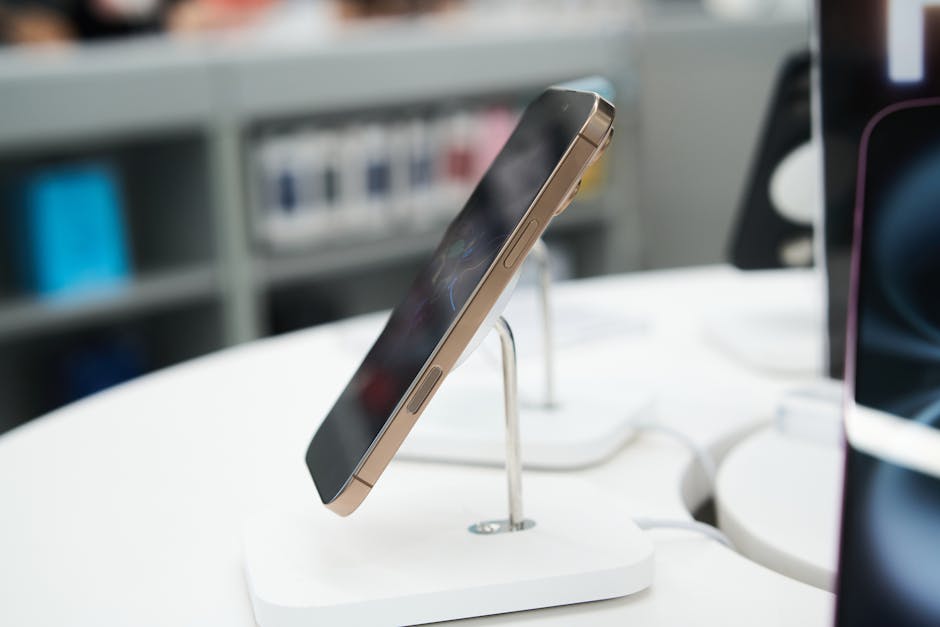
Photo by webber Amir on Pexels
Android Customization as Business Logic
Hardware that passes certification still needs software that enforces the business model. Android device customization for operators is not bloatware installation; it is the rendering of prepaid versus postpaid economics in user interface logic. A prepaid operator requires deep integration of top-up flows, usage dashboards, and wallet architectures that must survive factory resets. Postpaid operators need zero-touch enrollment systems that provision corporate security certificates before the user completes setup. Google’s success with Pixel devices across major carriers shows how GMS compliance with operator-specific feature extensions builds sustainable advantage, while Chinese OEMs often struggle with the firmware maintenance required to keep business logic synchronized across regional variants. The critical decision is whether to ship with standard Android and add operator apps, or negotiate a custom Android flavor that bakes business rules into the framework. The latter increases per-device engineering costs but reduces support calls when payment integration fails.