Gloved Hands Cannot Rely on Capacitance
The first architectural casualty of this inversion is the touchscreen. Standard capacitive interfaces fail the moment a technician dons insulated climbing gloves rated for high-voltage proximity work. This is not a minor UX inconvenience. It forces the technician to de-glove to adjust a setting, exposing hands to weather and RF hazard, or to descend to change a parameter.
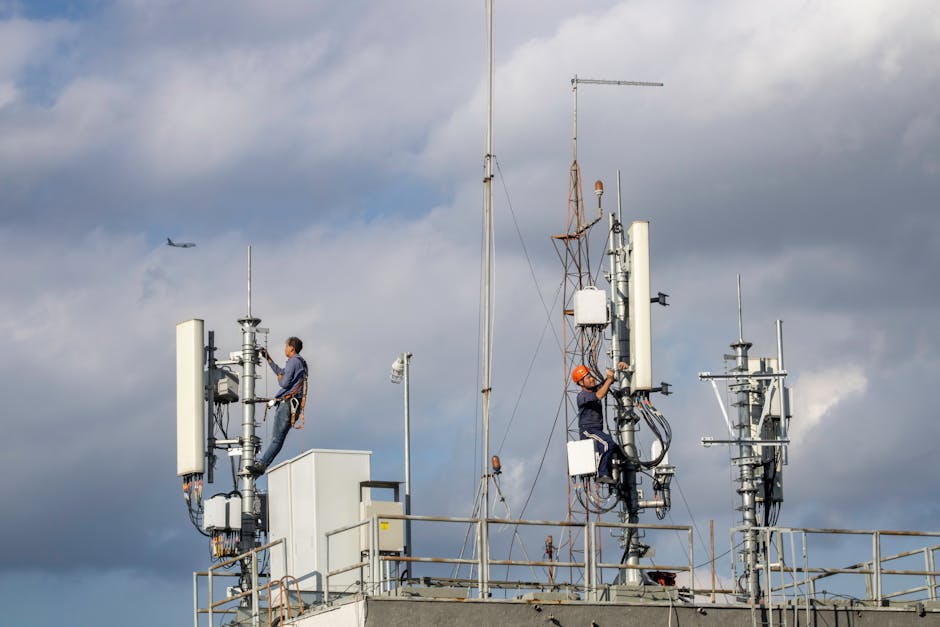
Photo by Barbara Reis on Pexels
**Tower technician device hardware** must default to tactile physical inputs for critical functions. The Panasonic Toughbook 40 and Juniper Systems Mesa families demonstrate this trade-off: they sacrifice screen-to-body ratio for banks of programmable membrane buttons that register through leather and vibration. When a technician hangs from a lanyard at a sector mount, the device hangs below them, visible only at odd angles—meaning your UI layer must be navigable without looking at the screen. If the workflow requires pinch-to-zoom or precise touch targets, the **tower maintenance device UX** has already failed. Haptic confirmation and audible feedback become signal integrity features, not accessibility add-ons.
Sealing Creates Heat That Destroys Battery Chemistry
Moving the device up the tower moves it into unshaded solar load and freezing wind chill, often within the same afternoon. **Outdoor telecom service device** requirements typically demand IP67 sealing against rain and dust, but that sealing eliminates convective cooling. Processors running RF analysis suites generate heat that cannot dissipate through sealed housings.
This thermal trap creates a compounding failure. Lithium-ion cells discharge faster in cold and degrade faster when hot. A device that calculates remaining climb time based on ground-level temperature will strand a technician when the battery chemistry contracts at altitude. FLIR addressed this in their tower-inspection thermal cameras by isolating the sensor module from the processor, using the aluminum housing as a thermal flywheel rather than a barrier—a lesson that thermal design must account for the 60°C delta between sun-soaked steel and winter wind, not lab conditions. If the device shuts down to protect its processor, the technician loses their documentation link, their safety check-in timer, and their ability to call for extraction.
The Lanyard Is Part of the Chassis
Drop protection in consumer electronics means surviving a fall to concrete. In **cell tower inspection device** design, drop protection means never falling in the first place. The device must live on a lanyard or retractor clipped to the harness, which introduces a failure mode consumer tablets never face: pendulum torque. A 600-gram device swinging on a 30-centimeter tether generates enough momentum to dislodge a climber’s grip during a hand-over-hand transition.
Photo by Barbara Reis on Pexels
Successful **telecom field service hardware** integrates the tether anchor into the structural chassis, not a stick-on accessory. The attachment point must align with the device’s center of mass to prevent rotation, and it must not interfere with the battery compartment seal. This constraint often forces a thicker, boxier form factor than modern industrial design prefers. But the alternative—a slim device that rotates and slaps against the tower during gusts—creates the exact distraction that leads to dropped tools or lost footing. Field testing at Harris Corporation revealed that technicians preferred devices they could operate one-handed while gripping steel with the other, which means weight distribution matters more than absolute mass. A device that hangs neutrally in the hand while tethered allows the pinky finger to share the load with the palm, reducing grip fatigue over a six-hour climb.