Bang Design

How to design devices that unify voice, data, and video

Hybrid work infrastructure has collapsed the boundaries between communication modes. Users no longer tolerate switching devices when a voice call escalates to video or a conference room session pivots to screen annotation. They expect a single endpoint to host telephony, videoconferencing, and collaborative data sharing without perceptible modality shifts. This convergence creates a hardware paradox: voice requires deterministic sub-150ms latency, video demands sustained computational encoding loads, and data requires reliable packet management. These three real-time constraints compete for identical processor cycles, thermal budgets, and electromagnetic isolation. A converged communication device only succeeds when thermal management and acoustic isolation are engineered as a single system, because processor throttling from video encoding degrades acoustic echo cancellation algorithms before users notice video artifacts.

Voice, Video, and Data Compete for Thermal Headroom

The real bottleneck in multiservice device design is not raw processing power but heat dissipation capacity. Voice-over-IP maintains intelligibility only when round-trip latency stays below 150 milliseconds per ITU-T G.114 standards; jitter buffers cannot compensate for thermal throttling that introduces computational delay. Simultaneous 4K video encoding loads the SoC with sustained thermal output that triggers frequency scaling. When the processor reduces clock speed to manage junction temperature, the real-time DSP threads handling acoustic echo cancellation stall first. Video frames buffer; audio drops syllables. Users perceive the device as “broken” during exactly the high-stakes moments—executive presentations, client negotiations—where unified communications must prove reliable.
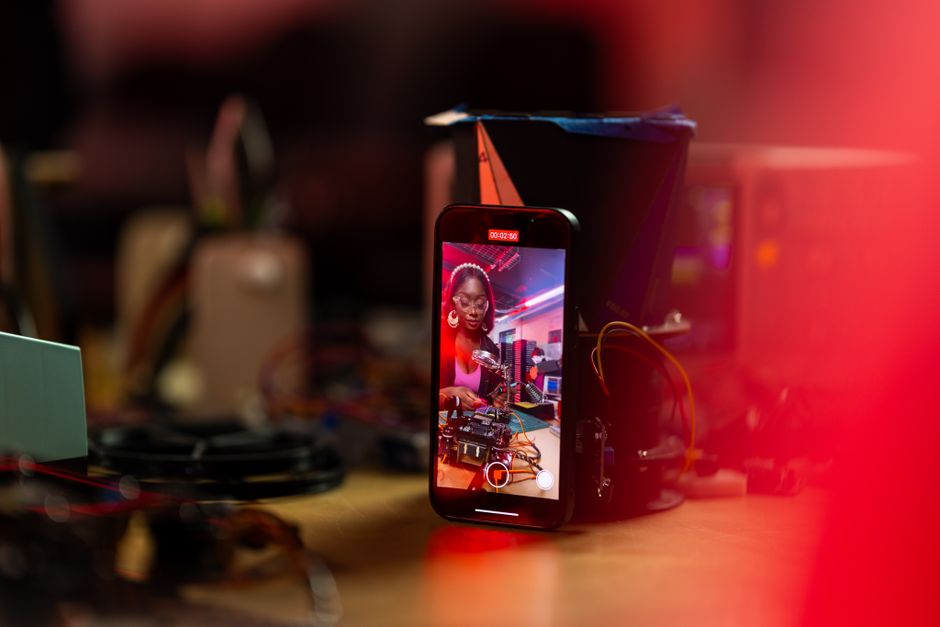
A woman records a tech tutorial using her smartphone on a desk filled with electronics.

Photo by ThisIsEngineering on Pexels

This thermal-acoustic coupling means UC endpoint engineering cannot follow traditional consumer electronics layouts, where heat sinks are placed for convenience and microphones positioned for aesthetics. The enclosure must evacuate heat from the processor while keeping microphone capsules thermally isolated and acoustically sealed from fan turbulence.

Microphone Arrays Share Real Estate with Heat Sinks

Far-field microphone arrays require specific geometries to achieve beamforming accuracy, typically demanding open baffle spaces or specific cavity volumes. These same volumes compete with heat sink fins and air channels necessary to cool video encoding ASICs. The conflict intensifies when active cooling becomes necessary. Small fans generate broadband noise precisely in the frequency spectrum where human voice consonants reside, forcing DSPs to apply aggressive noise suppression that degrades natural speech clarity.

Aluminum Chassis Reflect Sound as Readily as Heat

Material selection for converged UC hardware predetermines acoustic treatment costs. Aluminum extrusions conduct heat efficiently but reflect acoustic energy, creating reverberation that confuses far-field algorithms. Thermoplastics absorb sound but insulate heat, trapping thermal energy near the processor. Some designs employ hybrid constructions—aluminum heat spreaders coupled with acoustic fabric shrouds—but each interface introduces assembly complexity and potential failure modes. Bang Design’s work on product engineering for converged endpoints often begins with thermal simulation and acoustic modeling running in parallel, because the heat path determines the noise path.

Multiple Radios Force Antenna Compromises in Tight Enclosures

The thermal problem compounds when considering radio frequency isolation. UCaaS endpoint hardware must simultaneously maintain WiFi 6 connectivity, Bluetooth for peripheral pairing, and often DECT or cellular fallback. These radios share the 2.4 GHz spectrum or operate in harmonic relationships that create intermodulation distortion. Antennas require ground plane clearance and isolation from metallic structures—exactly the metallic structures used for heat dissipation.

A low-angle view of communication dishes and antennas on a building against a clear blue sky.

Photo by Francesco Ungaro on Pexels

Antenna placement determines whether audio codecs run in dedicated hardware DSPs or software on the main SoC. Hardware acceleration reduces thermal load but requires specific shielding that competes with thermal venting. Software decoding offers flexibility but increases processor utilization, raising junction temperatures that trigger the throttling cascade. Teams designing converged UC devices must validate thermal performance with all radios transmitting simultaneously, not in isolation, because the combined electromagnetic and thermal load represents the actual user scenario.

4K Encoding Loads Push Processors Past Acoustic Echo Cancellation Thresholds

Video encoding generates the specific thermal load that triggers acoustic degradation. H.265 encoding sustained at 30 frames per second generates processor utilization curves that differ significantly from bursty data workloads. This sustained load pushes silicon past the thermal threshold where real-time AEC algorithms—which must process microphone input and reference signals within 10-20 milliseconds—begin dropping samples.

Cisco’s Webex Room Series and Poly’s Studio devices solve this through dedicated audio DSPs physically isolated from video encoding processors, accepting higher component costs to maintain audio clarity across extended calls. Consumer-oriented UC devices often integrate both functions on a single SoC to reduce bill-of-materials costs, a trade-off that becomes apparent after twenty minutes of continuous use, when the integrated solution begins exhibiting audio artifacts while the dedicated architecture maintains fidelity. For hardware founders entering this market, the decision between integrated versus discrete processing is fundamentally a thermal budget decision masquerading as a cost decision.

Power Delivery Limits Determine Sustained Performance, Not Peak Specifications

Consider the device in a six-person huddle room during a quarterly business review. USB-C Power Delivery theoretically supplies 100 watts, but thermal constraints within compact enclosures often limit sustained draw to 60-65 watts before automatic current limiting occurs. The device simultaneously runs 4K video encoding, far-field voice pickup with automatic gain control, and high-speed data bridging for screen sharing. As internal temperatures rise, the power management IC reduces current to protect the battery or capacitors, forcing the processor to throttle. Automatic gain control algorithms attempt to compensate for fading voice input by raising gain, which amplifies the thermal noise floor from the electronics.

This cascade reveals that power delivery specification determines sustained performance, not peak. The device that performs flawlessly in a five-minute demo fails in the forty-minute meeting. Users abandon endpoints that require mid-call reboots or exhibit the “helicopter effect” of fan noise overwhelming conversation.

If you’re architecting unified communication device design strategies that must survive the thermal and acoustic realities of modern hybrid workspaces, Bang Design has spent 25 years taking products from concept to manufactured reality—across technology and consumer markets. Their subscription-based model means you get a full-stack team—design, engineering, visualization, and production—without the overhead of a traditional agency. Explore their work or start a project.

See all plans

Get in touch with us

By registering, you confirm that you agree to the processing of personal data by BangDesign as described in our privacy policy