Antenna Geometry Is Dictated by Canopy, Not Industrial Design Trends
Road watches assume open sky. Trail watches assume occlusion. In dense canopy or slot canyons, consumer-grade GPS drops from three-meter accuracy to thirty-meter drift within seconds. Multi-band GNSS (L1/L5) helps, but the industrial design determines whether those signals reach the chip.

Photo by RUN 4 FFWPU on Pexels
The antenna needs ground plane isolation from the wrist, which contradicts the ergonomic trend toward thinner, flexing cases. Garmin’s Fenix series and Coros Vertix solve this with raised antenna bezels that sacrifice wrist-hugging comfort for sky visibility. A flat, sleek design might score points in an urban office but becomes a navigation liability on a switchback where three meters of error puts a runner off a cliff edge.
Material choice matters too. Metal cases look premium but detune antennas. The shift to fiber-reinforced polymers in serious off-road GPS watch hardware isn’t cost-cutting—it preserves signal integrity. When you design the housing, you are designing the RF front end.
Power Management Under Search Stress
Poor signal forces the GPS module into high-power acquisition mode, burning three to four times the energy of steady-state tracking. This hidden drain in trail runner device engineering means the watch isn’t just running longer; it is working harder per mile.
Standard lithium-polymer cells degrade in cold, and mountain ultras often start before dawn at freezing temperatures. The battery chemistry and thermal management must handle discharge rates that spike when the device searches for satellites in a narrow valley, then drop during ridge cruising. You cannot simply add a bigger cell without increasing weight that affects running economy. The architecture needs predictive algorithms that reduce GPS sampling frequency when inertial sensors indicate steady pace on a known trail, ramping up only at intersections. This requires fusion between the GPS module and the IMU that most road watches never attempt.
Navigation UX for Technical Descents
When descending technical scree at mile forty of a hundred-miler, the runner has no fine motor control and minimal working memory. This is where topo map GPS watch design diverges from road navigation. Turn-by-turn directions fail because trails aren’t in mapping databases. The user needs situational awareness: contour lines, water sources, bailout routes.
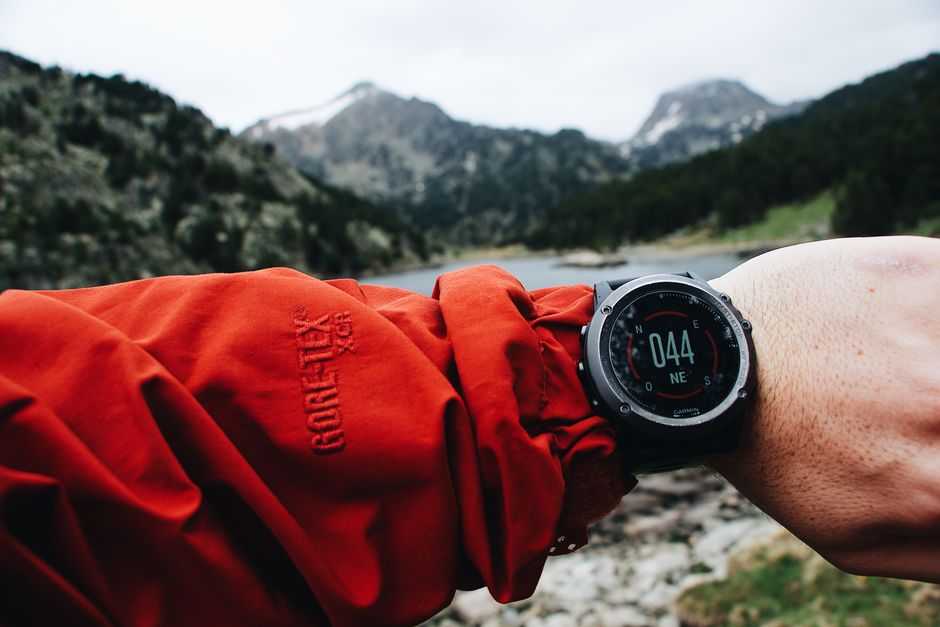
Photo by Maël BALLAND on Pexels
Touchscreen devices like Apple Watch fail with sweat, rain, or gloves. Dedicated trail watches from Suunto use physical buttons with distinct textures, enabling operation by feel alone. The screen must remain visible in direct alpine sun without the backlight consuming the battery budget allocated for night running.
The map rendering itself is a hardware decision. Vector topography requires GPU acceleration that draws power; raster maps require storage that adds cost. The compromise affects whether a runner can identify a ridge line during a whiteout.