Wear Maps Determine Your Fastening Strategy
Consumer electronics fail in predictable patterns. Lithium-polymer cells degrade after five hundred charge cycles. USB-C ports suffer mechanical wear from daily insertion. Displays crack from single-impact events. Long-life electronics design requires mapping these failure modes before the first CAD constraint is placed, then architecting the enclosure to make the mortal components accessible without destroying the immortal ones.
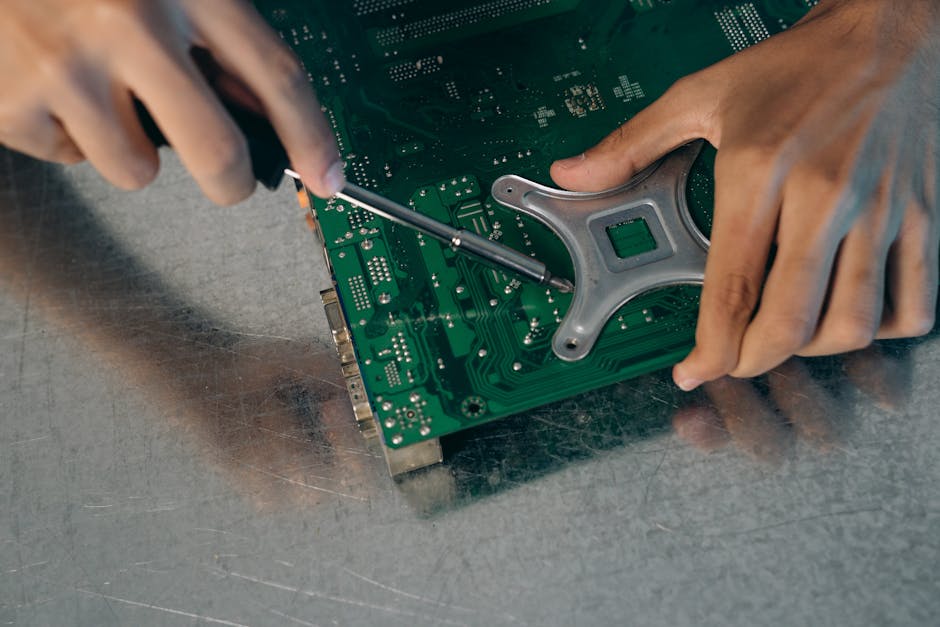
Photo by Mikhail Nilov on Pexels
This map determines your fastening strategy. When Framework designed their Laptop 13, they prioritized battery and keyboard replacement over sub-millimeter thickness, using captive screws and magnetic attachment rather than adhesive and ultrasonic welding. The result is a device that opens in minutes without tools, but retains structural rigidity through a magnesium alloy chassis that protects the logic board while leaving the battery field-replaceable. Contrast this with smartphones where the display assembly is glued to the midframe: a $12 digitizer failure requires destroying a $400 OLED panel to access, incentivizing replacement over repair.
Batteries as Structural Members vs. Serviceable Units
The battery represents the most consequential replaceable component design decision. In ultrathin devices, OEMs often use the battery pouch as a structural element, bonding it between the display stack and the rear housing to eliminate the need for a dedicated sub-chassis. This recovers two to three millimeters of Z-height and reduces bill-of-materials count, but it means the cell cannot be removed without dissolving adhesive that secures the entire device stack.
Fairphone took the opposite approach in the Fairphone 5, housing the battery in a compression-fit tray accessible under a removable back cover. The trade-off is visible: the device is 9.6mm thick versus the industry average of 7-8mm for flagship phones. For right-to-repair devices, that two-millimeter penalty buys a user-serviceable power source that extends functional life from three years to eight. The design team accepted the dimensional cost to eliminate the skilled-labor barrier—no heat guns, no prying tools, no risk of puncturing a volatile cell during extraction.
Connector Strategy: The Hidden Repair Tax
Modular consumer electronics rely on board-to-board connectors to separate sub-assemblies, but connector selection creates a hidden taxonomy of repair difficulty. Zero-insertion-force connectors with locking actuators allow screen replacement with fingernail pressure. Press-fit board-to-board connectors require specialized jigs and microscopic alignment. Valve’s Steam Deck uses ribbon cables with pull-tabs and standard Phillips screws for every user-touchable component, making display and joystick replacement accessible to owners; most handheld gaming devices solder the analog sticks directly to the mainboard, converting a $3 component failure into a board-level repair requiring hot-air rework stations—a barrier that turns routine failures into disposal decisions.
The connector decision scales commercially. User-serviceable device engineering requires selecting interconnects that survive ten mate/demate cycles without degradation, then documenting the sequence in the service manual. This adds cents per unit in BOM cost and requires validation testing that pure assembly optimization skips. Those cents compound across millions of units, but they prevent the device from becoming e-waste when a single sub-assembly fails.
The Service Manual as Parallel Architecture
Sustainable device repair fails when the disassembly sequence is an afterthought. Design teams routinely optimize for robotic assembly speed. Components press together in linear order with no consideration for extraction. This creates trap states where removing a failed power button requires desoldering the charging port that sits atop it in the assembly stack.

Photo by Quang Nguyen Vinh on Pexels
Dell’s Latitude laptops demonstrate the alternative. By designing the chassis with rear-access panels that expose the motherboard plane, they created a repair hierarchy where storage, memory, and cooling systems extract without disturbing the display hinge assembly. This required deciding the service manual structure before finalizing the assembly line jigs. The mechanical team had to accept that certain adhesive bonds could not be used, not because they failed structural tests, but because they prevented non-destructive access to components with known failure rates.