How to design robot vacuum cleaners for pet owners
Seventy percent of US households now include at least one pet, yet the robot vacuum category still treats fur as an edge case rather than a primary material input. The physics of pet hair differs fundamentally from household dust: keratin fibers bind electrostatically to carpet backing, wrap around axles under torsion, and compress into dense mats that choke impellers designed for lightweight debris. This distinction creates the central design constraint for modern autonomous cleaning. Every specification in pet hair robot cleaner hardware must be validated against the entanglement threshold, not the debris pickup threshold, because a device that jams silently at 2 PM while the owner is at work destroys trust faster than one that misses a corner.
The entanglement problem cascades through the entire electromechanical system. A hair-wrapped motor draws excess current, generates localized heat, and triggers failure modes that standard debris-filtered devices never encounter. When designing for pet owners, the maintenance interval becomes the true product specification. The question is not whether the vacuum can lift fur from carpet, but whether it can complete a full week of unsupervised cycles without biological material compromising the drivetrain.
Brush Roll Materials Determine Entanglement Risk
iRobot introduced the AeroForce system with dual rubber rollers that shear against each other to prevent wrapping. The engineering insight recognized that pet hair behaves like a low-strength filament under tension: it needs a surface to grip and a mechanism to shed before torsion builds to 0.5 Nm—the typical stall torque of a brush motor. Competitors using traditional bristle arrays with “anti-tangle” combs often fail because the comb itself becomes a collection point where hair aggregates under centripetal force. The rubber compound must balance Shore A hardness against surface energy to allow hair to slide toward the suction port rather than winding around the axle. This material decision determines whether your fur-cleaning robot vacuum requires weekly de-hairing or monthly attention, which directly impacts customer lifetime value in subscription-driven markets.
Photo by Andrey Matveev on Pexels
Self-Emptying Docks Manage Fur Volume, Not Just Frequency
Even with a tangle-free brush, pet hair presents a volumetric challenge. A golden retriever sheds approximately 60 grams of undercoat weekly—low density but high bulk that fills 400ml bins designed for dust. This shifts the design burden to the dock. Cyclonic separation compresses hair before bagging, while bagless designs risk allergen re-release during the 15-second auto-empty cycle when dock motor pressure can trigger thermal protection in underspecified motors. The autonomous vacuum engineering here involves managing pressure differentials: emptying a fur-clogged bin requires 22 kPa of sustained suction. Bagged systems create recurring revenue but add friction to the user journey; bagless cyclonic systems reduce lifetime cost but require the user to confront compressed fur during manual maintenance. The engineering decision determines whether your business model tilts toward consumables or hardware margins.
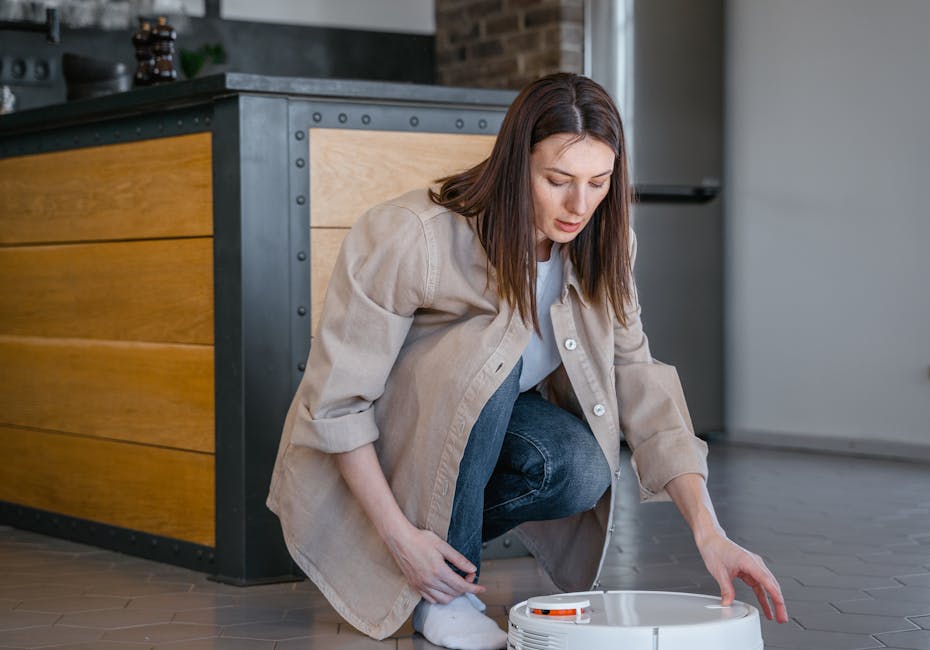
Photo by MART PRODUCTION on Pexels
Pet Safety Navigation Requires Biological Classification, Not Just Obstacle Avoidance
The pet owner robot vacuum UX extends beyond cleaning efficacy to biological safety. Obstacle avoidance algorithms can recognize pet toys and sleeping animals, but the harder problem is behavioral acoustics. A device operating at 70 decibels on hard flooring triggers stress responses in anxious animals, particularly when high-pitched whines from brushless DC motors fall within the 3-4 kHz range that disturbs canine hearing. The critical moment occurs on a typical workday: the owner at work, the vacuum commencing its cycle, encountering an unexpected “accident” common with puppies or senior pets. If the device lacks visuospatial classification—relying solely on bump sensors—it spreads contamination across square meters rather than avoiding the organic matter. Smart pet vacuum device architecture must prioritize avoidance over cleaning in ambiguous scenarios, using RGB cameras or structured light to classify waste before engagement, accepting the trade-off of higher bill-of-materials costs against the liability of biohazard distribution.
Designing for pet owners means accepting that the product operates in a biological system rather than merely a mechanical one. The hair is only the visible symptom; the real design space involves predicting animal behavior, managing allergen containment across disposal cycles, and building trust through silent reliability. If you’re developing the next generation of robot vacuum pet design, Bang Design has spent 25 years navigating the intersection of mechanical systems and user psychology—from medical device containment to consumer robotics. Their subscription-based model integrates industrial design, engineering, and production planning into a single partnership. Explore their work or start a project.