Impact Physics Determines Your PCB Mounting Strategy
That dual-product requirement changes how you calculate every gram of mass inside the shell. Traditional helmets manage energy through expanded polystyrene (EPS) foam that compresses during impact, extending the stopping distance for your brain. Any electronics embedded within this foam will experience crushing forces exceeding 250G during a standard drop test. This means your connected motorcycle helmet hardware cannot share material with the crumple zones. You must design a “hard halo”—a suspended cage or rigid pod that keeps cameras, processors, and batteries in the void spaces above the crown or behind the occipital ridge, areas where the EPS remains relatively stable during oblique impacts.
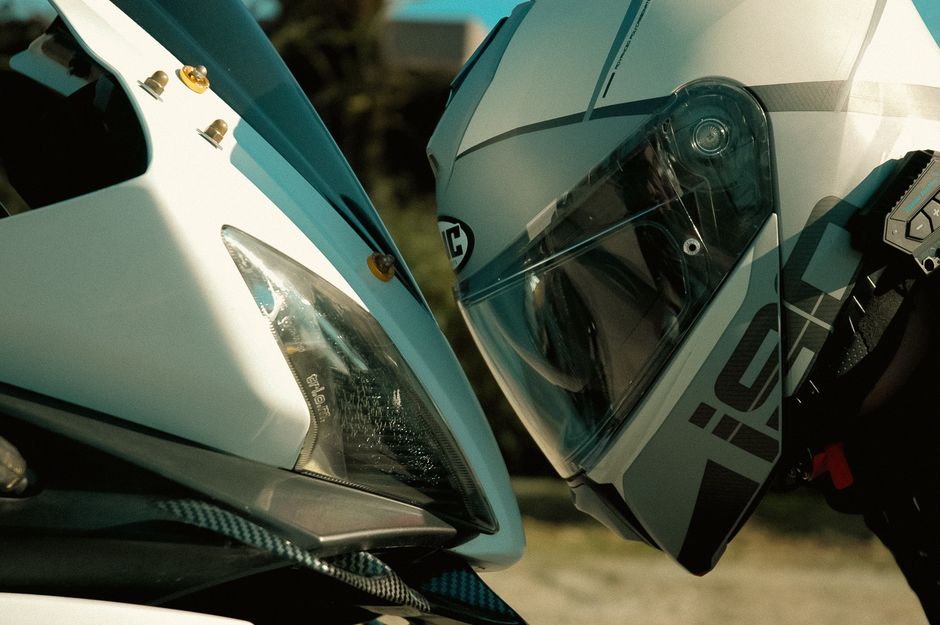
Photo by Retrokliks By Jarne on Pexels
Sena and Cardo solve this by clamping their communication modules to the exterior shell, avoiding the certification problem entirely but creating aerodynamic drag and theft risk. Integrated solutions like the Forcite MK1 attempted internal mounting, requiring them to pre-fracture the EPS liner to accommodate battery pods—trading recertification costs against serviceability. Your electronics chassis must be removable for charging without compromising the structural continuity of the EPS, which means designing snap-fit isolators that decouple the hardware from the shell during impact but keep it rigid during normal vibration.
Heat and Sound Compete for the Same Real Estate
The space you preserve for impact isolation immediately becomes contested territory between thermal management and acoustic engineering. A Qualcomm Snapdragon processor running navigation and noise cancellation generates 3–5 watts of heat in an enclosure with no airflow, while neodymium drivers require acoustic chambers behind the speaker to produce bass frequencies audible over 110dB of wind noise at highway speeds. You cannot sink heat into the EPS foam without degrading its impact absorption properties, nor can you vent hot air through the shell without creating water ingress paths that short your integrated speaker components.
This forces you to spec components based on thermal efficiency before processing power, often choosing dedicated DSPs over application processors. It also dictates microphone placement. Beamforming arrays that cancel road noise require specific distances from the mouth, usually conflicting with the chin bar vents that prevent fogging. Your wiring harness must thread through the EPS like a catheter, avoiding crush zones while maintaining shielding integrity for audio signals. You are not just designing a product; you are negotiating a peace treaty between physics and electronics.
HUD Helmet Engineering Collides with Human Factors
The packaging constraints are simpler than the interface constraints. Early smart helmets like the Nuviz and BMW Motorrad HUD promised heads-up displays projected onto the visor, but they all faced the same kinematic reality: a rider’s focal plane sits at infinity, focused on the road ahead. Any display close to the eye requires either complex optics that add 100+ grams to the front of the helmet—creating dangerous torque on the neck during impact—or forces the rider to refocus their eyes downward, taking visual attention off traffic for 400–600 milliseconds. At 60 mph, that is 35–50 feet of blind travel.

Photo by Jan Kopřiva on Pexels
This is why the smart helmet UX has converged on audio as the primary interface, not video. Directional audio cues—turn-by-turn navigation that sounds like it originates from the correct spatial direction—allow riders to keep eyes on the road while receiving complex data. The engineering shifts from optics to bone conduction transducers or micro-speakers positioned at the jaw hinge, where they can use the mandible as a resonating surface. Your product becomes a communication device first, and everything else—cameras, telemetry, Bluetooth—becomes a secondary feature supporting that auditory core. If your team is still optimizing screen brightness instead of wind-noise algorithms, you are solving the wrong safety problem.
Manufacturing Two Products Under One SKU
This architecture forces you to manage two distinct supply chains under a single SKU. The safety shell comes from traditional helmet manufacturing ecosystems—typically Korean or Italian composite shops with deep expertise in carbon fiber layup and multi-density EPS molding. The electronics come from consumer technology supply chains in Shenzhen or Taipei, with entirely different quality regimes, component lifecycles, and obsolescence curves. A helmet factory lacks the ESD protocols and reflow capabilities to install PCBs, just as electronics contract manufacturers cannot handle the material variances of composite shells.
Your assembly process involves potting electronics in IP67-rated enclosures at one facility, then shipping those modules to the helmet factory for foam-in-place integration. You must design for disassembly, because in most jurisdictions, a helmet that has taken an impact must be destroyed, but the electronics may still be functional. The business model must account for whether the consumer buys a complete replacement or sends the unit back for transplant surgery—a logistics decision that determines your warranty cost structure and customer lifetime value.