Heat Accumulation Degrades Reaction Time Before Impact Does
That thermal load begins the moment a player straps on thigh pads. In ambient temperatures above 30°C, which are standard for matches in Mumbai, Lahore, or Brisbane, the human body sheds 200 watts of metabolic heat through evaporative cooling. Traditional closed-cell foams used in cricket equipment design block that escape route. Gray-Nicolls and Kookaburra have optimized for impact absorption density, but the resulting vapor barriers force sweat to pool against the skin, compromising the thermoregulatory gradient. By the 35th over, a batsman’s reaction time degrades measurably; the constraint is not the weight of the gear, but the microclimate it creates. This means the material stack must prioritize vertical heat escape channels over simple impact absorption, changing how engineering teams specify open-cell versus closed-cell foam laminates.
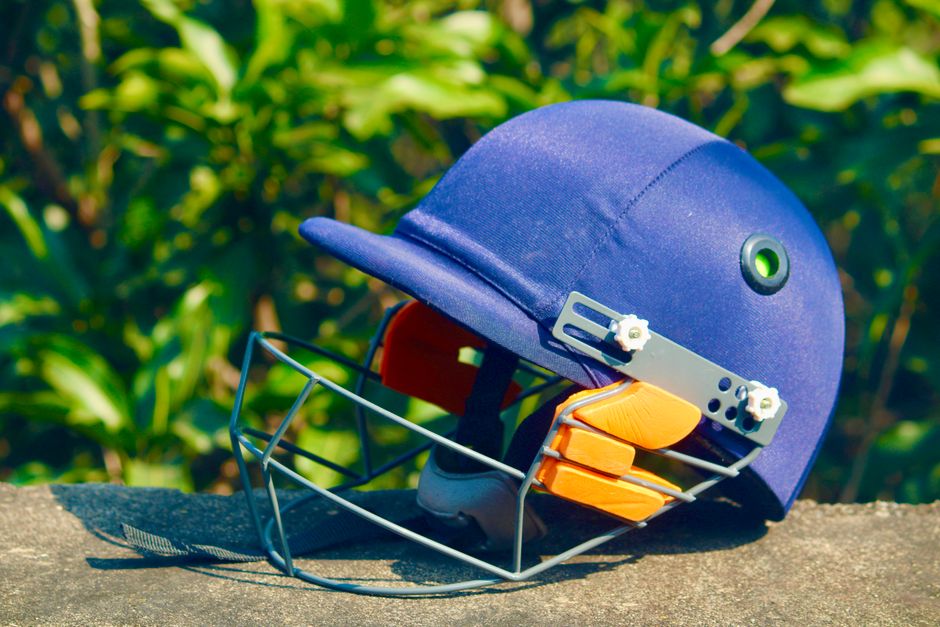
Photo by Manoj Poosam on Pexels
Bat Pad Hardware Requires Velocity-Graduated Materials
Bat pad hardware illustrates this material challenge most clearly. A dead bat blocking a spin bowler transmits low-velocity force, while a fresh leather ball striking the same point at 145 km/h delivers catastrophic energy. Single-density polyethylene foam fails at one extreme or the other; too soft and the fast bowler fractures bone, too firm and the batsman loses proprioception during gentle contact. Masuri solved this in helmet design using multi-density EPS layers that activate progressively—a constraint that leg guards have not yet addressed. The interface must manage not just the ball’s kinetic energy, but the shear forces generated when a batsman pivots on his back foot. This means the retention strap system is as critical as the protective shell, because a pad that shifts 3 millimeters during the stance converts to a pressure point that alters batting mechanics by the 50th ball.
Protective Gear Interface Breaks Down After 80 Overs
No position illustrates this interface better than the wicketkeeper. Crouching for 90 overs involves 600 squat repetitions while wearing protective gear designed and tested on fresh athletes in climate-controlled labs. By the 80th over on a humid Chennai afternoon, sweat has saturated the inner liners. The keeper’s gloves slip not from lack of skill, but from reduced friction coefficients on saturated palms. Straps designed for upright posture now compress the popliteal artery during sustained flexion, reducing blood flow to the calves. This means hardware must maintain position without elastic compression that occludes circulation, requiring graded textile weaves that change modulus when wet rather than simple neoprene tubes.
Photo by Manoj Poosam on Pexels
Smart Cricket Equipment Cannot Add Thermal Load
The same thermal envelope constrains any attempt at sensor integration. Spektacom’s bat sensor and Str8bat’s wearable sleeves represent genuine advances in swing analysis, but they introduce new failure modes—batteries and microcontrollers add heat precisely where the body cannot dissipate it. Antennas require cutouts that compromise waterproofing against sweat, and waterproofing electronics often requires conformal coatings that act as thermal insulators, exacerbating the exact fatigue the data is meant to optimize. This means sensor placement must respect the body’s cooling map, embedding electronics only in zones with secondary heat dissipation, such as the dorsal forearm, never under the sternum guard where core heat concentrates.