Bang Design

How to design devices for automotive component plants

Automotive component plants are entering a retooling cycle. Between EV powertrain transitions and aluminum-intensive vehicle architectures, the assembly sequences that defined the last decade are being rewritten. For device designers, this is the moment: new torque applications, new bonding processes, and new verification requirements all need hardware solutions. But these plants operate on economics that tolerate no deviation. A single escaped defect can trigger a million-unit recall; a cycle time slip of two seconds can erase the margin on an entire platform. The central tension is that these environments demand both extreme ruggedness and extreme precision. Devices must survive thermal shock, metal shavings, and pneumatic vibration while performing measurements accurate enough to satisfy IATF 16949 quality gates. Automotive plant device design succeeds when the hardware is treated as error-proofing infrastructure first and functional equipment second. The PFMEA drives the architecture, not the feature list.

How IATF 16949 Treats Production Equipment as Quality Control

That economic pressure is codified in IATF 16949, the quality management standard that governs every automotive supplier. Unlike general manufacturing standards, IATF 16949 treats production equipment as an extension of the quality system. This means your assembly device is not simply a tool that performs work; it is a control point that prevents defects from propagating downstream. The standard requires layered error-proofing: first, physical prevention (making the wrong action impossible); second, detection (recognizing when variation occurs); third, containment (stopping the line before bad parts escape). These layers determine physical geometry. A housing that allows an operator to grip a fastener from the wrong angle fails the standard before it ships. A connector without mechanical keying violates the prevention layer. The enclosure design becomes a quality decision.
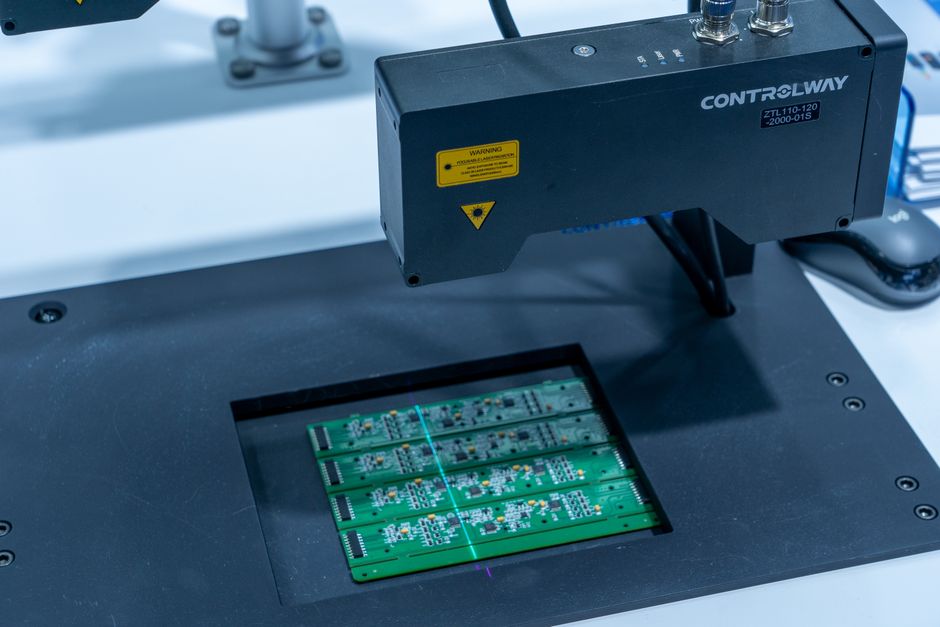
Close-up of a PCB inspection machine in action, highlighting technology.

Photo by Peter Xie on Pexels

Turning PFMEA Risk Scores Into Mechanical Specifications

The Process Failure Mode and Effects Analysis (PFMEA) is the primary design input for automotive assembly devices, not a validation checkbox. The PFMEA assigns Risk Priority Numbers to every potential failure mode, from cross-threaded fasteners to voltage fluctuations. High RPN scores must be addressed through hardware design changes, not procedures. This is why torque verification devices include angle encoders alongside torque sensors; the PFMEA identified “seating detection failure” as a high-risk mode, so the device architecture now measures rotation to distinguish between proper clamp load and thread stripping. Cable strain relief is not a durability afterthought. It is a critical safety feature because the PFMEA identified “intermittent signal loss during critical fastening” as a potential escape path for defects. Every mechanical constraint exists to close a failure mode.

Detecting Aluminum Galling Before It Becomes a Recall

Torque verification stations illustrate how this architecture responds to material shifts. As OEMs replace steel with aluminum to reduce vehicle weight, the assembly process becomes more sensitive. Aluminum galling and thread stripping occur without warning, often at torque levels below specification. A traditional tool applies torque until it reaches the setpoint; a PFMEA-driven device monitors the torque-angle curve in real time to detect the subtle yield point that indicates thread failure. The hardware must sample data at high frequency while filtering out plant floor vibration. This requires isolated mechanical coupling and signal conditioning hardware that adds cost and complexity. For a safety-critical component like a steering knuckle or battery tray, that cost is offset by the cost of a recall. The device must hard-stop the operator when the curve deviates from the teach signature. The physical design encodes the reject logic.

Detailed close-up of a metallic engine block showcasing industrial machinery elements.

Photo by Jakub Zerdzicki on Pexels

The Hardware Must Function at the Point of Assembly

All of this logic converges on a single moment: an operator installing a battery tray fastener on an EV line, wearing impact-resistant gloves, surrounded by the pneumatic noise of adjacent stations. The device must function when the user cannot feel fine textures or see small indicators. Button travel must be deep enough to register through Kevlar. HMI screens must be readable under sodium vapor lights and resistant to cutting oil. The device must prevent reverse installation through physical keying that cannot be defeated by force. If the torque verification fails, the error signal must cut through ambient noise. These are not usability preferences. In the IATF framework, operator error is a failure mode of the device, not the person. The design succeeds when the correct assembly sequence is the only physically possible sequence.

Developing equipment for the next generation of automotive assembly requires a team that understands how PFMEA translates into mechanical constraints. Bang Design has spent 25 years taking products from concept to manufactured reality across manufacturing and automotive supply chains. Their subscription-based model delivers product engineering and industrial design expertise without the overhead of traditional agencies. From torque verification systems to ergonomic assembly aids, they design hardware that satisfies IATF 16949 while surviving the realities of the plant floor. Explore their work or start a project.

See all plans

Get in touch with us

By registering, you confirm that you agree to the processing of personal data by BangDesign as described in our privacy policy