Speed as an Architectural Constraint
High-speed bottling devices face a brutal physics problem. When containers move at 15 meters per second, a 100-millisecond processing delay equals 16 bottles lost to jammed conveyors or misfilled cases. This reality forces architectural choices that prioritize deterministic latency over computational sophistication. Teams often specify industrial PCs with surplus compute headroom, only to discover that operating system jitter and update cycles introduce unacceptable variance. The beverage line automation device that survives validation uses bare-metal embedded controllers or real-time Linux kernels with preempt patches. Krones and Sidel both specify dedicated FPGA coprocessors for vision tasks rather than burdening general-purpose CPUs. These hardware choices reflect a business reality: a line stopping for 30 minutes to clear a jam costs more than the occasional false reject. Your processing pipeline must guarantee worst-case latency, not average throughput, because variance kills line efficiency faster than raw error rates.
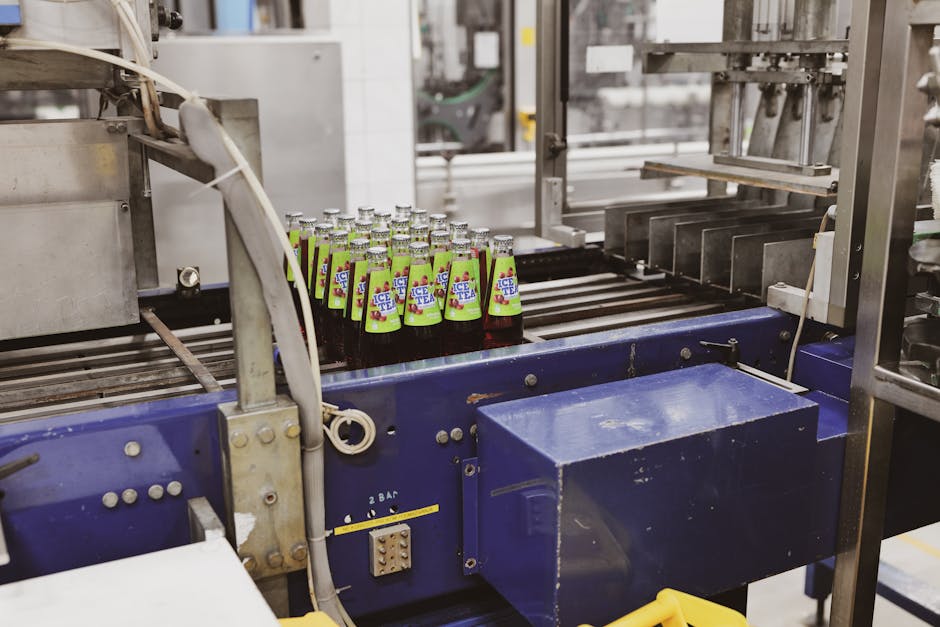
Photo by Vladimir Srajber on Pexels
Washdown Chemistry as a Material Constraint
That speed generates harmonic vibration. Vibration fatigues seals. Failed seals admit high-pressure caustic foam. In bottling plant device engineering, IP69K rating is not a marketing checkbox but a survival requirement. The washdown protocols that prevent bacterial biofilms use 80-degree Celsius jets at 100 bar pressure, cycling between acidic and caustic chemistries. These find every microscopic gap in an enclosure, destroying standard electronics within weeks. This shifts material selection from aluminum to stainless 316L not for aesthetics, but because chlorine-based sanitizers pit lesser metals within months, creating ingress paths. It mandates metal cable glands with strain relief instead of plastic, and full conformal coating on every PCB surface. Thermal management becomes particularly constrained. You cannot ventilate a sealed box, so heat must conduct through the housing itself. Sidel’s filling stations demonstrate this discipline, using thermal vias to conduct processor heat directly to the stainless exterior, turning the entire housing into a heat sink. The material choice becomes a thermal decision that affects processor throttling and sensor accuracy two layers deep.
Optical Systems Through Condensation and Film
Sealed enclosures create microclimates. When 4-degree Celsius bottles enter a 25-degree ambient fill room, condensation instantly clouds every optical port. Sealed device design must therefore assume the lens is perpetually wet. This forces lighting strategies away from standard strobes toward structured LED arrays at shallow angles that minimize reflection off water droplets. Machine vision algorithms must train on datasets that include deliberate distortion and partial occlusion. Systems like Cognex deployed in dairy bottling use polarized filters and near-infrared wavelengths that penetrate vapor better than visible spectrum, reducing the false-reject rate as optical conditions degrade. Proximity sensing presents parallel challenges. Capacitive sensors drift when coated in sticky residue, while ultrasonic sensors confuse foam with liquid. The calibration valid in week one drifts by week four as sugar films accumulate, requiring frequent recalibration that production schedules rarely permit. Successful designs integrate self-cleaning air knives that consume significant compressed air budgets but preserve signal integrity through the production run, accepting operational cost to avoid downtime.
Photo by Vladimir Srajber on Pexels