Heat Management in Inherited Geometry
That fixed volume becomes a thermal trap once modern silicon meets legacy ventilation patterns. Legacy cabinets often rely on passive convection through louvers sized for 1990s power supplies, not for fanless panel PCs dissipating 35 watts in sealed IP65 fronts. Retrofit panel device engineering demands that thermal design happen in millimeters of clearance. Beckhoff’s CP2xxx series solves this by extruding the aluminum chassis into external fins that protrude through the panel cutout itself, turning the cabinet skin into a heatsink, a pattern worth copying if your retrofit cannot modify the cabinet structure. Advantech’s UTC series uses heat pipes to conduct processor heat to a rear mounting plate that bolts directly to the cabinet’s metal framework. When you cannot add fans because of dust ingress ratings, the material choice, aluminum extrusion versus sheet metal, becomes the primary thermal calculation before any PCB layout begins.

Photo by Jakub Zerdzicki on Pexels
Wiring That Predates the Device
Those thermal paths compete for the same cubic centimeters as the wiring harness that predates the device by twenty years. Legacy cabinets route cables through dedicated ducting with fixed bend radii and gland plates positioned for obsolete connector types. A space-constrained industrial device cannot simply relocate ports to the rear if the existing trunking occupies that space. Siemens addresses this in their SIMATIC industrial PCs by placing I/O on the side bezel, allowing cables to exit horizontally into existing wireways without violating the front IP65 seal, a decision that trades aesthetic balance for cabinet compatibility. Removable terminal blocks become essential for existing cabinet device integration; if the device fails, the technician must extract it without unscrewing fifty individual conductors from a cramped terminal strip. The physical volume allocated to service access, usually none, must be manufactured into the device’s connector geometry itself.
Isolation in Crowded Metal
That wiring carries harmonics from adjacent drives, and proximity in a compact machine interface amplifies every millivolt of noise. UL 508A industrial control panel standards mandate creepage and clearance distances that assume air gaps; when you compress a controller into a 50mm depth behind the panel, air gaps disappear. Isolation transformers and optocouplers must fit within the same footprint as the processing logic. Allen-Bradley’s PanelView 5510 series achieves EMC resilience not through additional shielding layers, which add thickness, but by integrating the isolation into the PCB stackup and using the metal mounting chassis as a Faraday extension. In these environments, safety margins become mechanical integration problems: you cannot achieve electrical isolation by spreading components apart, so you must achieve it through better grounding architecture and reinforced insulation systems that fit within the legacy mounting pattern.
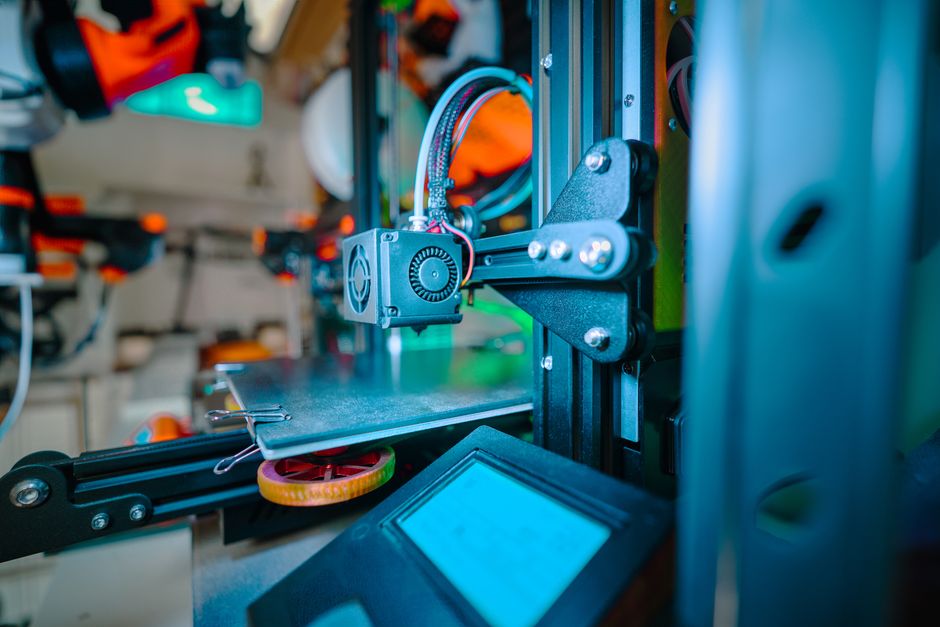
Photo by Jakub Zerdzicki on Pexels