Bang Design

How to design handheld tools for assembly line workers

The industrial power tool market spends millions advertising torque and RPMs, but plant managers buy based on defect rates and workers’ compensation claims. This disconnect reveals the actual product design brief: assembly line handheld tool design must solve for the 2,000th repetition of the day, not the first. The central tension is that every specification optimized for speed increases the risk of cumulative trauma disorders, while every safety feature adds milliseconds to cycle time. The thesis is mechanical transparency. Tools that succeed achieve a physical sensation where the fastener transmits vibration and resistance without distortion, because operators detect quality variations through their palms long before torque sensors register them. When the tool becomes an extension of the hand rather than an object requiring conscious manipulation, throughput and precision align.

Grip Geometry Determines Defect Rates, Not Comfort

In ergonomic assembly tool engineering, the grip functions as a force transmission system, not a handle. The angle between wrist and forearm during the final torque phase determines whether an operator can maintain consistent downward pressure. When the wrist deviates more than 15 degrees ulnarly during high-torque application, the risk of ligament strain increases exponentially. Atlas Copco positions motor housings at calculated angles relative to the drive axis, aligning reaction torque with the radius and ulna rather than the vulnerable carpal tunnel. This is not comfort engineering. It is defect prevention. A fatigued grip releases pressure unevenly, causing cam-out on Phillips heads or thread galling on aluminum inserts, quality failures that escape visual inspection until the assembly reaches the customer. The geometry that protects the worker simultaneously protects the assembly.
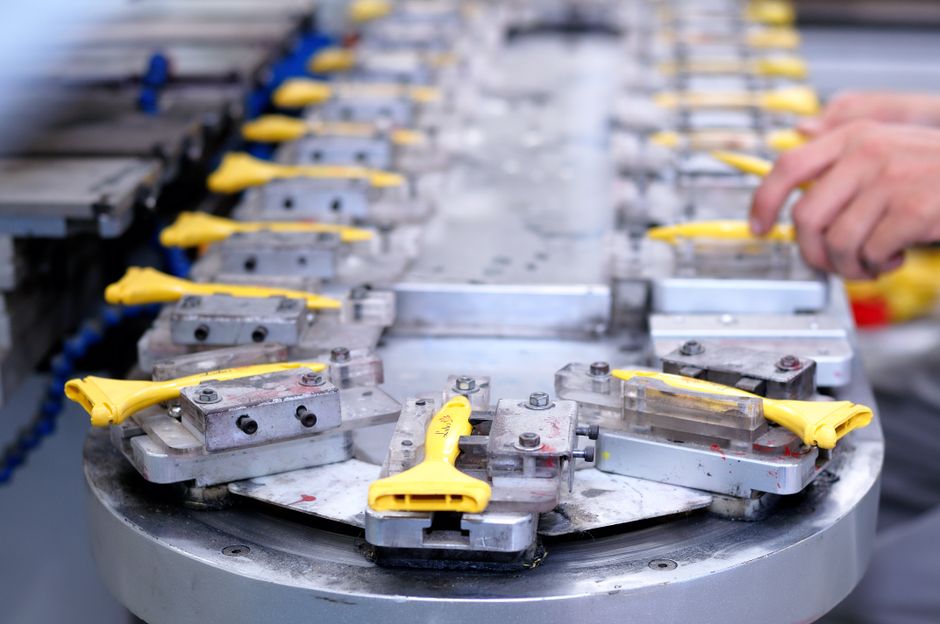
Close-up of a factory production line with yellow components being assembled.

Photo by Cọ Sơn Thanh Bình on Pexels

Torque Reaction Management Is a Safety System, Not a Convenience

Newton’s third law applies instantly to assembly station tool hardware. For every 50 Nm applied to the fastener, the operator’s wrist absorbs 50 Nm unless the tool mechanically grounds that energy. Pneumatic pulse tools manage this through internal hammer mechanisms that isolate the chassis from peak reaction forces. Electric alternatives require sensor-driven shut-off systems. Bosch Rexroth’s smart nutrunners employ gyroscopic arrays to cut power the moment the fastener seats, eliminating the run-on torque that strains joints. The design decision affects the PPE budget directly. Tools without reaction arms require anti-vibration gloves that reduce tactile feedback, creating sensory deprivation that invites cross-threading and rework. The engineering choice between absorbing reaction force at the tool or at the worker’s wrist determines whether quality control improves or degrades.

The 400th Fastener Exposes Design Flaws That Lab Testing Misses

Production worker handheld device design must account for the circadian rhythm of industrial output. By hour six, grip strength drops twenty percent and proprioceptive precision degrades. This is when power tool ergonomics design faces its real test: the moment an operator installs dashboard fasteners while bent beneath the steering column, arms extended overhead, visual access blocked by the cowl, with no margin for error before the vehicle moves to the next station. Snap-on reduces mass above the grip centerline in their cordless impacts to minimize moment arm fatigue during these contorted positions. Weight distribution matters more than total weight. A tool that is handle-heavy requires constant flexor activation to maintain bit alignment, accelerating tendonitis onset while inducing angular errors in fastener seating. The device must function when the operator is exhausted, dehydrated, and working by touch alone.

Close-up of a factory production line with yellow components being assembled.

Photo by Cọ Sơn Thanh Bình on Pexels

Validation Belongs on the Second Shift, Not the Showroom Floor

Industrial handheld tool manufacturing requires validation protocols that mirror actual production chaos. Laboratory testing with fresh engineering graduates holding tools at chest height proves nothing. The critical prototype phase occurs during the second shift when experienced operators work through the fatigue window. Digital displays that require line-of-sight force the operator to interrupt workflow to verify torque values, breaking the kinetic chain and introducing setup variability. Successful tools provide haptic confirmation. Tactile detents or vibration patterns transmit data through the hand without visual disengagement, keeping the operator locked into rhythm. This is where product engineering intersects with human factors: the interface must communicate binarily through the palm before the operator consciously processes the information. If the prototype survives three weeks on the graveyard shift without generating quality holds or injury reports, the industrial design is complete.

If you are developing assembly line handheld tool design for high-volume manufacturing, Bang Design has spent 25 years bridging the gap between human factors and production physics across automotive, aerospace, and electronics assembly. Their embedded design model places industrial designers and mechanical engineers directly into your validation process, ensuring prototypes survive contact with the second shift. Explore their manufacturing work or start a project to test your next tool where it actually matters.

Meta: Assembly line handheld tool design requires mechanical transparency, ergonomic force management, and validation during the second shift to prevent defects and injury.

See all plans

Get in touch with us

By registering, you confirm that you agree to the processing of personal data by BangDesign as described in our privacy policy