Signal Integrity in Vibration: How EEG Electrodes Survive Industrial Environments
EEG fatigue monitors detect microsleeps by measuring changes in posterior dominant rhythm, typically 8-13 Hz alpha activity that increases as the brain disengages. In a clinical setting, this requires gel electrodes and a quiet room. In a haul truck cab, the same signal competes with 50Hz vibration from the diesel engine and 2G shocks from rough terrain. A worker alertness monitoring device that relies on optical heart rate (PPG) faces similar interference: motion artifacts from repetitive lifting or driving create baseline drift that mimics the very HRV suppression that indicates fatigue.
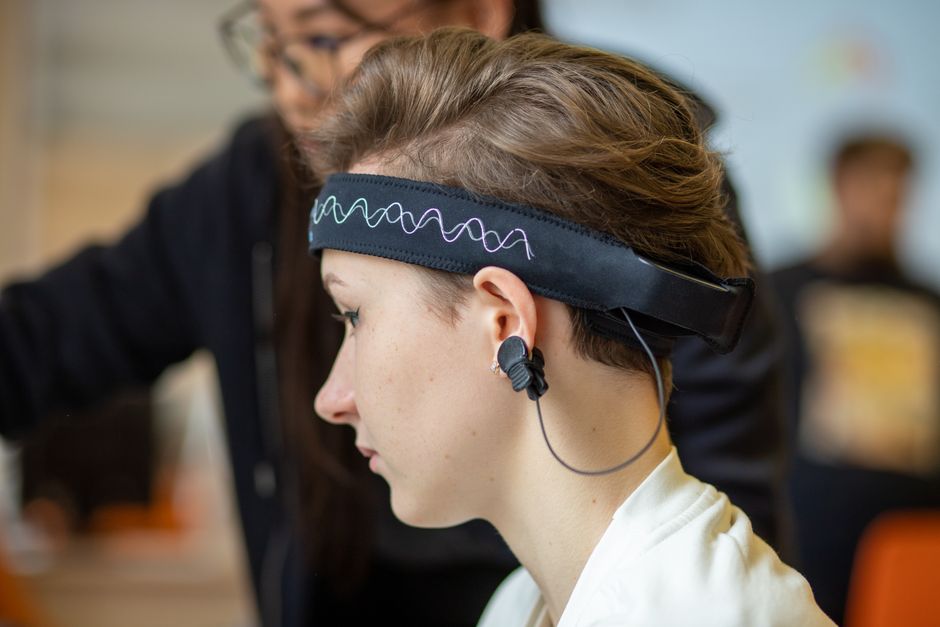
Photo by Михаил Крамор on Pexels
This means the primary engineering challenge is not sensor sensitivity but common-mode rejection. The device must mechanically filter the body’s movement from its electrical signals before amplification occurs. Products like SmartCap, used in Australian mining operations, solved this by integrating dry EEG electrodes into a baseball cap form factor that stabilizes against the occipital ridge, using the scalp itself as a mechanical damper. Camera-based systems like those from Seeing Machines avoid contact entirely but require line-of-sight that hard hats, dust, and darkness eliminate. Each architecture, electrical, optical, or accelerometric, trades off reliability against visibility: the choice depends entirely on whether the worker’s head remains visible or covered during the task.
Contact Mechanics Determine Data Quality
Once a drowsiness detection wearable leaves the lab, it enters an environment designed to break electrical contact. Hard hat pressure points shift. Sweat changes skin impedance from 10kΩ to 100kΩ in minutes. Temperature swings from -10°C in a refrigerated warehouse to 40°C on a loading dock alter electrode gel viscosity. For shift worker wearable hardware, the industrial design specification must treat these as signal variables, not comfort afterthoughts.
Electrode geometry becomes critical: spring-loaded contacts maintain pressure through head movement better than adhesive patches, but require specific contact forces (typically 0.5-1.0N per electrode) to penetrate the stratum corneum without causing pressure ulcers over eight hours. Material selection follows: conductive silicone composites can maintain impedance below 5kΩ through sweat cycles, whereas standard Ag/AgCl electrodes degrade after two hours in high humidity. The garment or mount must also integrate with existing PPE. A fatigue monitor that requires removing a hard hat to adjust the sensor fails in a mine where helmet removal stops production. This is where manufacturing considerations meet human factors: the device must survive autoclave cycles or chemical wipe-downs if it lives inside food processing or pharmaceutical environments.
Building Algorithms That Tolerate Corrupt Data
Even with perfect mechanical design, the occupational fatigue sensor must assume 30-40% of raw data is artifact. This changes the firmware architecture fundamentally. Consumer wearables smooth data with moving averages that mask the sudden state transitions characteristic of microsleeps. Industrial systems need artifact-robust classifiers, machine learning models trained on dirty data from the specific work context.

A driver fatigue wearable in a semi-truck must distinguish between lane-change head rotation and drowsy nodding by correlating accelerometer patterns with steering wheel telemetry or GPS road curvature. The processing pipeline also faces power constraints. Continuous EEG sampling at 256Hz drains batteries in four hours. Event-driven architectures that trigger high-fidelity sampling only when basic motion thresholds suggest risk can extend shifts to twelve hours. This requires edge computing capable of running lightweight inference models locally, because underground mines and remote trucking routes lack reliable connectivity for cloud processing. The expertise required here crosses into signal processing engineering: you are building a noise-rejection system that happens to measure biology.