Evidence Integrity Requires Fault-Tolerant Architecture
Legal admissibility depends on proving the recording is unaltered from capture to courtroom. This transforms the device from a camera into an evidence capture device design problem. The hardware must maintain a rolling pre-event buffer, typically 30 to 120 seconds, that continuously overwrites temporary memory until the officer activates recording, at which point the buffer appends to the permanent file. This requires redundant NAND storage with wear-leveling algorithms that can survive sudden power loss during a battery ejection or impact. The device cannot simply power down when the battery dies; it needs enough capacitance to flush the buffer to non-volatile memory, preserving the final seconds of a critical incident even if the officer is incapacitated. Cryptographic hashing must begin at the sensor level, chaining each frame to the next so that any post-capture alteration breaks the sequence. Because this chain of custody starts the moment photons hit the sensor, the PCB layout must prioritize signal integrity for the storage bus over miniaturization. A corrupted file header from a voltage dip during a struggle renders the footage worthless regardless of lens quality.
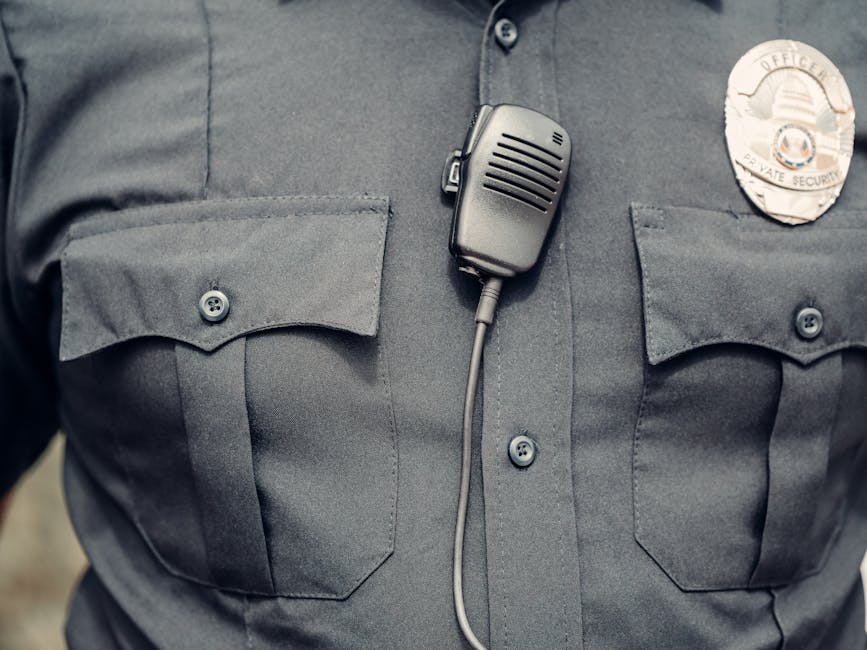
Photo by Kindel Media on Pexels
Ruggedization Redraws Component Topology
That forensic requirement gets complicated when the device strikes concrete during a foot pursuit. Body-worn camera rugged design starts with the assumption that the officer will fall, roll, or take impact while the device is recording. This forces specific component placement: the main ASIC and storage must sit centrally, away from corner impact zones where G-forces exceed 2000g during a six-foot drop. Battery retention systems cannot rely on simple friction latches; they need mechanical locks that maintain electrical continuity through vibration and shock. Connectors must avoid standard FPC ribbons in high-flex areas like the interface between body and camera head; instead, pogo pins or rigid-flex boards survive the repetitive stress of an officer entering and exiting a vehicle. Even the lens barrel must float within the housing on elastomeric mounts, decoupling the optical stack from chassis deformation during compression. Axon and Motorola Solutions have settled on chest-mounted geometries that place the lens at sternum height, which creates shear exposure during vehicle collisions, a gap that forces designers to isolate the mount mechanically through magnetic breakaway connectors that disengage physically while preserving data lines until the final millisecond of separation, ensuring external cameras continue streaming even after impact.
Weather Sealing Creates Thermal Traps
That impact protection creates a thermal puzzle once the device is sealed against rain, blood, and decontamination chemicals. IP67 or IP68 ratings require gaskets and conformal coatings that trap heat from the 4K video encoder, which can draw 3-5 watts during operation. If the processor hits its thermal limit, it throttles clock speed, potentially dropping frames or reducing bitrate, creating exactly the evidence gaps the device exists to prevent. Thermal management must be treated as a legal requirement, not a comfort feature. This often means abandoning plastic enclosures for aluminum unibodies that function as heat sinks, with thermal interface material conducting heat from the SoC directly to the chassis surface. The codec choice becomes critical here. H.265 offers 50% bitrate savings over H.264, reducing storage heat and write cycles, but requires more processing power to encode, increasing die temperature, a tradeoff that forces designers to choose between bitrate efficiency and thermal headroom. Some designs sacrifice resolution for reliability, recording 1080p at high bitrates rather than 4K to stay within thermal envelopes during summer patrols in Arizona. The exterior texture must balance heat dissipation against grip security; smooth metal sheds heat but becomes slippery when wet, while aggressive knurling traps contaminants.
Photo by Kindel Media on Pexels