FC Bayern Munich: Football’s Most Efficient Machine
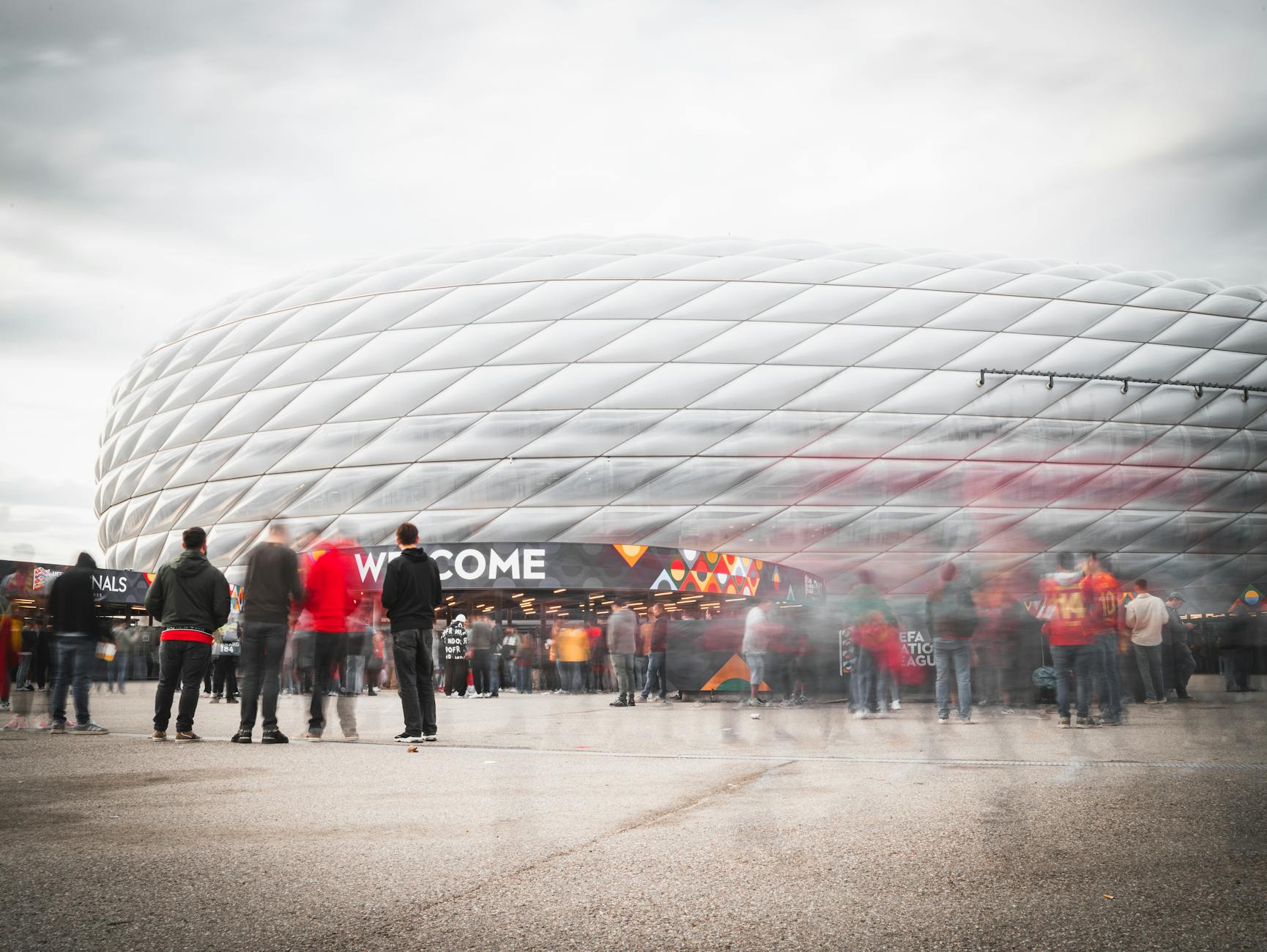
On matchdays, the Allianz Arena consumes Munich. Seventy-five thousand people flow through its curved, inflatable exterior, white, red, and illuminated, having paid roughly nine euros per game for their season tickets. Inside, the stands remain full through injury time even when the score is settled by halftime, which it often is. The club has not failed to sell a ticket in twelve years. This is not merely loyalty; it is structural. The stadium operates as a physical manifestation of a business model that has produced thirty consecutive years of net profit and zero debt in an industry where loss-making is the norm and leverage is frequently the strategy.
To understand FC Bayern Munich is to grapple with a contradiction. The club is simultaneously the most commercially aggressive entity in German football, extracting €130 million annually from four jersey sponsors alone, and the most conservative, bound by a governance structure that treats external capital as contamination rather than fuel. It dominates its domestic league to the point of rendering competition nearly ornamental, ten consecutive Bundesliga titles, yet remains perpetually vulnerable to the accusation that this very dominance undermines its ability to compete at the highest European level. The model works, until it doesn’t. And the conditions under which it might stop working are embedded in the very mechanisms that have made it the best-run club in the sport.
The Unequal Distribution
The engine of Bayern’s economics is not visible on the pitch. It is buried in the Bundesliga’s television revenue distribution formula, a mechanism that allocates broadcast income based on performance rather than equality. In the 2022 fiscal year, Bayern received approximately €90 million from domestic television rights. The last-place club received roughly €18 million. This five-to-one multiplier is the widest disparity in any top-five European league; the English Premier League, by contrast, distributes its domestic pot with a ratio of roughly 1.6 to 1 between first and last. The gap between Bayern and the relegation zone is not merely sporting. It is financial, compounding, and structural.
This unequal distribution creates a flywheel. The additional €70 million that Bayern extracts annually compared to a struggling competitor funds player acquisitions that sustain on-pitch dominance. That dominance justifies premium rates from commercial partners, a href=”https://www.adidas.com” target=”_blank” rel=”noopener noreferrer”>Adidas pays €60 million annually for kit manufacturing and sponsorship, Deutsche Telekom pays €45 million for jersey-front placement, ecause the brand is guaranteed Champions League exposure and domestic trophies. The commercial revenue, in turn, funds further squad investment. The cycle compounds because competitors cannot match either the revenue base or the continuity required to resist short-term spending pressure. When a rival club receives a windfall from player sales, it often deploys the capital immediately to close the gap, sacrificing long-term stability for a single season of hope. Bayern, cushioned by the TV asymmetry, sells at peak value and buys young, amortizing transfers over longer horizons.
The durability of this advantage rests on political economy. Changing the Bundesliga distribution model requires consensus among eighteen clubs, each of which currently benefits from the status quo relative to lower divisions. The system is not an accident; it is the intended outcome of a league structure designed to reward performance hierarchically. For as long as the formula persists, Bayern’s revenue advantage is mechanically enforced, not competitively earned each season. The club begins every August with a €50-70 million head start before a ball is kicked.
The Ownership Cage
Yet this engine is housed within a chassis that strictly limits how the power can be applied. The German 50+1 rule mandates that club members, not external investors, must retain majority voting control. Bayern is 75 percent owned by its members, who pay €60 annually for the privilege. The remaining 25 percent is held by three Bavarian corporates: Adidas, Audi, and Allianz, each with 8.33 percent stakes acquired between 2002 and 2010. These partnerships provided capital for expansion, the Allianz Arena, the FC Bayern World complex, hotels, and restaurants, without ceding governance control.
The constraint is binding. To fund the stadium construction in the early 2000s, Bayern could not simply issue equity to a sovereign wealth fund or private equity consortium, as Manchester City or Paris Saint-Germain might. It had to negotiate with industrial partners who were culturally aligned and geographically proximate, accepting diluted economic returns in exchange for marketing association rather than control. This has kept the club debt-free: n almost mythical condition in modern football where stadium finance and transfer spending typically require bond issuance or owner loans. But it also caps the ceiling. When Barcelona or Real Madrid need liquidity, they leverage their global brands against future revenue streams. When Bayern needs liquidity, it must either dip into reserves, negotiate with its three corporate partners, or increase membership fees, the latter being politically toxic given the club’s working-class roots.
The 25 percent external stake represents a compromise that already pushes the boundary of acceptability among the membership base. Further dilution risks losing the governance control that enables long-term decision-making; refusing it caps the ability to compete with state-backed clubs or leveraged buyouts elsewhere in Europe. The club has navigated this by maximizing commercial yield within the constraint, squeezing €378 million from partnerships, licensing, and hospitality, but the constraint remains. Bayern is a scaled enterprise operating under small-business governance rules.
The Player as Capital Allocator
The most underappreciated structural advantage is not the stadium or the TV formula, but the composition of the boardroom. For four decades, Bayern has been managed by former players who treat the institution as a permanent family business rather than a financial asset with an exit horizon. Uli Hoeneß served as sporting director and president for forty years, from 1979 to 2019, after a career-ending injury at age twenty-seven forced his early retirement from the pitch. Karl-Heinz Rummenigge led the commercial operations for three decades. Today, Oliver Kahn (former goalkeeper) and Hasan Salihamidžić (former midfielder) occupy the executive suite alongside Herbert Hainer (Adidas veteran, but steeped in Bavarian corporate culture).

This continuity functions as an economic variable, not a sentimental narrative. When decision-makers are former players with multi-decade tenures, capital allocation changes. They do not face quarterly earnings pressure from activist investors. They do not need to spike short-term results to secure contract extensions. They understand, intuitively, that selling a player at peak valuation, say, Thiago Alcântara to Liverpool for €25 million with one year remaining on his contract, creates more long-term value than holding out for a €40 million fee that might never arrive and risks a dressing room distraction. They know that signing a 19-year-old Canadian left-back for €11 million (Alphonso Davies) and developing him creates more surplus value than purchasing a ready-made star for €80 million.
The result is a cost discipline that is mathematically impossible for hired-gun executives or owner-operators with leverage service. Bayern has remained profitable for thirty consecutive years not because it generates vastly more revenue than Manchester City or Real Madrid, it doesn’t, but because it allocates what it generates with a time horizon that matches the half-life of a football career. The club behaves like a conservative manufacturing firm in Swabia, not like a media company in Los Angeles or an oligarch’s toy in London.
This model is fragile precisely because it depends on specific individuals. Hoeneß possessed a particular combination of commercial ruthlessness and emotional intelligence, e could sell a club legend while convincing the membership it was for the greater good. Kahn and Salihamidžić represent a younger generation, but they are still in their fifties and forties. The institutional knowledge of how to say no, to a €100 million transfer, to a leveraged stadium renovation, to a private equity injection, is concentrated in a cohort that will eventually retire. If succession brings external hires or executives without player credibility, the risk tolerance will shift. The temptation to borrow against future Champions League participation to secure immediate success is overwhelming for most football executives. Resisting it requires a governance culture that selects for patience.
The Membership Moat
Beneath the executive layer lies a foundation that competitors cannot replicate: 300,000 fee-paying members, the largest membership base of any sports organization globally. This is not merely a fan club. It is a governance mechanism and a commercial asset. The members vote on strategic decisions, including the composition of the supervisory board. They provide €15 million in annual dues, odest in absolute terms, but crucial as a signal of democratic legitimacy. More importantly, they stabilize the revenue base. The 75,000-capacity Allianz Arena has sold out for twelve consecutive years, not because of dynamic pricing algorithms but because season tickets cost roughly €170 for eighteen matches, a price point set deliberately below market clearing to ensure accessibility.
This cheap-ticket policy is economically rational in ways that are invisible on the balance sheet. By locking in working-class and middle-class loyalty through affordability, Bayern prevents the gentrification of its supporter base that has hollowed out clubs in London or Paris. The members provide political ballast against commercial overreach, witness the sustained protests against the Qatar Airways sponsorship, and they provide data. Three hundred thousand direct relationships, with email addresses, demographic information, and purchasing histories, create a targeting capability that rivals the digital platforms of major retailers. When Bayern launches a new e-commerce line or a hospitality package, it markets to a known quantity, reducing customer acquisition costs to near zero.
The moat is durably wide because it took decades to dig. You cannot manufacture 300,000 members in five years; it requires generational continuity of success. The membership base is self-reinforcing: winning drives enrollment, enrollment funds the academy and infrastructure, infrastructure drives continuity, continuity drives winning. Competitors in the Premier League or La Liga may have larger global followings, but they lack the concentrated, organized, fee-paying membership that votes on strategy and fills the stadium regardless of weather or league position.
The Qatar Tension
The friction between this membership governance and commercial necessity manifests most acutely in the sponsorship portfolio. Bayern earns €20 million annually from Qatar Airways, a partnership that has provoked sustained protest from fan groups and local politicians over human rights concerns. For a club controlled by members, many of whom are socially progressive Bavarians, the ethical contradiction is acute. For a club requiring commercial revenue to fund competition with state-backed entities, the €20 million is non-trivial.
This tension reveals the economic constraints of the model. A club owned by an oligarch or a sovereign fund could absorb the reputational cost of a controversial sponsor, or simply reject it without financial consequence. Bayern cannot easily do either. Rejecting the €20 million would require finding replacement revenue within a sponsorship market that is increasingly concentrated among a few global brands, many with their own geopolitical entanglements. Accepting it risks alienating the membership base that provides the governance stability and political protection the club relies upon. The compromise, accepting the sponsorship while maintaining a public dialogue about human rights, satisfies no one but keeps the mechanism functioning. It is the economic equivalent of walking with a limp: sustainable, but not optimal.
The Domestic Trap
The merit-based TV distribution that funds Bayern’s advantage simultaneously undermines the ecosystem from which it draws. By receiving €90 million while competitors scrape by on €30-40 million, Bayern ensures that the Bundesliga is effectively a monoculture. Ten consecutive titles is not merely dominance; it is entropy. The league lacks the competitive uncertainty that drives broadcast valuations in England, where six clubs could theoretically win the title and mid-table teams can upset giants.
This domestic comfort creates a European ceiling. The Champions League, where Bayern earned its sixth title in 2020, requires adaptation to high-variance knockout football against opponents who have been sharpened by more competitive domestic leagues. When Bayern faces Real Madrid or Manchester City, it meets clubs that have been stress-tested by weekly high-stakes competition. Bayern, meanwhile, rotates squad players against opponents who cannot afford comparable depth. The model optimizes for Bundesliga certainty, which may be suboptimal for European glory.

If UEFA were to enforce salary caps or equalize domestic TV distributions across leagues, Bayern’s advantage would compress. The €50-70 million annual head start would evaporate. The club would be forced to rely solely on its commercial revenue, substantial, but not superior to that of English or Spanish giants, while maintaining a cost structure built for dominance. The virtuous cycle would slow, then potentially reverse.
The Fragile Assumption
What breaks the model is not a single catastrophic event but the intersection of three correlated risks: competitive decline, sponsor concentration, and leadership succession. Bayern’s commercial rates depend on winning. The €60 million from Adidas, the €45 million from Deutsche Telekom, the €20 million from Qatar Airways, hese are priced for a club that guarantees Champions League participation and domestic trophies. If Bayern were to miss the Champions League for two consecutive seasons, a scenario unthinkable since 1995 but mathematically possible given an aging squad and the rising costs of player retention, broadcasting revenue would fall by €50-100 million. Simultaneously, jersey sponsorship renegotiations would compress by €20-60 million.
The squad is aging. The core group that won the 2020 Champions League is in its thirties. Replacing them requires either the academy pipeline, which is productive but unpredictable, or transfer expenditure that has historically been disciplined. If the club deviates from its sell-high, buy-young algorithm to acquire established stars at premium prices, the wage structure inflates. If it maintains discipline but misjudges talent, competitive decline accelerates. The cost structure is fixed in the short term, contracts are guaranteed, stadium maintenance is constant, but revenue is variable and correlated with performance. The thirty-year profit streak is not a law of physics; it is the outcome of superior capital allocation during a period of uninterrupted sporting success.
The succession risk compounds this fragility. Kahn and Salihamidžić do not possess the forty-year institutional memory of Hoeneß. They operate in a football economy where transfer fees and wages have inflated beyond the growth rate of commercial revenue. The next generation of executives may lack the credibility to tell a superstar agent no, or the patience to sell a fan favorite at the optimal moment. If the governance culture shifts from long-term value preservation to short-term results protection, the debt-free discipline will erode. The first bond issuance will signal that the model has shifted from manufacturing to speculation.
The Permanence Premium
Bayern Munich represents a bet that permanence outperforms volatility. In an industry optimized for extraction, of players, of broadcast rights, of emotional loyalty, the club has built a structure optimized for endurance. The 50+1 rule, the membership base, the former-player executives, the unequal TV distribution, hese are not separate features but interlocking components of a machine designed to compound advantages over decades rather than quarters.
The machine is running at capacity. The stadium is full, the jerseys are sold, the Bundesliga trophy is engraved before the season begins. But the gears are meshed tightly; there is little slack. A missed Champions League qualification, a failed leadership transition, a regulatory change to TV distribution, hese are not distant risks but proximate pressures. The club that has solved football’s economic puzzle better than any other remains hostage to the continuity of its own success. In Munich, the only thing more expensive than winning is the alternative.
The stadium itself is a financial instrument disguised as architecture. When Bayern and 1860 Munich jointly commissioned the Allianz Arena in 2002, the €340 million construction cost was financed through a subsidiary structure that allowed Bayern to treat the asset as a long-term capital lease rather than a balance-sheet liability. The inflatable ETFE exterior panels, 2,784 of them, each capable of being illuminated independently, serve a purpose beyond aesthetics. They reduce heating and cooling loads by approximately 40 percent compared to conventional stadium materials, lowering the operational cost per seat to roughly €12 per matchday, among the most efficient in European football. This matters because the stadium generates €68 million annually in matchday revenue, but more critically, it generates it without the debt service that cripples competitors. Barcelona’s Camp Nou renovation has forced the club to leverage future broadcast rights; Tottenham’s new stadium carries £637 million in loans requiring £40 million annual interest payments. Bayern’s arena is unencumbered, owned through a GmbH structure where the three corporate partners, Adidas, Audi, and Allianz, hold equity stakes that entitle them to hospitality allocations and branding rights rather than cash coupons.
This distinction between equity partnership and debt financing defines the Bayern model. When Audi acquired its 8.33 percent stake for €90 million in 2010, it purchased not a bond with a fixed return but a perpetual association with the brand, secured by a seat on the advisory board and first right of refusal on automotive fleet partnerships. The capital was permanent. It could not be called in during a liquidity crisis, did not require covenant compliance, and carried no maturity date. In exchange, Bayern accepted a valuation cap; it cannot issue additional equity to a sovereign wealth fund at a €3 billion valuation without diluting these historical partners, who possess preemptive rights. The arrangement resembles a medieval commenda contract, capital provided for a voyage, with profits shared but control retained by the sailing master, more than it resembles modern private equity.
The economic implications of this structure manifest in the transfer market with peculiar precision. Consider the acquisition of Alphonso Davies from Vancouver Whitecaps in January 2019 for €11 million, a figure that included performance escalators tied to Champions League appearances. At the time, Davies was a 17-year-old left winger with 31 MLS appearances. By 2020, he had converted to left-back and was starting in a Champions League final. By 2022, his estimated market value exceeded €70 million. The surplus value created, roughly €60 million in unrealized gain, did not appear as profit on the income statement; it remained on the balance sheet as an intangible asset, allowing Bayern to amortize his original cost over the life of his contract while simultaneously holding a liquid reserve that could be monetized through sale if necessary.

This algorithm is repeatable. Benjamin Pavard arrived from Stuttgart for €35 million with World Cup winner status; Joshua Kimmich cost €8.5 million from Leipzig before Leipzig became a direct competitor. The pattern involves identifying players in the 20-23 age bracket with 2,000+ professional minutes but below celebrity status, signing them to five-year contracts, and structuring wages at 60-70 percent of what comparable players earn at Premier League clubs. The wage compression is possible because Bayern offers non-monetary compensation: guaranteed Champions League football, a 75,000-seat stadium environment, and the cultural cachet of a club where national team selection is automatic. When a player like Thiago Alcântara reaches age 29 and demands a final contract aligned with Premier League benchmarks, Bayern sells him to Liverpool for €25 million rather than extending him. The transaction appears as squad weakening to casual observers, but economically it represents the harvesting of depreciated player capital at residual value, avoiding the deadweight loss of a veteran contract that would clog the wage structure for players aged 26-28 in their prime earning years.
The discipline extends to failure management. When Leroy Sané arrived from Manchester City in 2020 for €45 million (potentially rising to €60 million with bonuses), the contract structure included significant performance triggers. If Sané failed to meet appearance thresholds or statistical benchmarks, the total cost remained capped. More importantly, the psychological contract with the membership base was maintained: Sané was German, internationally known, and arrived at a discount to his pre-injury valuation. Even when transfers underperform, such as the €80 million combined outlay on Lucas Hernández and Corentin Tolisso in 2017-2018, the club absorbs the amortization without leveraged recourse, writing down the assets over time rather than forcing a fire sale to meet debt covenants.
This capital allocation culture is protected by the 50+1 rule’s mechanical function. The 300,000 members do not merely pay dues; they elect the nine-person supervisory board (Aufsichtsrat) that approates major capital expenditures. To issue bonds for a new training facility or to approve the Qatar Airways sponsorship extension, the executive board (Vorstand) must present proposals to this elected body, which meets quarterly and includes representatives from the fan clubs, the youth divisions, and the women’s team. The friction is intentional. A proposal to install dynamic pricing for matchday tickets, standard practice in the Premier League where Manchester United extracts £300 for Category A fixtures, would require convincing these representatives that the revenue gain outweighs the erosion of working-class accessibility. Historically, such proposals fail. The €170 season ticket price has risen by less than inflation over the past decade, not because Bayern lacks pricing power, but because the governance structure treats that power as a liability rather than an asset.
The Qatar Airways sponsorship crystallizes this governance tension. When the deal was extended in 2022 for a reported €20 million annually through 2027, the supervisory board vote was not unanimous. Fan representatives abstained, issuing a public statement that the partnership violated the club’s ethical guidelines regarding human rights in the Gulf states. The economic cost of termination, €100 million over five years, plus potential breakup penalties, was calculated by the finance department and presented to the membership at the annual general meeting. The members voted to retain the sponsorship by a margin of 78 percent, but with a binding addendum requiring the club to allocate €1 million annually to human rights education initiatives and to permit fan representatives to audit compliance with labor standards. This is not corporate social responsibility as marketing veneer; it is the negotiated price of capital extraction from a democratically controlled entity. The €20 million arrives in the account, but €1 million flows immediately to an escrow fund for advocacy, and the club’s commercial director must quarterly justify the arrangement to elected officials who are not compensated for their service and therefore immune to the career incentives that typically soften ethical scrutiny in publicly traded firms.
The fragility of this arrangement becomes visible when projected against the aging curve of the current squad. Manuel Neuer, Thomas Müller, and Joshua Kimmich represent a generation that won the 2014 World Cup and the 2020 Champions League. Their replacement cost, in current market conditions, exceeds €200 million. Bayern’s cash reserves, historically maintained at €150-200 million, are sufficient to fund one such transition cycle without external capital, but not two. If the academy fails to produce replacements at the rate of Davies or Kimmich, and if the commercial revenue plateau, Adidas’s contract renews in 2030, Deutsche Telekom in 2026, the club faces a compression window where costs rise as revenues stagnate. The 30-year profit streak would not survive a €100 million operating loss, not because the institution would collapse, but because the governance culture would fracture. Members accustomed to annual dividends (paid in the form of infrastructure investments and ticket price freezes) would demand accountability. The supervisory board, suddenly divided, might authorize the first debt issuance in club history to fund a “statement signing” that breaks the wage structure.
The Bundesliga ecosystem compounds this risk through competitive atrophy. Borussia Dortmund, theoretically the second force in German football, operates under a different constraint: it is publicly traded (via Borussia Dortmund GmbH & Co. KGaA), subject to quarterly earnings reporting and shareholder pressure for dividends. When Dortmund develops a player like Erling Haaland, it must sell him, often to a Premier League club, because the capital structure requires liquidity events to satisfy investors. Bayern benefits from this arrangement by purchasing Dortmund’s best players (Mats Hummels, Robert Lewandowski, Mario Götze) at inflection points, effectively outsourcing the high-risk development phase to a competitor who cannot afford to retain the finished product. The result is a league where Bayern’s revenue advantage, €654 million versus Dortmund’s €360 million, creates not a duopoly but a monopoly with vassals. The other 17 clubs function as developmental academies and occasional cup final opponents, but never as sustainable threats.
This monoculture degrades the broadcast product. Domestic Bundesliga rights, which peaked at €4.6 billion for the 2017-2021 cycle, declined to €4.4 billion in the 2021-2025 negotiations despite inflation. International rights growth has stalled at approximately €200 million annually, compared to the Premier League’s €2 billion. The merit-based distribution that enriches Bayern simultaneously impoverishes the narrative; international viewers prefer leagues with six potential winners, not one. If the Bundesliga’s international broadcast revenue contracts further, Bayern’s €90 million domestic advantage becomes less a foundation and more a shrinking pond. The club would be the last man standing in a drying riverbed, debt-free but diminished.
The women’s team offers a counter-narrative that is rarely incorporated into the financial analysis. While most women’s football operations operate at seven-figure losses funded by men’s team subsidies, Bayern’s women’s team generated €1.2 million net profit in 2022, making it the seventh-largest revenue generator in European women’s football. The economics differ: lower wages (the women’s squad payroll is roughly 8 percent of the men’s), smaller stadium requirements (they play at the 12,500-capacity FC Bayern Campus), and growing broadcast traction. More strategically, the women’s team provides hedge value against regulatory risk. If UEFA or the Bundesliga mandate spending caps or squad cost ratios (as is being trialed in UEFA’s Financial Sustainability Regulations), the women’s team’s profitable operation demonstrates that the club can maintain sporting breadth within constrained resources. It also locks in the female membership demographic, currently 20 percent of the 300,000 members, creating generational continuity that pure men’s football brands cannot replicate.
International expansion, constrained by the ownership structure, has taken the form of brand licensing rather than asset acquisition. The offices in Shanghai and New York do not sign players or negotiate local broadcast deals; they manage e-commerce channels and fan club coordination. Bayern sells €45 million annually in merchandise in China, but through licensed distributors rather than owned retail, avoiding the capital intensity of physical expansion while capturing royalty streams. This is the 50+1 rule’s invisible hand: because the club cannot issue equity to fund a Chinese stadium tour or an American academy purchase, it has developed a low-capital, high-margin licensing model that generates €30-40 million in pure profit with minimal operational risk. Compare this to Manchester City’s City Football Group, which has deployed billions in equity to acquire clubs in New York, Melbourne, Mumbai, and Tokyo, creating a network effect but requiring leverage that would violate Bayern’s governance covenant.
The succession question looms over these mechanical advantages. Herbert Hainer, the Adidas veteran who chairs the supervisory board, is in his seventies. Oliver Kahn, despite his playing legend status, has never operated a €600 million revenue enterprise through a downturn. Hasan Salihamidžić, as sporting director, manages the transfer algorithm but does not set the capital allocation strategy. The generation that built the model, Hoeneß, Rummenigge, and the industrial partners who subscribed to the equity structure in the 2000s, is retiring. The next generation of Bavarian corporate leaders may not view 8.33 percent of a football club as a strategic asset; they may demand liquidity events or dividend recapitalizations. If Adidas, facing its own margin compression in the athletic wear market, were to sell its stake to a private equity fund specializing in sports assets, the governance structure would face its first hostile pressure. A fund would seek to monetize the stadium real estate, introduce dynamic pricing, and leverage the brand for expansion capital, recisely the moves the membership structure exists to prevent.
The bear case, then, is not sudden bankruptcy but slow conversion. Bayern would remain solvent, profitable by conventional metrics, but transformed into a leveraged entity with quarterly earnings targets. The 30-year profit streak would continue, but the profits would service debt rather than fund the academy. The membership base would become a marketing demographic rather than a governance check. The unequal TV distribution would still deliver €90 million, but it would be offset by interest payments that currently do not exist. The club would look more like Manchester United, commercially brilliant, operationally indebted, governed by financial engineers, than like the family business it has been.
This conversion is the hidden cost of the model’s success. By proving that football clubs can be debt-free and profitable, Bayern has demonstrated that the sport is extractable. Private capital observes the €654 million revenue, the €150 million cash reserves, the global brand equity, and calculates the leverage capacity that the current governance structure refuses to deploy. The 50+1 rule is the only barrier, and rules change. If German law were amended to permit majority external ownership, pressured by clubs facing insolvency who seek white knights, Bayern would become the most attractive acquisition target in sports. A sovereign wealth fund could offer €3 billion for 51 percent, promising to maintain the culture while extracting the surplus through stadium naming rights, cryptocurrency partnerships, and leveraged expansion. The members would vote, and perhaps reject the offer, but the price would rise until the democratic structure cracked under the weight of individual financial self-interest.
Until that fracture, the machine continues. The Allianz Arena fills, the jerseys sell, the Bundesliga trophy is engraved. The €90 million domestic TV advantage compounds against competitors who cannot match it. The former players in the boardroom decline the €100 million transfer that would break the wage curve. The members pay their €60, vote their conscience, and accept the contradictions of a club that is simultaneously a moral compass and a commercial juggernaut, a local cooperative and a global brand, a debt-free fortress and a sitting duck for the capital it refuses to employ.