
Hermès: When Viral Success Becomes a Threat

Fifteen years ago, in Tokyo, a canvas beach bag began selling unusually well. It was not leather. It carried no Kelly buckle, no Birkin flap, no equestrian heritage stitched into the seams. It was simple, practical, priced around $150, and it was flying off shelves. For any normal consumer goods company, this is the dream: unexpected demand, low production cost, viral velocity. For Hermès, it was a crisis. The company gathered the remaining inventory and destroyed it. When then-CEO Patrick Thomas reported this decision to the board, he received a standing ovation.
This is the Rosetta Stone for understanding Hermès. The destruction of the beach bag was not an act of scarcity theater but of economic discipline. The bag threatened to democratize access, to collapse the distance between the initiated and the merely wealthy. In a company governed by capital efficiency, such destruction would constitute malpractice. At Hermès, it was stewardship.
To understand why requires abandoning standard luxury analysis. Hermès does not compete on craftsmanship alone, hough its artisans train for two years in French ateliers to hand-finish leather goods that generate 70 percent gross margins. It does not compete on heritage alone, hough the house traces its lineage to 1837 and the carriage trade of Paris. It competes on the credible commitment to refusal. The business generates €9 billion in revenue at 40 percent operating margins not despite its refusal to scale, but because of it. The family owners, descendants spread across 23 to 24 branches, controlling more than 50 percent of shares across the sixth generation, function not as shareholders but as stewards. Their governance enforces a supply constraint that no competitor can replicate, because no competitor is willing to leave money on the table at the scale Hermès does. This creates a moat where rational economic entry becomes irrational: competitors can match the leather, the stitching, the price point, but they cannot match the absence.
The Status Signal That Requires Literacy
The Birkin and Kelly bags have not changed in decades. The Kelly, named for Grace Kelly in the 1950s, retains the same trapezoid silhouette, the same turn-lock closure, the same optional shoulder strap. The Birkin, born from a chance encounter between Jane Birkin and Jean-Louis Dumas in 1984, remains identical to its original design. This stasis is not laziness or nostalgia. It is architecture.
In surveys, more than 90 percent of female consumers name the Birkin or Kelly as their handbag choice when presented with any option, including competitors priced above, at, or below Hermès. Competitors have attempted to displace these bags with superior leather, more functional designs, or aggressive pricing. None have succeeded because the advantage is not functional. It is semiotic.
The Birkin functions as a signaling device that requires cultural literacy to read. Unlike logos that scream across a room, the Hermès bag whispers to those who know. There is no external branding beyond the occasional clochette. The recognition depends on the observer’s ability to identify the specific proportions, the stitching, the hardware weight, etails invisible to the uninitiated. This creates a two-tiered social filter: the owner signals wealth, but more specifically, signals membership in a cohort that recognizes the signal. The value lies not in the object but in the shared secret.
This psychological moat explains the pricing inelasticity. A Birkin retails for $25,000 to $30,000, with secondary market prices often exceeding retail depending on color, year, and provenance. Kelly bags start at $6,500 for entry-level models. Yet demand remains structurally unmet. The company could raise prices further, could produce more units, could license the design to manufacturers in lower-cost regions. It does none of these things because each would collapse the “you have to know to know” positioning that underpins the premium. If the bags became ubiquitous, if they achieved the 40-million-unit penetration Louis Vuitton reached in Japan alone, the psychological cache would compress toward commodity luxury. The margin would follow.
The product design thus functions as a fixed coordinate in a shifting market. While fashion cycles accelerate and brands chase viral moments, Hermès offers permanence. The bag you purchase today is identical to the one your mother might have carried, which will be identical to the one your daughter might inherit. This creates a form of temporal arbitrage: the brand sells the future’s vintage at today’s retail prices.
The Governance of No
The beach bag could have generated millions in incremental revenue. It was destroyed because Hermès is governed by a structure that treats brand equity as a multi-generational inheritance rather than a quarterly resource. The Dumas family, descendants of founder Thierry Hermès, maintain majority control across more than two dozen branches. They describe themselves not as owners but as stewards, tasked with passing the business intact to the seventh generation.
This governance structure acts as a binding commitment mechanism that solves the time-inconsistency problem endemic to luxury brands. A typical publicly traded company or private-equity-backed competitor faces relentless pressure to optimize returns on capital. Faced with 40 percent operating margins and demand exceeding supply by multiples, rational capital allocation would dictate scaling production, entering new categories through acquisition, and maximizing short-term revenue. This is exactly what would destroy Hermès.
The family ownership enforces what economists call a “credible commitment” to scarcity. Because the family controls the board and prioritizes brand preservation over shareholder return optimization, they can refuse growth opportunities that would damage the exclusivity premium. When Axel Dumas, a sixth-generation family member, serves as CEO, he operates within constraints that professional managers at other luxury houses do not face. He cannot authorize offshoring to meet demand. He cannot approve a line extension into accessible price points that would dilute the flagship positioning. He cannot even keep a hit product on shelves if it attracts the wrong customer profile.
This governance model creates a competitive advantage that cannot be purchased or engineered. A rival could replicate the French ateliers, the two-year artisan training programs, the hand-finishing techniques. They could even match the leather quality and hardware weight. But they cannot replicate the willingness to destroy inventory, to refuse geographic expansion, to leave €90 billion on the table in order to protect €9 billion in current revenue. This refusal is the moat.
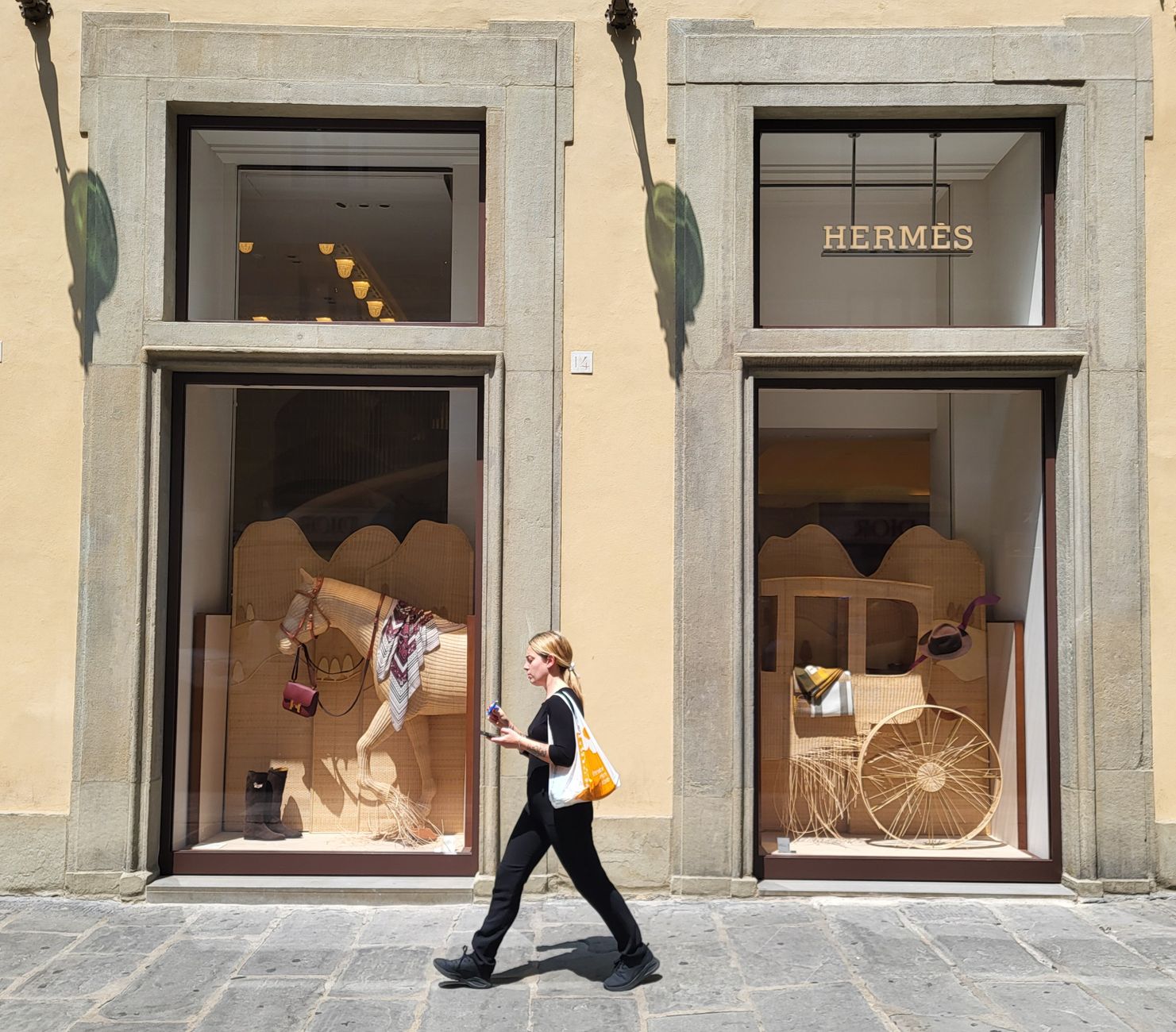
The contrast with capital-driven competitors illustrates the mechanism. When private equity acquires a luxury brand, the playbook typically involves identifying “untapped” market segments, scaling production to meet demand, and expanding distribution through wholesale and digital channels. Each step increases revenue and destroys exclusivity. Hermès inverts this logic. The company actively destroys inventory rather than capitalize on fads, restricts online sales to low-single-digit revenue shares (selling only straps, scarves, and perfumes, never bags), and maintains a direct-to-consumer model that deliberately underserves geographic markets.
The Geography of Refusal
Walk into the flagship on Rue du Faubourg Saint-Honoré, or Bond Street in London, or Madison Avenue in New York, and you enter a ritualized economy of friction. Appointments last 90 minutes. Clients are offered champagne or tea. The unveiling of a bag follows a choreography designed to emphasize rarity. There is no e-commerce convenience, no click-to-purchase, no overnight shipping to secondary markets in the American Midwest or the emerging Middle East.
This distribution strategy appears economically irrational. Wealthy consumers exist in Texas, in Dubai, in online forums. Competitors with omnichannel reach capture these segments while Hermès leaves them deliberately underserved. Yet this friction functions as a filtering mechanism. The appointment system ensures that acquisition requires time, relationship, and patience, osts that price out the merely affluent while preserving the brand for the truly wealthy. The absence of digital sales for core leather goods prevents the brand from becoming searchable, shoppable, and therefore common.
The production model reinforces this geographic constraint. All manufacturing occurs in French ateliers. Artisans undergo two years of training before reaching productivity. The company refuses to offshore, not because it cannot, but because the “made in France” narrative constitutes part of the psychological product. This creates a hard ceiling on volume growth independent of market demand. While a competitor could theoretically match quality by hiring artisans or automating production, the two-year ramp time and geographic restriction mean that scaling requires years of lead time and dilutes the heritage narrative.
This is a time-based moat rather than a capital-based one. Competitors cannot buy their way to Hermès’ position because the position requires decades of accumulated refusal. The scarcity is not merely a production bottleneck but a curated absence. When demand spikes, the company does not expand capacity; it extends waitlists. The waitlist itself becomes part of the product, transforming purchase into achievement.
The Tensions of Stewardship
The model generates three structural tensions that define the company’s strategic boundaries. First, growth versus exclusivity. The company has grown revenue from €1.2 billion in the early 2000s to €9 billion today, but tenfold expansion risks ubiquity. If Hermès reached €90 billion in revenue, the scale of mass luxury competitors, it would require the production volume and geographic penetration that make “you have to know to know” impossible. The brand would become visible in airports, on secondary markets, in digital advertising. The margins would compress toward the industry standard of 20-25 percent operating margins rather than the current 40 percent.
Second, artisanal constraint versus market demand. The two-year training requirement and French-only manufacturing create an absolute ceiling on leather goods production, which generates 50 percent of revenue and the majority of profitability. If consumer psychology shifts to value speed-to-market, customization, or sustainability over heritage craftsmanship, this production model becomes a liability rather than a moat. A competitor offering equivalent quality with six-month artisan training or ethical offshore production could capture price-insensitive segments that Hermès cannot serve.
Third, heritage versus generational relevance. The brand’s defensibility rests on 190 years of equestrian history and French artisanship. But luxury psychology evolves. Younger consumers may prioritize sustainability credentials, digital-native aesthetics, or anti-status signaling over the coded exclusivity of the Birkin. Social media poses a particular threat: the “you have to know” positioning becomes difficult to maintain when every bag is photographed, posted, and recognized by algorithms. If the secret becomes common knowledge, the cachet evaporates.
These tensions are not operational problems to be solved but existential conditions to be managed. Hermès navigates them by refusing to navigate them. The company does not chase youth markets with collaborations or fringes. It does not adopt sustainability messaging that might compromise the leather-centric product architecture. It maintains the 1.5-hour appointment ritual even as younger consumers expect frictionless transactions. Each refusal reinforces the commitment mechanism, but each also accumulates risk that the underlying assumption, heritage as value, might shift.
The Fragile Consensus
The model depends on a fragile long-term assumption: that wealthy consumers will continue to value heritage, French artisanship, and insider recognition as primary drivers of luxury purchases. If this consensus fractures, the entire economic engine stalls.
Consider the geographic concentration. The business relies on flagship appointments in primary global cities, aris, London, New York, Tokyo. Expansion to secondary markets is deliberately constrained. Yet wealth is dispersing. If high-net-worth individuals in the American interior, in secondary Chinese cities, or in emerging Middle Eastern markets shift to competitors offering omnichannel convenience and immediate availability, Hermès’ revenue growth could decouple from global wealth creation. The appointment system, currently a feature signaling exclusivity, could become a friction point that drives consumers to rivals.
More fundamentally, the generational transfer of values poses an existential threat. The Birkin and Kelly bags function because they transmit status within a specific cultural grammar. But luxury is undergoing a value shift toward sustainability, authenticity, and anti-conspicuous consumption. If the next generation of wealthy consumers views the €30,000 leather bag not as a signal of discernment but as an environmental liability, or if they reject the “you have to know” exclusivity in favor of democratic accessibility, Hermès’ psychological moat drains.
The production constraint, currently a source of pricing power, could invert into a competitive liability. If automation or offshore training produces equivalent quality at faster speeds, and if consumers begin to value those attributes over French heritage, Hermès faces a choice that breaks the model: abandon the atelier system to compete, or maintain it and cede market share. The family stewardship that prevents scaling becomes a straitjacket.
The Economic Logic of Anti-Economics
Hermès represents a counterintuitive proposition in business strategy: the deliberate refusal to capture available surplus is the source of the surplus. The company leaves billions in revenue uncollected, estroying the beach bag, refusing online sales for core products, declining to expand atelier capacity, ignoring geographic markets that would gladly pay premium prices. This is not altruism or incompetence. It is the enforcement of scarcity as a capital allocation strategy.
The family governance structure makes this refusal credible. A public company announcing an intention to restrict supply would face activist pressure, short-term earnings penalties, and eventual strategic reversal. The Dumas family, with their multi-generational time horizon and majority control, can make the refusal stick. They can destroy inventory and receive standing ovations rather than termination notices. This credibility transforms scarcity from a marketing claim into an economic fact.
Competitors cannot replicate this because they cannot replicate the governance. A private equity firm acquiring Hermès would immediately identify the “inefficiency” of underproduction and move to optimize it, thereby destroying the brand. A public competitor with quarterly earnings pressure cannot maintain empty shelves while demand soars. Only a structure that treats the business as an inheritance rather than an asset can enforce the constraint that creates the value.
The result is a moat where rational entry is economically irrational. A competitor could hire better artisans, source better leather, price 20 percent below the Birkin, and still fail because they cannot replicate the absence. They cannot replicate the decades of refusing to meet demand, the destruction of faddish hits, the 90-minute appointments, the exclusion from e-commerce. The product is the constraint.
This generates the final paradox. Hermès is simultaneously a massive commercial success, €9 billion in revenue, 40 percent operating margins, 90 percent consumer preference in its category, and an act of economic negation. It succeeds not by giving customers what they want, but by refusing to. The scarcity is not a byproduct of craftsmanship limitations but a produced condition, enforced by family stewards who measure their tenure not in quarterly earnings but in generational continuity.
The beach bag died so that the Birkin could live. The destroyed inventory, the unbuilt factories, the unserved markets, hese are not losses but investments in the premium. In a business culture obsessed with scale, Hermès proves that the ultimate pricing power lies in the willingness to stay small. The family keeps the keys, the artisans keep the ateliers, and the customers keep waiting. The margin is in the no.
The mechanics of this refusal manifest most starkly in the ateliers of Pantin and Bugatti, where the company has concentrated its leather production in the suburbs of Paris. Here, the two-year training period functions not merely as a quality control mechanism but as a deliberate throttle. A prospective artisan arrives with manual dexterity and departs with the ability to construct a Birkin’s saddle stitching, the signature double-needle technique that creates the distinctive raised seam, at the required tempo of approximately three bags per week. This is not inefficiency masquerading as craftsmanship; it is a calculated production ceiling. If Hermès wished to triple output, it could not simply hire three times as many artisans tomorrow. The training pipeline creates a hard constraint that operates independently of capital availability. Competitors attempting to replicate this face a temporal barrier: they can hire leatherworkers immediately, but they cannot instantly create the specific muscle memory and tactile knowledge required for Hermès’ construction standards. The scarcity is manufactured through pedagogy.
Yet this model rests on a historical contingency that is eroding. The apprenticeship system assumes a labor market willing to commit to two years of substandard wages in exchange for eventual artisan status, and a consumer base willing to wait years for delivery. Both assumptions are increasingly fragile. French labor costs continue to rise relative to global alternatives, and the pool of young workers willing to spend twenty-four months learning hand-stitching rather than digital design or software engineering narrows with each demographic cohort. More critically, the consumer psychology that validates the wait is shifting. The resale market, where Birkins trade at premiums ranging from thirty to one hundred percent above retail depending on colorway and hardware, currently reinforces the model by proving that the bags appreciate while customers queue. But this secondary economy also creates a shortcut. If a buyer can acquire the bag immediately at a premium on the secondary market, the waiting list becomes an arbitrage opportunity rather than a loyalty test. The brand risks training its customers to view the primary purchase as a speculative asset rather than a personal acquisition, transforming the emotional relationship into a financial one.
This financialization poses an existential threat to the “you have to know” signaling mechanism. When bags trade as alternative assets, cataloged by investment funds and authenticated by blockchain ledgers, the insider knowledge required to recognize the product becomes ubiquitous. The cachet depends on a certain opacity: he ability to distinguish between a $25,000 entry-level Kelly and a $150,000 Himalayan crocodile Birkin without looking at the price tag. As the secondary market professionalizes, with online platforms publishing detailed price histories and rarity indices, that opacity dissipates. The bag becomes a transparent commodity, indexed and tracked like pork bellies or sovereign debt. For a brand that sells secrecy, transparency is toxic.
The geographic concentration of wealth creation exacerbates these fissures. Hermès currently captures the majority of its revenue from the traditional luxury capitals, Paris, London, New York, Tokyo, Shanghai, where flagship stores anchor the brand’s physical presence. But global wealth is dispersing. The American interior, secondary Chinese cities, and the emerging economies of the Middle East and Southeast Asia are generating high-net-worth individuals who lack access to the flagship appointment system. When a wealthy consumer in Dallas or Denver wishes to purchase a Birkin, they cannot simply visit the local boutique and expect the 1.5-hour champagne ritual. They encounter a referral system that requires pre-existing relationships, purchase histories of ancillary goods (scarves, jewelry, home goods), and often years of waiting. Many turn to the secondary market or to competitors. Louis Vuitton, Chanel, and Dior have built omnichannel infrastructures that deliver immediately to these underserved markets. They capture the customer Hermès refuses to serve, not because these customers lack the capital, but because they lack the patience for a governance model designed for the rhythms of the nineteenth century.

This refusal creates a vacuum that competitors have attempted to fill, and their failures illuminate the peculiar durability of Hermès’ position. Consider the case of The Row, the American brand founded by Mary-Kate and Ashley Olsen, which positioned its “Ginza” and “Margaux” bags as alternatives to the Birkin, utilizing similar Italian leathers, comparable hand-construction, and pricing that occasionally exceeds Hermès’ entry points. Or consider Bottega Veneta under Daniel Lee, which revived the “Knot” and introduced the “Jodie” with an aggressive emphasis on artisanal weaving and scarcity marketing. Both brands achieved cultural moments, editorial coverage, waitlists, resale premiums, yet neither displaced the Birkin or Kelly in consumer preference surveys. The reason is instructive: they could not replicate the decades of accumulated refusal. Bottega Veneta, owned by Kering, faces quarterly pressure to scale successful products. When a bag hits, the corporate imperative demands production increases, wholesale distribution, and eventually, outlet channeling. The scarcity is tactical, not structural. Hermès’ refusal is constitutional, encoded in family ownership agreements that span generations.
Even more telling are the attempts by heritage houses to outflank Hermès on its own terms. In the early 2000s, Prada attempted to enter the ultra-high-end leather goods market with hand-stitched bags priced above the Birkin, utilizing rare skins and limited editions. The product was technically impeccable. It failed to achieve the cultural penetration of the Kelly because it lacked the specific narrative of enforced scarcity backed by governance. Miuccia Prada, despite her formidable design reputation, could not credibly commit to destroying inventory or refusing digital sales. Prada is publicly traded; the board would revolt. The attempt demonstrated that quality and price positioning are insufficient without the supporting architecture of refusal.
The fragility of the Hermès model, however, becomes most apparent when examining the generational transfer of luxury values. The company’s defensibility rests on the assumption that wealthy consumers will continue to view heritage, French artisanship, and coded exclusivity as primary signifiers of status. But empirical evidence suggests a pivot. Younger high-net-worth individuals, those inheriting or creating wealth in the technology and sustainability sectors, increasingly prioritize traceability, environmental impact, and democratic accessibility over the opaque signaling of traditional luxury. They buy from brands like Bottega Veneta or Loewe not despite their relative accessibility but because of their cultural visibility. They value collaborations, limited editions that are temporary rather than eternal, and brand narratives that emphasize innovation over preservation.
Hermès resists these currents with absolute discipline. The company has avoided the collaboration economy that drives contemporary fashion, refusing the Supreme partnerships and Nike alliances that generate viral moments for competitors. It maintains a digital presence that is deliberately archaic: he website functions as a catalog for scarves and ties, a placeholder rather than a marketplace. This refusal to participate in the attention economy protects the brand from dilution but risks rendering it invisible to consumers whose primary luxury touchpoint is the screen. If the next generation of wealth formation occurs predominantly in digital-native contexts, cryptocurrency, artificial intelligence, remote work, then the physical ritual of the Faubourg appointment becomes an anachronism rather than a privilege.
The family governance that enforces these refusals is itself a point of fragility. The stewardship model depends on the continued alignment of twenty-three to twenty-four family branches, a feat of dynastic coordination that becomes statistically improbable with each generational transition. The sixth generation currently controls the majority, but the seventh generation faces different economic realities. As the family expands, the per-capita value of the inheritance dilutes, creating pressure to monetize the asset more aggressively. If a faction of the family were to force a liquidity event, or if professional managers, Axel Dumas represents a hybrid model of family and professional management, were to gain control and optimize for shareholder returns, the constraint mechanism would shatter. The beach bag would not be destroyed; it would be mass-produced.
Moreover, the artisanal production model faces an ecological reckoning that the brand is ill-positioned to address. The leather goods that generate fifty percent of revenue and the majority of profits rely on exotic skins, crocodile, alligator, ostrich, that face increasing regulatory scrutiny and consumer ethical resistance. While Hermès has invested in crocodile farms to ensure supply chain control, the sustainability narrative favors brands pivoting to lab-grown materials or circular production models. Hermès cannot pivot. The “made in France” heritage and the natural skin products are inseparable from the brand’s identity. If regulatory regimes in key markets, California, the European Union, restrict exotic skin trade, or if consumer sentiment shifts decisively against animal products, the company faces a choice between its ethics and its economics, with no middle ground.
The appointment system, currently a moat, could equally become a trap. As wealth disperses geographically and time becomes the ultimate luxury for the global elite, requiring a physical presence in specific postal codes for purchase privileges excludes the newly wealthy who value mobility over location. The competitor that solves the last-mile problem for ultra-luxury, delivering equivalent quality with the convenience of digital immediacy, could capture the marginal consumer. Hermès’ resistance to e-commerce for core leather goods leaves billions in revenue for competitors willing to compromise on ritual.
Ultimately, the business operates on a tightrope where the balancing pole is made of the same material as the rope. The production constraint, the geographic concentration, the family governance, and the refusal of digital scale are simultaneously the sources of pricing power and the vectors of potential collapse. The company has engineered a position where it cannot grow without dying, yet stasis invites obsolescence. It is a machine designed to run at a specific RPM; any acceleration burns the engine, any deceleration stalls it. The standing ovation for the destroyed beach bag represented not just stewardship but a recognition of this precarious equilibrium. To have kept the bag would have been to admit that the machine could be recalibrated, that the margins could be stretched, that the no could become a yes. And in that yes lies the end of the only advantage that matters: the credible promise that some things remain unavailable, regardless of price.
The secondary market reveals the brittleness of this promise with clinical precision. When a Birkin 25 in Jaune Poussin with palladium hardware trades for $45,000 on a resale platform while the retail price sits at $10,000, the gap represents not just a premium but a market failure that Hermès deliberately maintains. The company could close this arbitrage instantly by raising retail prices to market-clearing levels or by increasing volume. It does neither. Instead, it allows a parallel economy to flourish where speculators, not the house, capture the surplus. This creates a perverse incentive structure: the customer who secures an appointment and purchases the bag for $10,000 is frequently not the end user but an intermediary executing a risk-free option trade. The bag leaves the Faubourg boutique sealed in its orange box, untouched, and travels directly to a resale warehouse. The ritual, the champagne, the unwrapping, the supposed relationship between artisan and owner, becomes pure theater performed for the benefit of liquidity providers.
This financialization corrodes the brand’s semiotic function from within. When the Birkin trades like a Treasury bond with a ticker symbol and a Sharpe ratio, the “you have to know” signaling mechanism collapses into pure price signaling. The observer no longer needs cultural literacy to recognize the bag; they need only check the listing price. Moreover, the secondary market destroys the geographic moat. A consumer in Houston who cannot secure a Paris appointment can acquire the bag overnight from a reseller, often with faster delivery than Hermès itself provides for a scarf. The company’s refusal to sell online becomes irrelevant when the aftermarket operates with Amazon-like efficiency. Hermès retains the margin on the initial sale, but it loses the control that margin was supposed to purchase: the ability to select who carries the product and in what context.
The appointment system, designed to enforce selection, has evolved into an opaque economy of favor and precedent that increasingly resembles a loyalty program for high-frequency purchasers. To receive the call offering a quota bag, the industry term for the Birkin or Kelly, a client must first demonstrate commitment through “profile building.” This involves purchasing thousands of dollars of silk twillies, silver jewelry, and home goods that often languish unworn, functioning as entry tickets rather than products. The ratio is unwritten but widely understood in collector forums: expect to spend one-to-one, sometimes two-to-one, on ancillary goods before receiving an offer on leather. This creates a shadow revenue stream for Hermès, illions in silk and perfume sold not for their intrinsic value but as options on future leather allocations. Yet it also trains the customer to view the brand through a transactional lens. When the scarcity becomes monetized through these side payments, the emotional resonance frays. The collector becomes a speculator; the wardrobe becomes inventory.
The labor constraint adds another vector of fragility. The two-year training period assumes a stable supply of young French craftspeople willing to apprentice at wages that start below €25,000 annually. But France’s leatherworking tradition faces demographic collapse. The median age of artisans in the Pantin ateliers skews toward fifty, and enrollment in the specialized schools that feed the trade, Institut National des Métiers d’Art, Compagnons du Devoir, has declined steadily as digital careers pull talent toward Paris’s tech sector. Hermès has responded by opening new ateliers in Normandy and the Ardennes, not to offshore but to decentralize within France, hunting for labor pools in post-industrial towns where the artisanal wage competes favorably with local alternatives. Yet each new atelier dilutes the concentrated mystique of the Faubourg. When a bag is stamped “Made in France” but constructed in a former textile mill in Roubaix, the geographic specificity that justified the two-year wait weakens. The customer who flew to Paris for the ritual discovers the object could have been produced three hours from their home in Detroit.
If the seventh generation fractures, or if a professional manager decides that closing the secondary market premium is more valuable than preserving it, the constraint mechanism shatters instantly. The history of luxury is littered with houses that broke the spell. Burberry, once a byword for exclusivity, licensed its check to discount markets in the 1990s and spent two decades recovering credibility. Even within the upper echelon, the danger is present. When Bernard Arnault acquired Louis Vuitton and applied industrial-scale production to leather goods, he created a €20 billion behemoth but permanently foreclosed the possibility of Hermès-level margins. The Dumas family knows this history. They have watched competitors trade ten points of margin for twenty points of growth, and they have chosen the opposite: sacrificing growth to protect the margin. But choice requires choosers. When the sixth generation passes the keys to the seventh, the question will not be whether they understand the model. It will be whether they have the stomach to keep saying no when the yes is worth fifty billion euros.